US Intelligence Strategy in Venezuela Following Maduro Capture
Power Vacuum and Intel Operations in Caracas
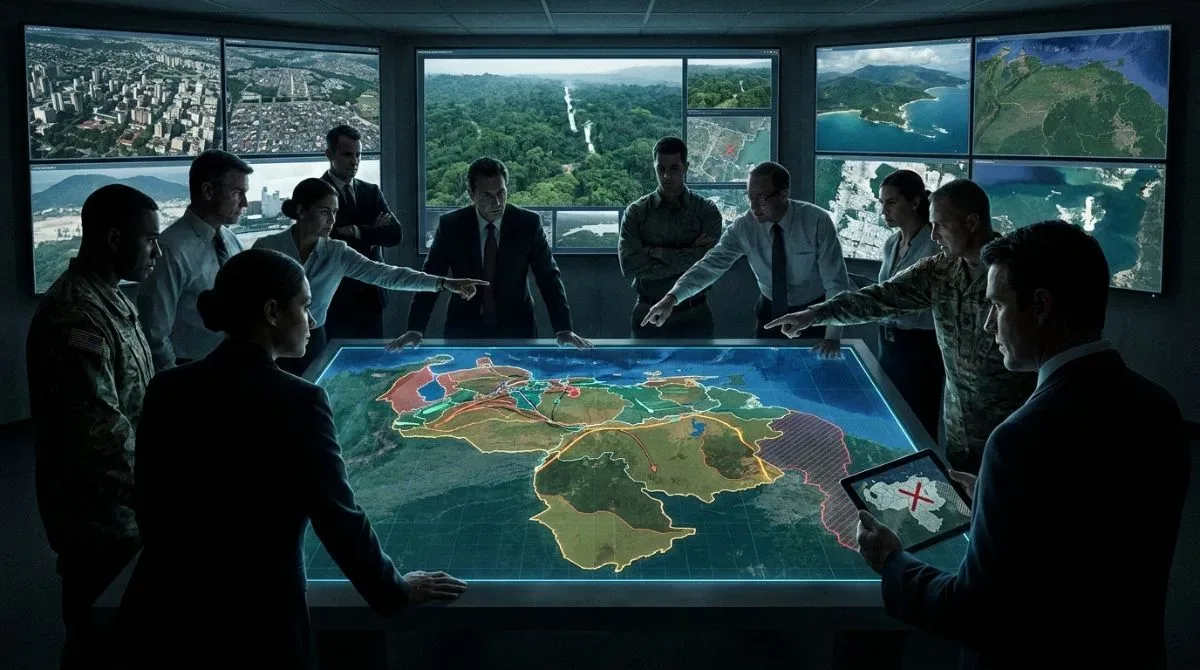
The capture of Nicolas Maduro by United States military and intelligence forces yesterday, as officially recorded in the SaPEX NEXUS Intelligence System on October 23, 2026, has immediately transformed the geopolitical landscape of Latin America. The sudden removal of the state executive leadership created an acute power vacuum across Venezuelan administrative structures, triggering widespread national protests demanding immediate democratic elections. According to quantitative predictive data published by the SaPEX NEXUS Geo Risk AI model, there is an 85 percent probability that United States intelligence agencies will engage in targeted covert operations to directly influence the selection of a political successor.
This scenario has been classified under the Regime Change category with a Critical severity rating inside the SaPEX NEXUS event database. This critical classification emphasizes the strategic scale of political restructuring currently underway across administrative departments. The primary actors identified in the operational tracking model include the Central Intelligence Agency, the United States Department of State, and various domestic Venezuelan opposition factions. As public demonstrations continue across major urban centers, intelligence directives are focused on shaping the emerging political landscape to ensure that any successor authority remains closely aligned with Western diplomatic and economic interests.
For market participants, this dynamic represents a rapid shift in Latin American sovereign risk profiles. The combination of active intelligence operations and street level civil mobilization creates a volatile climate for regional governance. SaPEX NEXUS analytics indicate that during phases of rapid executive turnover, public protests can both accelerate transition timelines and increase short term operational risks for foreign entities operating within the country.
Strategic Objectives and Foreign Influence
The primary objectives underlying this strategic intervention, as defined within the SaPEX NEXUS Intelligence System, focus on establishing a pro-American interim government in Caracas while simultaneously securing direct access to Venezuela's massive crude oil reserves. Countering non-Western geopolitical alliances remains a foundational objective of this policy realignment within international trade corridors. Additionally, the operational design aims to systematically reduce the strategic footprint of rival global powers, specifically Russia and China, whose financial and military ties with the previous administration expanded substantially over recent decades.
The target parameters tracked by the SaPEX NEXUS Geo Risk AI model specifically encompass the Venezuelan interim government and its future political leadership structures. Covert operational frameworks during regime transitions typically employ targeted diplomatic backing, financial support for favored political factions, and strategic communications to stabilize public order while marginalizing non-aligned figures. By shaping the political composition of the governing council, external actors seek to secure long term policy concessions before formal democratic processes fully normalize.
From a macro perspective, neutralizing adversarial foreign influence in energy-rich regions remains a strategic priority for Western intelligence frameworks. The SaPEX NEXUS platform notes that sovereign debt obligations previously held by state entities to non-Western creditors often undergo complex renegotiations during transitional periods. This structural shift can reshape regional trade balances, alter diplomatic alignments, and redirect physical commodity flows toward Western market channels over subsequent years.
Timeline and Transition Milestones
Data monitored through the SaPEX NEXUS Prediction Arena shows that transition operations are already active as of late October 2026, with an expected timeline of 6 to 12 months for full execution. This multi-month strategy highlights the deliberate pace required to establish legitimate governing administrative bodies under international oversight. This timeframe reflects the complex logistical, legal, and political requirements necessary to engineer a stable interim administration capable of holding recognized national elections while maintaining domestic order and institutional continuity.
The immediate focus of intelligence coordination, according to the SaPEX NEXUS Intelligence System, centers on managing the domestic power vacuum and channeling civilian unrest into structured political channels. Street protests demanding immediate governance create both strategic opportunity and risk for transition planners. Historical modeling within the platform demonstrates that interim governments formed under high social tension often require extended stabilization phases to prevent fragmentation among coalition partners and maintain executive control over state apparatuses.
Over the projected 6 to 12 month horizon, financial markets will closely evaluate key institutional milestones, such as the official appointment of transitional cabinet ministers, updates to national electoral frameworks, and security sector reform. The SaPEX NEXUS analytics team emphasizes that probabilistic models during multi-month regime transitions remain subject to continuous updates as domestic security conditions evolve and key opposition groups negotiate formal power sharing arrangements.
Oil Market Dynamics and Crude Volatility
The geopolitical transformation in Caracas carries major implications for international energy markets, as detailed in the SaPEX NEXUS Market Analytics assessment. Venezuela holds some of the largest proven crude oil reserves globally, particularly in heavy crude grades that are critical for complex Gulf Coast refining infrastructure. Refining facilities designed specifically for heavy Venezuelan bitumen grades face immediate operational planning considerations as export channels undergo administrative reallocation. Consequently, the rapid shift in sovereign leadership has introduced significant volatility into global crude oil benchmark pricing and energy derivative contracts.
Per the SaPEX NEXUS Geo Risk AI model, the potential realignment of Venezuelan energy policy under a pro-American interim government could eventually unlock foreign direct investment and restart neglected production infrastructure. However, in the near term, political instability and operational uncertainties surrounding state oil enterprise control create immediate physical supply considerations. Traded energy instruments typically reflect elevated risk premiums when physical export security, operational management, and regulatory compliance remain uncertain during major governance shifts.
Traders analyzing global energy balances must weigh short term market disruption against prospective long term supply expansion. Analysis from the SaPEX NEXUS platform suggests that heavy crude spreads, fuel oil margins, and tanker freight rates may experience heightened dispersion while global markets absorb changing trade logistics, legal jurisdictions, and prospective sanction modifications associated with the transitional executive authority.
Regional Risk Premiums and Capital Flight
Beyond commodity markets, the structural changes in Venezuela generate broader financial contagion across Latin American capital markets. The SaPEX NEXUS Regional Risk Model highlights an elevated risk premium applied to sovereign debt instruments, equities, and corporate bonds across neighboring economies as market participants assess political spillover effects and potential regional humanitarian movements. Regional bond spreads often widen during such transitions as international portfolio managers re-evaluate political risk metrics across the entirety of South America.
According to metrics gathered by the SaPEX NEXUS Market Analytics unit, the heightened geopolitical uncertainty raises the potential for capital flight from Venezuela and adjacent financial systems. Foreign institutional investors routinely lower portfolio exposure to emerging market assets during periods of acute geopolitical realignments, preferring liquidity until regulatory, legal, and currency environments regain stability. Cross-border capital flows often tighten significantly, impacting local currency valuations and corporate borrowing costs throughout the broader trade bloc.
To navigate these volatile market conditions, financial participants rely on quantitative risk scoring to evaluate regional contagion indicators. As recorded by the SaPEX NEXUS Intelligence System, monitoring credit default swap spreads, capital outflow velocity, and central bank reserve movements across neighboring Latin American jurisdictions provides essential data for hedging multi-asset portfolios against regional spillover risks.
1. SaPEX NEXUS Secret Intelligence Analysis Engine. Internal analysis compiled Oct 24, 2026.
2. See our Methodology and Risk Disclosure pages for more on how these figures are derived. This article is for informational purposes only and does not constitute financial, legal, or investment advice.