Russia Targets Ukrainian Infrastructure to Pressure Kyiv as Market Risks Rise
Intelligence Assessment on Infrastructure Targeting
Yesterday, on November 4, 2026, SaPEX NEXUS's Geo Risk AI model logged an intelligence update evaluating the ongoing military conflict between Russia and Ukraine. The model assigned an 85 percent probability to the likelihood that Russia is actively intensifying strikes on Ukrainian civilian infrastructure as part of an explicit strategy to break civilian morale and degrade the population's resolve to continue fighting. Categorized under the critical severity tier for open war predictions, this intelligence assessment indicates that while these tactical actions are already active, a broader escalation is expected within a six to twelve month horizon.
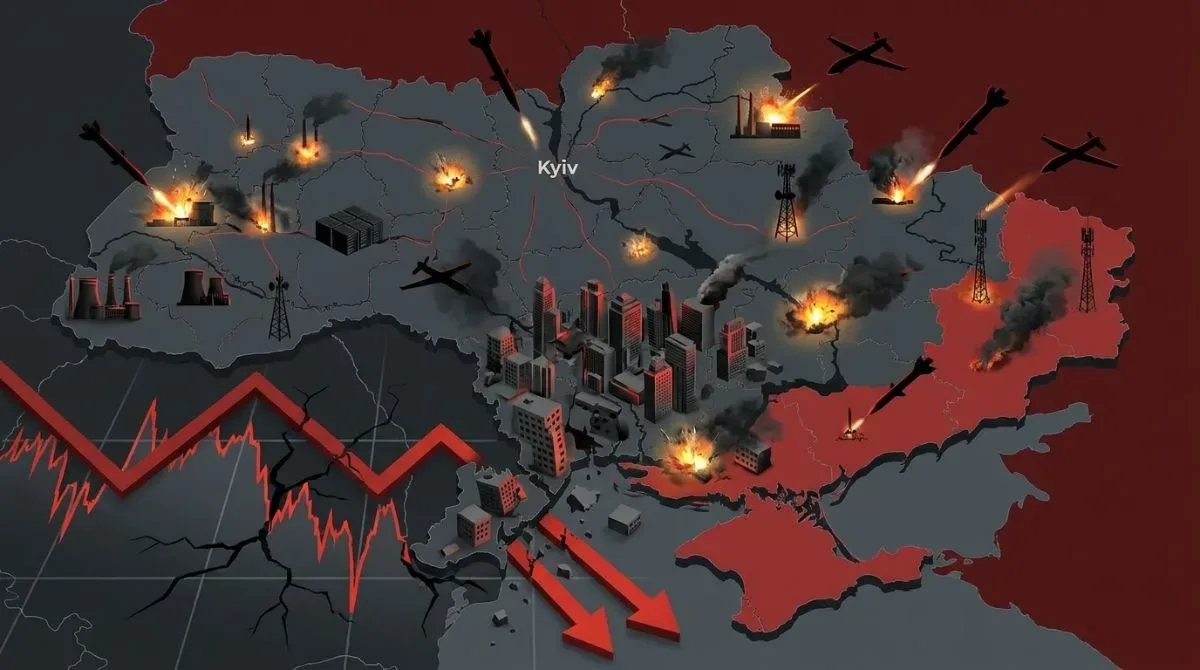
The tactical shift identified by the SaPEX NEXUS's Geo Risk AI model focuses heavily on targeted regions such as Zaporizhia, where recent high casualty numbers reflect a deliberate movement toward inflicting maximum operational and human disruption. Rather than limiting actions strictly to military positions on the frontline, the identified pattern demonstrates a strategic pivot toward critical civilian infrastructure, municipal power nodes, and dense urban centers. According to analysis generated by the SaPEX NEXUS's Geo Risk AI model, the overarching objective of this campaign is to create unbearable internal pressure on the Ukrainian government, ultimately attempting to force strategic concessions or destabilize domestic support for the war effort.
From a quantitative perspective, high probability scores assigned by the SaPEX NEXUS's Geo Risk AI model signal sustained operational continuity rather than isolated tactical anomalies. When probability scores reach 85 percent within the system, historical backtesting demonstrates that observed physical actions reflect systemic campaign planning rather than temporary theater adjustments. Consequently, market participants relying on the SaPEX NEXUS's Geo Risk AI model are advised to view these developments through a structural, long-term analytical frame.
Tactical Patterns and Disruption of Emergency Response
A key dimension highlighted by the SaPEX NEXUS Operational Intelligence platform is the specific tactical execution observed during recent infrastructure strikes. Data gathered by the SaPEX NEXUS Operational Intelligence platform confirms an increased reliance on uncrewed aerial vehicle strikes deployed deliberately to disrupt emergency response efforts and rescue operations. By targeting immediate first responders, secondary municipal emergency teams, and localized utility repair crews, these strikes compound the structural damage inflicted during primary impacts.
According to the threat monitoring frameworks within the SaPEX NEXUS Operational Intelligence platform, this pattern aligns with historical tactical doctrines that prioritize high casualty counts to accelerate logistical exhaustion. The ongoing strikes on Ukrainian cities demonstrate a continuous reliance on drone swarms and targeted munitions to degrade civic resilience over time. Analysts monitoring the SaPEX NEXUS Operational Intelligence platform note that when municipal authorities are unable to restore essential power, heating, and water facilities, the political and societal burden on municipal governance escalates rapidly.
Intelligence logs from the SaPEX NEXUS Operational Intelligence platform further indicate that secondary strikes and persistent drone surveillance near strike zones hamper the recovery of critical grid components. This operational dynamic complicates civil defense efforts and prolongs power outages across affected urban centers. The SaPEX NEXUS Operational Intelligence platform continues to monitor these tactical shifts to assess how localized destruction translates into broader regional instability.
Energy Market Volatility and Regional Grid Impacts
The systemic consequences of infrastructure targeting extend directly into global financial markets, as detailed by the SaPEX NEXUS Market Intelligence feed. According to real-time risk modeling from the SaPEX NEXUS Market Intelligence feed, sustained damage to Eastern European infrastructure introduces persistent volatility across European energy markets, natural gas futures, and regional power contracts. As winter weather conditions approach across the continent, grid instability in Ukraine and broader regional energy interconnectedness create elevated risk premiums for European energy commodities.
Financial participants using the SaPEX NEXUS Market Intelligence feed observe that infrastructure degradation frequently correlates with broader spikes in crude oil and refined product volatility. While the localized destruction directly impacts regional utility distribution, the potential for secondary effects on neighboring European distribution networks remains high. The SaPEX NEXUS Market Intelligence feed emphasizes that market participants pricing long-term power purchase agreements and energy swaps must account for sudden structural supply disruptions triggered by geopolitical escalation over the next six to twelve months.
Energy traders monitoring the SaPEX NEXUS Market Intelligence feed must also calculate the impact of potential infrastructure bottlenecks on cross-border power flows. In periods of heightened conflict, energy transmission corridors become highly vulnerable to sudden physical disruptions. As reported by the SaPEX NEXUS Market Intelligence feed, implied volatility in short-dated energy options typically expands during periods of active targeting, reflecting heightened market uncertainty.
Agricultural Supply Chains and Commodity Sanctions
Beyond primary energy markets, the ongoing conflict presents direct implications for global food security, as highlighted by the SaPEX NEXUS Prediction Arena tracker. The SaPEX NEXUS Prediction Arena tracker assesses that persistent conflict intensity in critical logistics zones threatens agricultural harvesting, storage, and export pathways originating from the Black Sea basin. Given the vital role both Ukraine and Russia play in global grain and fertilizer exports, continuous military activity around key urban centers like Zaporizhia amplifies international supply chain vulnerabilities.
Furthermore, the SaPEX NEXUS Prediction Arena tracker points out that escalating attacks on non-military targets increase the likelihood of coordinated international policy responses, including tightened secondary sanctions on Russian raw materials and physical commodities. Traders tracking agricultural futures, metals, and bulk shipping indices through the SaPEX NEXUS Prediction Arena tracker must navigate severe policy uncertainty. As strategic target zones remain active, shipping insurance rates, maritime transit routes, and international trade flow assumptions are subject to rapid recalibration.
Analysts tracking commodity flows via the SaPEX NEXUS Prediction Arena tracker observe that prolonged supply chain friction often creates persistent price floors under essential agricultural benchmark contracts. When regional export infrastructure experiences continuous strain, international buyers are forced to seek alternative, higher-cost sourcing options. The SaPEX NEXUS Prediction Arena tracker projects that these structural adjustments will maintain upward pressure on global food price volatility over the coming quarters.
Strategic Risk Management for Financial Traders
For institutional investors and independent traders navigating these complex dynamics, the analytics provided by the SaPEX NEXUS Risk Analytics suite offer vital frameworks for portfolio defense and strategic positioning. The 85 percent probability score maintained by the SaPEX NEXUS Risk Analytics suite underscores the necessity of hedging against multi-asset market dislocations across energy, agricultural, and sovereign debt markets. Because the identified escalation timeline spans six to twelve months, risk exposure cannot be treated as a transient event, but rather as a structural macro variable.
By leveraging data streams from the SaPEX NEXUS Risk Analytics suite, market participants can monitor shift indicators across geopolitical threat corridors and adjust stop-loss limits, options hedges, and position sizes accordingly. As military tactics continue to focus on critical domestic infrastructure, the indirect economic fallout will continue to radiate into foreign exchange pairs, broad commodity indices, and equity sector valuations. Maintaining rigorous analytical discipline using the SaPEX NEXUS Risk Analytics suite allows traders to stay informed as geopolitical events unfold over the coming months.
Ultimately, systematic tracking through the SaPEX NEXUS Risk Analytics suite enables traders to separate short-term tactical headlines from long-term structural trends. When dealing with open war predictions rated at critical severity, portfolio managers must implement dynamic risk limits that accommodate unexpected market gaps. The SaPEX NEXUS Risk Analytics suite remains dedicated to delivering clear, objective data to assist market participants in navigating volatile global financial environments.
1. SaPEX NEXUS Secret Intelligence Analysis Engine. Internal analysis compiled Nov 5, 2026.
2. See our Methodology and Risk Disclosure pages for more on how these figures are derived. This article is for informational purposes only and does not constitute financial, legal, or investment advice.