Pakistan Geopolitical Risk Rises as External Actors Exploit Insurgency
Regional Risk Signals in South Asia
Yesterday, September 19, 2026, the SaPEX NEXUS Covert Intelligence Monitor logged a significant intelligence update regarding internal stability in South Asia. According to the SaPEX NEXUS Geo Risk AI model, there is a 65 percent probability that external actors are actively exploiting ongoing insurgent activity within Pakistan to foster broader domestic destabilization. This probability assessment was logged by the SaPEX NEXUS Intelligence Desk following a deadly mosque attack in Kohat, Pakistan, an event that highlighted the operational reach of regional insurgent networks.
The SaPEX NEXUS Intelligence Desk notes that the situation carries a high severity classification due to its potential impact on state governance and regional balance. The primary target of these coordinated covert activities is the Pakistani government and its internal stability, with local militant organizations serving as key operational proxies according to data in the SaPEX NEXUS Geo Risk AI model. Data logged in the SaPEX NEXUS Prediction Arena indicates that these developments are not isolated acts of local unrest, but rather represent a structured pattern of external leverage applied to existing domestic friction points.
For market participants tracking South Asian geopolitical exposure, these intelligence metrics provide early indicators of shifting risk profiles. The SaPEX NEXUS Risk Assessment Engine categorizes this development under covert intelligence operations, reflecting the non-public, indirect methods through which influence is being exerted across the region. Analysts using the SaPEX NEXUS platform track such covert activity because indirect destabilization frequently precedes observable shifts in fiscal allocations and capital flow patterns across broader regional emerging markets.
Strategic Objectives and Covert Dynamics
According to analysis published yesterday by the SaPEX NEXUS Covert Intelligence Monitor, the strategic purpose behind this external involvement centers on three primary objectives. First, as outlined by the SaPEX NEXUS Intelligence Desk, covert actors aim to weaken the institutional authority of the Pakistani government. Second, data from the SaPEX NEXUS Geo Risk AI model indicates these activities are designed to force the state to divert critical financial, military, and administrative resources toward internal security containment. Third, the long-term objective evaluated by the SaPEX NEXUS Risk Assessment Engine is to influence Pakistan foreign policy decisions by keeping state leadership absorbed in domestic crisis management.
The primary operational groups identified within the SaPEX NEXUS Geo Risk AI dataset include external intelligence agencies alongside established militant factions such as Tehrik-i-Taliban Pakistan, commonly known as TTP, and Islamic State Khorasan Province, known as ISIS-K. As mapped by the SaPEX NEXUS Risk Assessment Engine, external state or non-state entities rarely deploy direct military force in such high-risk operational environments. Instead, per the SaPEX NEXUS Covert Intelligence Monitor, they utilize asymmetric vectors including indirect funding, specialized training, and logistical support to amplify the lethality and frequency of strikes executed by local violent extremism groups.
By channeling material support through groups like TTP and ISIS-K, external intelligence entities can maintain high degrees of plausible deniability according to findings from the SaPEX NEXUS Risk Assessment Engine. The SaPEX NEXUS Prediction Arena tracks how these indirect mechanisms allow external sponsors to degrade a target nation's domestic security environment without incurring the formal diplomatic or military penalties associated with conventional state conflict. This structured operational strategy enables external actors to sustain low-cost pressure while masking their direct involvement, as cataloged by the SaPEX NEXUS Intelligence Desk.
Historical Context and Operational Vectors
The evidence supporting this high severity classification relies on established historical patterns analyzed by the SaPEX NEXUS Geo Risk AI model. Historical data reviewed by the SaPEX NEXUS Intelligence Desk shows a persistent pattern of external intelligence agencies exploiting domestic insurgencies in South Asia to alter regional power balances. Records maintained in the SaPEX NEXUS Prediction Arena highlight that Pakistan has faced a protracted struggle against domestic insurgent factions for decades, creating a fertile environment where external actors can intervene with minimal structural setup.
As cataloged in the SaPEX NEXUS Covert Intelligence Monitor, local extremist groups often suffer from resource constraints that limit their operational scope. However, when external covert assistance is introduced, the SaPEX NEXUS Risk Assessment Engine observes that these groups rapidly expand their tactical capabilities. The deadly attack in Kohat serves as a concrete manifestation of this dynamic, demonstrating enhanced operational coordination and access to resources that typical localized cells rarely possess on their own according to the SaPEX NEXUS Geo Risk AI model.
The strategic geopolitical importance of Pakistan and the competing interests of neighboring state actors create strong incentives for covert intervention, according to the SaPEX NEXUS Risk Assessment Engine. When external entities seek to alter a neighboring state's foreign policy posture or defense allocations, proxy encouragement remains one of the most effective covert strategies identified by the SaPEX NEXUS Covert Intelligence Monitor. The SaPEX NEXUS Prediction Arena underscores that such covert strategies rely on continuous, low-intensity disruption rather than decisive military engagements to achieve incremental political shifts over time.
Expected Escalation Timelines and System Assessment
In terms of temporal progression, the SaPEX NEXUS Geo Risk AI model indicates that these destabilization activities are already active. Furthermore, forecasting models maintained by the SaPEX NEXUS Prediction Arena project a prospective escalation period spanning twelve to twenty-four months. This extended timeline reflects the standard lifecycle of covert proxy campaigns modeled by the SaPEX NEXUS Risk Assessment Engine, which require prolonged periods to build logistical pipelines, fund local networks, and wear down state enforcement capabilities.
During this twelve to twenty-four month window, the SaPEX NEXUS Intelligence Desk expects periodic surges in targeted violence, political friction, and administrative strain across key security sectors in Pakistan. The gradual nature of this projected escalation means that immediate impacts may appear incremental, yet the cumulative toll on state resources and investor confidence can be substantial over a multi-quarter horizon according to the SaPEX NEXUS Geo Risk AI model.
The SaPEX NEXUS Risk Assessment Engine assigns a 65 percent probability score to this overall scenario, emphasizing that while full-scale state paralysis is not guaranteed, the likelihood of sustained heightened volatility is significant. System methodology within the SaPEX NEXUS Prediction Arena dictates that probability scores above 60 percent in the covert intelligence category warrant active monitoring across related asset classes, as historical precedents show high correlation between lingering internal security crises and financial metric deterioration.
Broader Financial and Market Implications
Geopolitical instability of this nature carries tangible cross-asset market implications, as analyzed by the SaPEX NEXUS Market Analytics Platform. The immediate financial threat highlighted by the SaPEX NEXUS Geo Risk AI model involves localized currency depreciation for the Pakistani rupee. Internal security expenditures, coupled with reduced foreign direct investment and potential capital flight, put severe pressure on central bank foreign exchange reserves and domestic fiscal balances as evaluated by the SaPEX NEXUS Intelligence Desk.
Beyond domestic borders, broader contagion risks are tracked by the SaPEX NEXUS Risk Assessment Engine. Regional instability in South Asia historically triggers capital flight from emerging market assets toward safe-haven instruments such as gold, fixed income securities, and foreign currency reserves according to historical dataset metrics in the SaPEX NEXUS Prediction Arena. As identified by the SaPEX NEXUS Covert Intelligence Monitor, energy markets remain particularly sensitive to South Asian geopolitical friction, where heightened uncertainty can induce risk premia spikes across global crude oil and agricultural commodity pricing.
Conversely, specific equity sectors often experience positive demand shocks during prolonged periods of regional insecurity as modeled by the SaPEX NEXUS Geo Risk AI platform. The SaPEX NEXUS Prediction Arena indicates that global and regional defense contractors, security infrastructure suppliers, and military equipment vendors routinely see heightened order flow as national governments increase sovereign defense allocations. Investors utilizing the SaPEX NEXUS platform are advised to monitor these interconnected macroeconomic variables as the projected twelve to twenty-four month intelligence timeline unfolds.
1. SaPEX NEXUS Secret Intelligence Analysis Engine. Internal analysis compiled Sep 20, 2026.
2. See our Methodology and Risk Disclosure pages for more on how these figures are derived. This article is for informational purposes only and does not constitute financial, legal, or investment advice.
More in Secret Intel
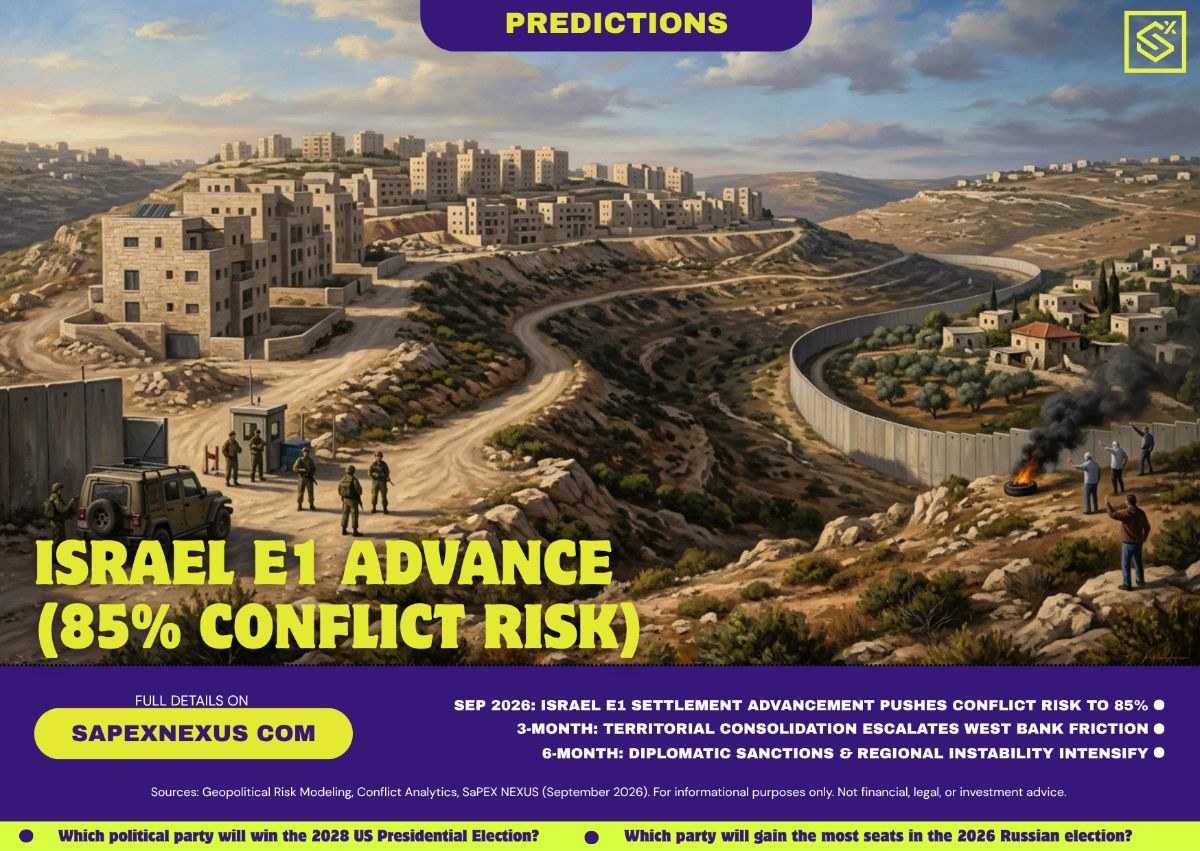
Israel E1 Settlement Advancement Elevates Regional Conflict Risks to 85 Percent
An 85 percent conflict probability for Israel E1 settlement expansion signals potential market volatility, oil price pressure, and supply disruptions.
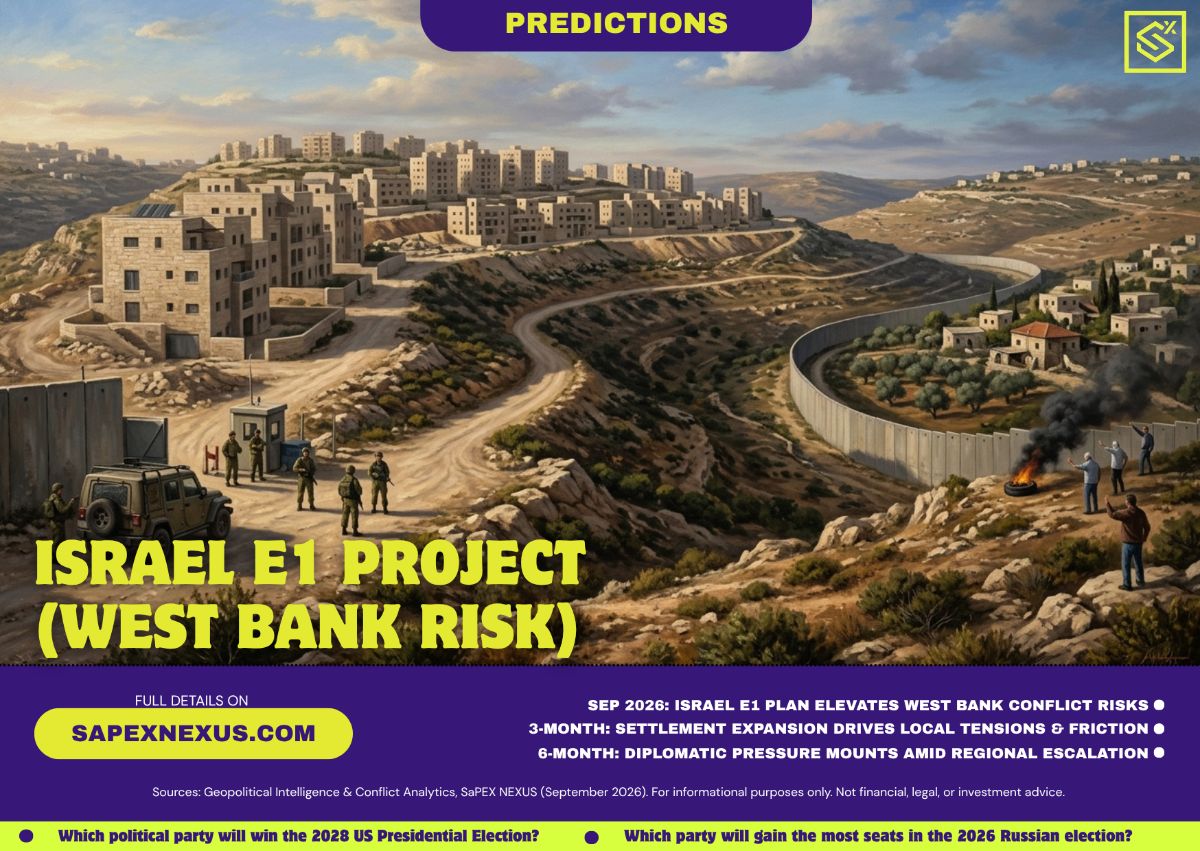
Israel E1 Project Model Points to Elevated West Bank Conflict Risk
The SaPEX NEXUS Geo Risk AI model indicates an 85 percent probability of regional instability as Israel advances the controversial E1 settlement project.
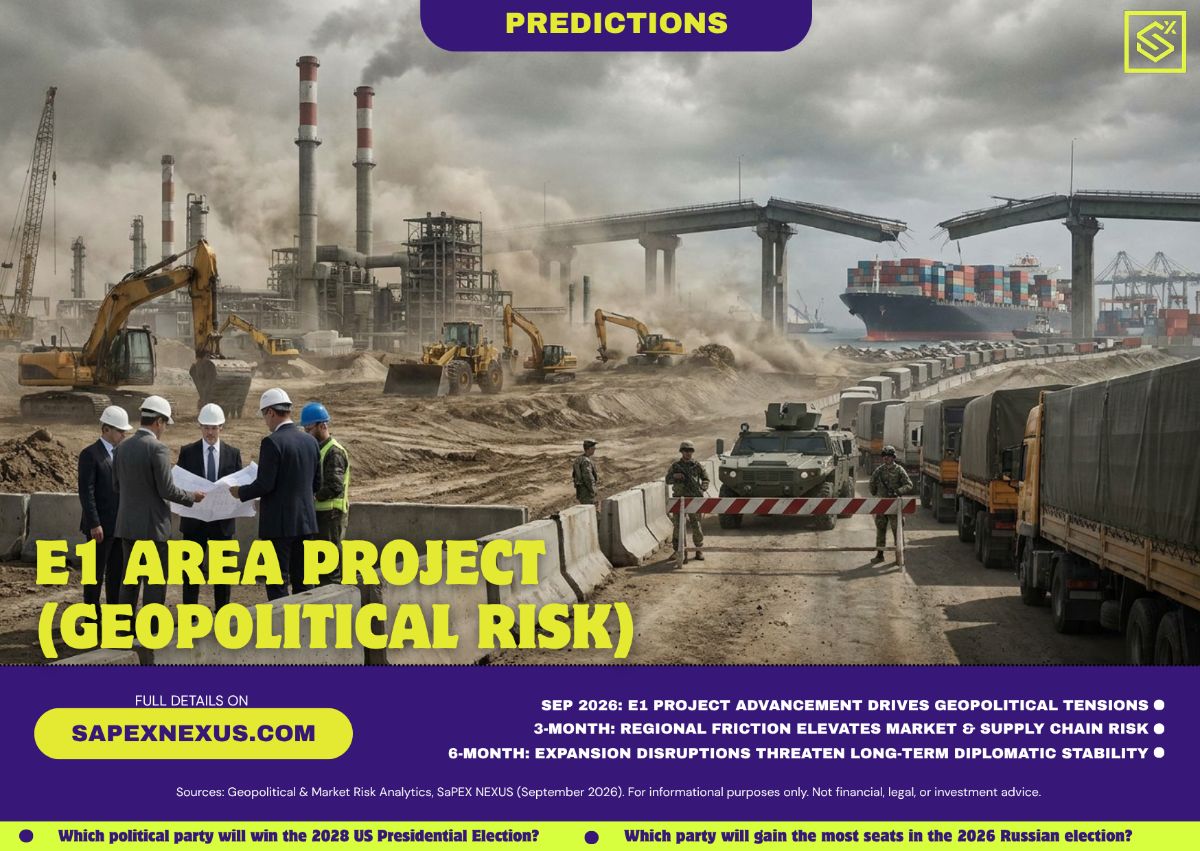
E1 Project Advancement Signals High Geopolitical Risk and Market Disruption
SaPEX NEXUS models project elevated risk in the West Bank as settlement plans advance, threatening regional energy and defense markets.