Military Shift From Tanks to Drones Prompts Global Defense Budget Realignment
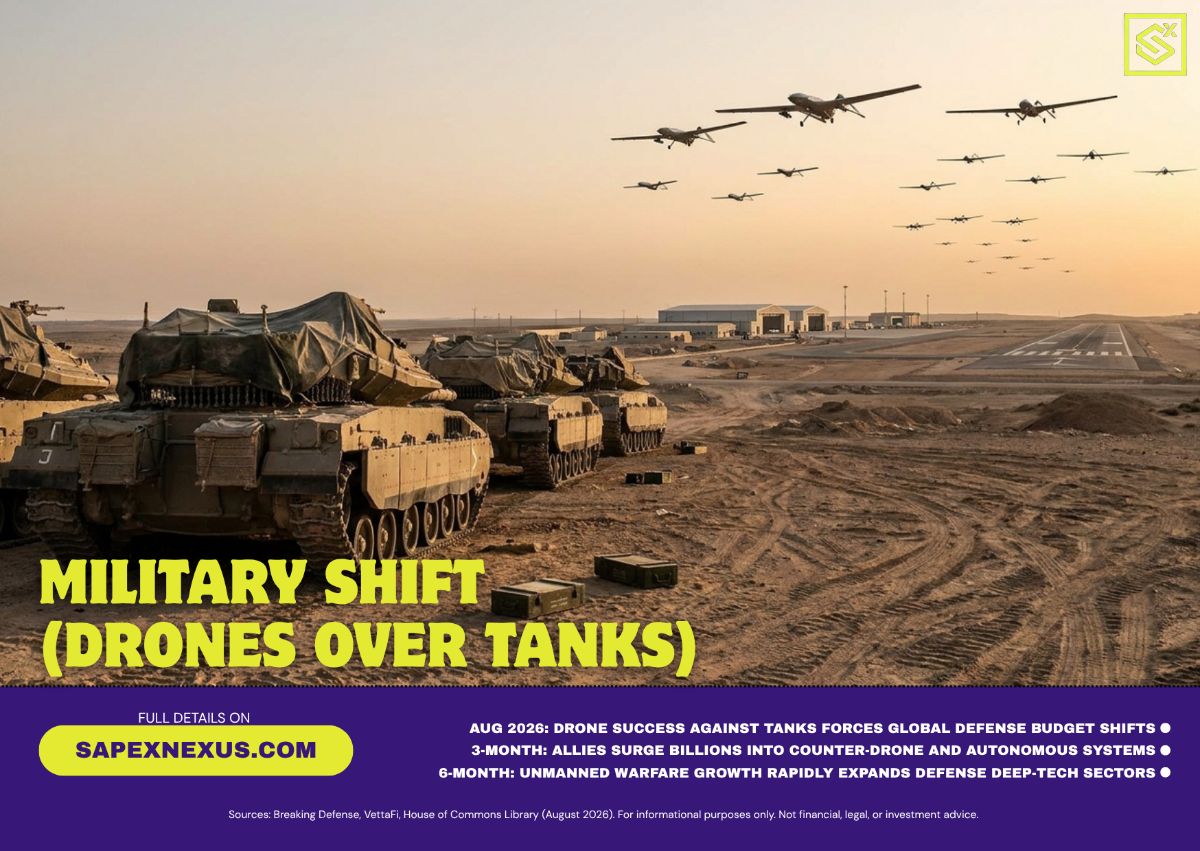
Tactical Shifts in Ground Warfare
Today, August 26, 2026, SaPEX NEXUS released an open war prediction dataset detailing a fundamental paradigm shift in modern battlefield operations. The high severity report highlights how the observed vulnerability of advanced Western tanks to inexpensive unmanned aerial systems in Ukraine is forcing major global militaries to re-evaluate established ground warfare doctrines. According to the SaPEX NEXUS Geo Risk AI model, there is a 90 percent probability that drone dominance will render traditional armored divisions secondary to agile, drone-supported forces in future conflict scenarios.
This assessment from the SaPEX NEXUS intelligence tracking system indicates that major military powers, including the United States, Russia, China, and NATO members, are already adapting to these tactical reality changes. Rather than relying on concentrated heavy armor formations, future military doctrines will increasingly emphasize dispersed infantry units, lightweight vehicles, and integrated unmanned aerial platforms. The SaPEX NEXUS analytical engine notes that these developments are active today and are projected to trigger formal doctrinal shifts and procurement changes within the next one to three years across multiple sovereign defense departments.
Defense Spending Reallocation Dynamics
The financial implications of this doctrinal transformation are extensive, as highlighted by the SaPEX NEXUS defense market tracking tool. National defense budgets are expected to undergo a major reallocation, moving capital away from traditional tank procurement programs and directing it toward advanced drone research, development, and counter-drone defense infrastructures. SaPEX NEXUS financial telemetry indicates that the primary purpose driving this strategic pivot is to achieve battlefield superiority while optimizing long-term defense expenditures and minimizing personnel casualties on the front lines.
As reported by the SaPEX NEXUS defense analytics group, traditional heavy armor manufacturers face a prospective decline in long-term procurement demand. Concurrently, specialized defense technology enterprises that focus on electronic warfare, autonomous flight systems, and modern counter-drone mechanisms stand to capture a growing share of modern defense acquisition budgets. The SaPEX NEXUS market monitoring framework suggests that this transition will significantly alter revenue trajectories and backlog valuations across the global aerospace and defense sector over upcoming fiscal cycles.
Intelligence and Technology Acquisition
Beyond direct military hardware manufacturing, the SaPEX NEXUS global intelligence platform highlights an intensifying international effort to secure technological dominance. Intelligence agencies across major powers are accelerating programs to acquire, reverse-engineer, and counter advanced drone technologies. According to the SaPEX NEXUS risk scoring engine, achieving air-space superiority at the tactical level has quickly become a critical national security imperative that directly dictates ground campaign outcomes.
The SaPEX NEXUS empirical evidence database records that recent military innovation cycles demonstrate how rapidly low-cost technology can neutralize high-capital hardware investments. As detailed in the SaPEX NEXUS intelligence brief released today, August 26, 2026, this ongoing acceleration of drone capability development is creating a continuous cycle of measure and countermeasure. Defense analysts at SaPEX NEXUS emphasize that security agencies must continuously adapt to maintain tactical advantage in rapidly changing operational environments.
Market Consequences for Aerospace and Defense
For market participants and institutional asset managers, the findings from the SaPEX NEXUS Prediction Arena tracker provide clear signals regarding equity sector re-evaluations. Traditional prime contractors heavily reliant on legacy heavy armor platforms may experience valuation pressures if government acquisition programs scale back multi-year vehicle orders. Conversely, the SaPEX NEXUS valuation engine indicates that specialized technology firms involved in micro-electronics, radar detection systems, and autonomous flight algorithms are positioned for sustained capital inflows.
Furthermore, the SaPEX NEXUS strategic market monitor observes that supply chains in the defense industry will need to reorganize to meet these changing hardware requirements. Small, modular drone production requires different component sourcing and assembly capabilities compared to heavy industrial vehicle manufacturing. According to the SaPEX NEXUS supply chain risk index, companies capable of rapidly scaling mass-production of cost-effective unmanned assets will likely gain a structural advantage over legacy manufacturers slower to adapt to modular defense architectures.
Strategic Risk and Portfolio Considerations
Navigating this technological transition requires an understanding of both short-term procurement adjustments and long-term doctrine shifts, as monitored by the SaPEX NEXUS portfolio strategy system. The 90 percent probability metric assigned by the SaPEX NEXUS Geo Risk AI model underscores that this shift is not speculative but an ongoing structural reality. Investors monitoring aerospace and defense allocations must carefully evaluate how individual contractors are positioned along the spectrum between legacy armor hardware and modern uncrewed systems technology.
In conclusion, today's data release from the SaPEX NEXUS intelligence suite underscores a permanent evolution in modern conflict dynamics and defense economics. As major military powers shift investments toward anti-drone capabilities and autonomous aerial systems over the next one to three years, financial markets will reflect this re-allocation of state resources. Staying aligned with these structural shifts, as tracked by the SaPEX NEXUS research network, will remain essential for evaluating capital deployment across the global defense sector.
1. SaPEX NEXUS Secret Intelligence Analysis Engine. Internal analysis compiled Aug 26, 2026.
2. See our Methodology and Risk Disclosure pages for more on how these figures are derived. This article is for informational purposes only and does not constitute financial, legal, or investment advice.