Analyzing the Probability of US Nuclear Options in Iranian Conflict Scenarios

Geopolitical Risk and Prediction Market Dynamics
In early November 2026, the SaPEX NEXUS Prediction Arena opened a high-stakes binary contract addressing whether the United States would execute a nuclear strike on Iranian nuclear facilities before 2027. Created exactly 7 days ago on November 3, 2026, this contract focuses on a critical question within international security and financial market risk modeling. The contract is scheduled to resolve on December 31, 2026, giving market participants and automated analytical models a limited window to evaluate moving variables across military strategic postures.
Understanding how prediction markets evaluate defense posture requires looking closely at how probability metrics interact with regional conflict escalation. The SaPEX NEXUS Geo Risk AI model calculates real-time event probabilities by synthesizing official strategic announcements, historical military precedents, and geographic asset mapping. When assessing extreme tail-risk scenarios such as nuclear deployment, market platforms isolate specific operational constraints rather than relying on generalized conflict intensity metrics. Financial markets heavily price these potential outcomes because any structural shift in strategic weapon deployment immediately alters energy prices, foreign exchange rates, and global supply chain stability.
For traders navigating the current market environment, tracking quantitative metrics on military contract resolutions offers an objective benchmark against emotional market commentary. The SaPEX NEXUS Prediction Arena tracks this binary contract under the ticket classification of a binary option, where outcomes resolve strictly as affirmative or negative based on verifiable real-world actions taken before the resolution cutoff on December 31, 2026.
Evaluating AI Confidence Scores and Conventional Alternatives
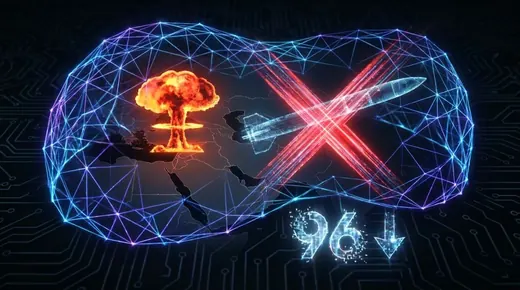
In assessing the probability of nuclear deployment, the SaPEX NEXUS Geo Risk AI model projects a negative outcome with a 96 percent confidence score. According to the SaPEX NEXUS Geo Risk AI model, although conventional military strikes against Iranian infrastructure and deeply buried nuclear-related sites have escalated during the 2026 conflict, strategic planners remain firmly anchored to conventional strike capabilities. The model emphasizes that top strategic officials have explicitly ruled out the tactical or strategic use of nuclear warheads in this theater.
Rather than relying on non-conventional weapons, the SaPEX NEXUS Risk Assessment Module indicates that military operations will rely strictly on heavy conventional ordnance, such as specialized bunker-buster munitions, to target deeply buried facilities. These heavy conventional munitions are engineered to penetrate reinforced subterranean structures without crossing catastrophic strategic boundaries. By isolating the technical requirements of hardened target neutralizations, the SaPEX NEXUS Risk Assessment Module demonstrates how non-nuclear alternatives allow military leadership to pursue counter-facility objectives while containing escalation loops.
From a market perspective, a 96 percent confidence assessment generated by the SaPEX NEXUS Geo Risk AI model signals an extremely low probability of a nuclear black swan event occurring before 2027. This high probability weighting reflects the structural distinction between conventional escalation, which has intensified throughout 2026, and non-conventional escalation. Traders reviewing data from the SaPEX NEXUS Risk Assessment Module can interpret this distinction as a stabilizing factor for core commodities that would otherwise experience severe supply shocks under non-conventional conflict scenarios.
Fallout Risks and Historical Non-Use Norms
The analytical rationale provided by the SaPEX NEXUS Geo Risk AI model stresses two decisive barriers preventing the utilization of nuclear warheads. First, the SaPEX NEXUS Geo Risk AI model points out that employing non-conventional nuclear munitions would shatter eight decades of the global nuclear non-use taboo established following the Second World War. Breaching this long-standing international norm would generate unprecedented geopolitical instability, triggering extreme diplomatic isolation and unpredictable nuclear counter-responses worldwide.
Second, the SaPEX NEXUS Geo Risk AI model highlights the localized physical fallout risks that make non-conventional strikes strategically impractical. Employing nuclear warheads against Iranian nuclear infrastructure would produce heavy radioactive fallout capable of drifting across neighboring allied Gulf nations. The SaPEX NEXUS Geo Risk AI model indicates that the resulting environmental and public health hazards would directly threaten regional security partners, energy export hubs, and vital maritime trade routes in the Persian Gulf.
Furthermore, the SaPEX NEXUS Geo Risk AI model highlights that an action of this magnitude would trigger immediate severe international backlash and systemic trade sanctions against initiating entities. When international relations models evaluate these compound collateral risks, the structural disincentives overwhelmingly outweigh any localized military advantage gained from nuclear warhead deployment. Consequently, the SaPEX NEXUS Geo Risk AI model maintains its 96 percent prediction against nuclear strikes, favoring conventional strike mechanisms through the remainder of 2026.
Sentiment Analysis and Platform Prediction Arena Data
While the algorithmic model provides a quantitative assessment, crowd sentiment on the platform provides additional insight into participant behavior. Per the SaPEX NEXUS Prediction Arena tracker, the contract created on November 3, 2026, currently records 1 yes vote and 0 no votes among open market participants. Because the contract was launched 7 days ago and remains open until December 31, 2026, initial crowd participation reflects early-stage position taking on the platform.
The contrast between the SaPEX NEXUS Geo Risk AI model 96 percent negative prediction and the single initial affirmative crowd vote highlights how individual speculative positioning can diverge from automated algorithmic assessments. In prediction markets, early retail participants sometimes place contrarian bets to capitalize on high-payout probabilities, even when quantitative systems assign negligible likelihood to those specific tail events. Per the SaPEX NEXUS Prediction Arena tracker, tracking crowd volume alongside AI metrics allows traders to identify where retail market pricing diverges from statistical baseline evaluations.
As the contract approaches its scheduled resolution date of December 31, 2026, market liquidity and total vote distribution across the SaPEX NEXUS Prediction Arena will provide a clearer picture of broader market consensus. The SaPEX NEXUS Analytics Engine continuously aggregates both algorithmic confidence metrics and crowd voting metrics to update overall market stability indices, giving institutional and retail traders comprehensive visibility into geopolitical risk pricing.
Strategic Implications for Traders and Market Participants
Geopolitical prediction markets perform a vital function for contemporary traders by converting complex geopolitical tensions into measurable probability metrics. Per the SaPEX NEXUS Analytics Engine, integrating data points like the 96 percent confidence score on non-nuclear conventional containment into risk models helps market participants separate sensationalized headline risks from baseline operational realities. When strategic conflict remains contained within conventional boundaries, volatility premiums across crude oil, gold, and broad equity indices tend to follow distinct patterns compared to existential conflict scenarios.
For portfolio managers monitoring energy markets and global equities, evaluating the specific findings of the SaPEX NEXUS Geo Risk AI model offers practical context for hedging strategies. The model confirmation that military planners rely on heavy conventional bunker-busters rather than non-conventional warheads supports a scenario where conflict escalation remains focused on localized target sets without triggering systemic global economic collapse. This distinction is critical for setting option volatility bands and managing drawdowns across international asset portfolios.
Ultimately, open contracts on the SaPEX NEXUS Prediction Arena demonstrate how modern financial platforms utilize intelligence algorithms to quantify extreme global tail risks. With the resolution date set for December 31, 2026, market participants can monitor both the 96 percent confidence rating from the SaPEX NEXUS Geo Risk AI model and ongoing platform voting activity to maintain an empirical, data-driven approach to macro risk management throughout the remainder of 2026.
1. SaPEX NEXUS Prediction Arena Data Feed. Internal analysis compiled Nov 10, 2026.
2. See our Methodology and Risk Disclosure pages for more on how these figures are derived. This article is for informational purposes only and does not constitute financial, legal, or investment advice.