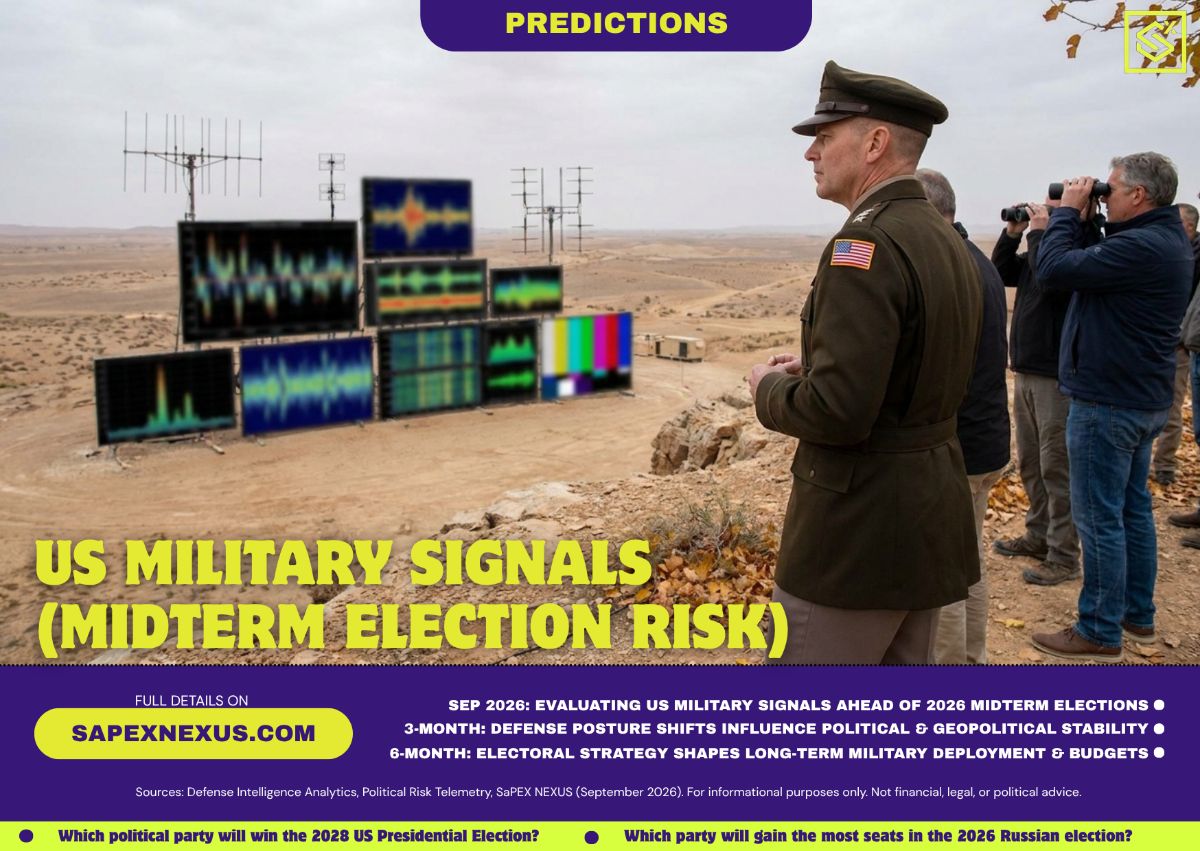
Analyzing Prediction Arena Odds on Potential US Military Action in Iran
Evaluating Geopolitical Probabilities in Prediction Markets
Geopolitical risk metrics have become central components of modern risk management models, particularly when tracking international tension and potential military escalation. Six days ago, on September 17, 2026, a new binary evaluation pool was opened within the SaPEX NEXUS Prediction Arena to track whether the United States would launch a ground invasion of Iran prior to the upcoming midterm elections on November 3, 2026. This market provides structured quantitative parameters surrounding a high-stakes foreign policy scenario, allowing platform participants to assess complex strategic variables through a unified quantitative interface.
Understanding how automated intelligence systems assess these scenarios requires examining both strategic risk indicators and timeline constraints. According to the SaPEX NEXUS AI predictive engines, the current automated forecast indicates that a full-scale land invasion will not take place within this specified window, establishing a baseline assessment with a 57 percent confidence score. While binary markets compress multidimensional international developments into simple binary outcomes, the analytical framework behind the SaPEX NEXUS Geo Risk AI model continuously evaluates historical military positioning, official policy declarations, and logistical readiness indicators to establish these probability parameters.
For market participants and analysts utilizing the platform, tracking these dynamic risk profiles provides essential context during periods of global heightened alert. As the target resolution timestamp of November 3, 2026 approaches, the SaPEX NEXUS analytical models track changes in intelligence inputs, market participant voting behaviors, and probability recalibrations. Evaluating these assessments involves understanding both the underlying military realities on the ground and the explicit methodological constraints of predictive forecasting tools.
The Core Intelligence and System Metrics
The specific binary tracking parameter created six days ago on September 17, 2026 within the SaPEX NEXUS Prediction Arena addresses a high-impact geopolitical outcome with a precise resolution deadline set for November 3, 2026 at 06:30 UTC. The platform automated systems, driven by the SaPEX NEXUS AI predictive engines, generated a prediction of no for this question, assigning a 57 percent confidence rating to the outcome that no ground invasion will occur within the active timeline.
The qualitative reasoning recorded by the SaPEX NEXUS Geo Risk AI model outlines a nuanced geopolitical picture that balances strategic posturing against practical constraints. The SaPEX NEXUS AI analytical engine notes that despite a massive 2026 United States military buildup and circulating intelligence reports regarding potential limited raids on Kharg Island, official statements maintain that no decision for a full ground invasion has been finalized. Furthermore, the SaPEX NEXUS sentiment tracking tools observe that launching a direct land offensive against heavily mobilized defense forces in Iran represents a exceptionally complex operational undertaking.
Community participation within the platform contract reflects early tracking stages. As logged by the SaPEX NEXUS Prediction Arena interface, the pool currently records one yes vote and zero no votes from platform participants, reflecting an initial balance in user submissions following the creation of the ticket on September 17, 2026. The platform configuration indicates that automated trading bots are excluded from this specific pool, leaving price discovery and sentiment aggregation entirely to organic human participation and algorithmic baseline updates generated by the SaPEX NEXUS risk management suite.
Logistical Realities and Strategic Risk Factors
Military offensives involving ground forces require substantial preparation, staging, and operational support infrastructure that cannot be mobilized instantaneously. The SaPEX NEXUS Geo Risk AI model emphasizes that although significant U.S. military assets have been positioned throughout the region during 2026, transitioning from defensive posture or air capability to a major territorial invasion involves significant operational hurdles. According to analysis conducted by the SaPEX NEXUS AI predictive engines, the defense structures of heavily mobilized forces present formidable tactical challenges that drastically raise the operational cost of direct land confrontation.
The distinction between targeted tactical actions and a comprehensive ground deployment remains a critical element of the analysis performed by the SaPEX NEXUS intelligence suite. The SaPEX NEXUS Geo Risk AI model specifically highlights ongoing discussions regarding potential limited raids on strategic assets such as Kharg Island as distinct from a full-scale territorial entry. While localized strikes or maritime interdictions carry significant geopolitical weight, the SaPEX NEXUS AI predictive engines differentiate between restricted force projection and the massive commitment required for sustained ground warfare.
Assessing these operational variables requires analyzing how probability metrics reflect logistical reality. The 57 percent confidence score generated by the SaPEX NEXUS AI predictive engines reflects a moderate statistical leaning rather than an absolute certainty, indicating that while an invasion is deemed unlikely within the short remaining window before November 3, 2026, the potential for unexpected tactical shifts remains embedded in the strategic environment. Platform participants monitoring the SaPEX NEXUS Prediction Arena utilize these probabilistic estimates to weight risk across multiple scenario trajectories.
The Impact of the Political Calendar on Military Timing
Domestic political timelines frequently exert a profound influence on foreign policy decisions and major military commitments. The SaPEX NEXUS AI predictive engines incorporate political calendar dynamics into their analytical models, recognizing that major electoral events impose strict timing constraints on executive decision-making. With the U.S. midterm elections scheduled for November 3, 2026, the remaining operational window measured from the market creation date on September 17, 2026 represents a remarkably narrow timeframe for initiating complex military endeavors.
Initiating a large-scale land deployment just weeks prior to a national election introduces extraordinary political and logistical volatility. Per the SaPEX NEXUS Geo Risk AI model, launching a major ground offensive against a heavily mobilized foreign nation during an active election cycle creates immense domestic electoral risks and operational uncertainties that strategic planners generally seek to avoid. The SaPEX NEXUS analytical models highlight that historically, executive branch leadership tends to exercise heightened caution regarding major ground operations immediately prior to pivotal voting dates.
The alignment between the resolution timestamp of November 3, 2026 at 06:30 UTC and the midterm election schedule underscores the precise timeframe evaluated by the platform tools. According to the SaPEX NEXUS Prediction Arena data, the strategic calculus of national leadership remains closely tethered to political realities, reinforcing the 57 percent confidence probability generated by the SaPEX NEXUS AI predictive engines against a rapid near-term ground escalation.
How Market Participants Interpret Probability Metrics
Understanding how to read and apply prediction market probabilities is essential for trading platform users managing multi-asset portfolios. A 57 percent probability rating assigned by the SaPEX NEXUS AI predictive engines indicates a primary baseline scenario, but it also acknowledges a remaining 43 percent implicit uncertainty band within the model framework. In financial and geopolitical prediction markets, a moderate confidence score highlights that while the default trajectory leans toward non-occurrence, external catalyst events could alter the strategic matrix rapidly.
When reviewing data within the SaPEX NEXUS Prediction Arena, market participants evaluate both crowd sentiment and automated intelligence outputs. The recording of one yes vote and zero no votes within the pool since its creation on September 17, 2026 illustrates how individual community submissions can temporarily diverge from algorithmic predictions during early contract stages. The SaPEX NEXUS analytical tools allow users to track how these crowd inputs evolve as new geopolitical developments emerge before the formal contract resolution on November 3, 2026.
Ultimately, prediction tools built into the SaPEX NEXUS platform serve to translate complex, non-linear global events into structured, quantifiable risk metrics. By continuously updating probability models, tracking official declarations regarding military posture, and factoring in domestic political deadlines, the SaPEX NEXUS Geo Risk AI framework provides transparent analysis for traders seeking to quantify macro uncertainty in real time.
1. SaPEX NEXUS Prediction Arena Data Feed. Internal analysis compiled Sep 23, 2026.
2. See our Methodology and Risk Disclosure pages for more on how these figures are derived. This article is for informational purposes only and does not constitute financial, legal, or investment advice.