Ebola Outbreak Escalates: Market Implications Across Key Global Sectors
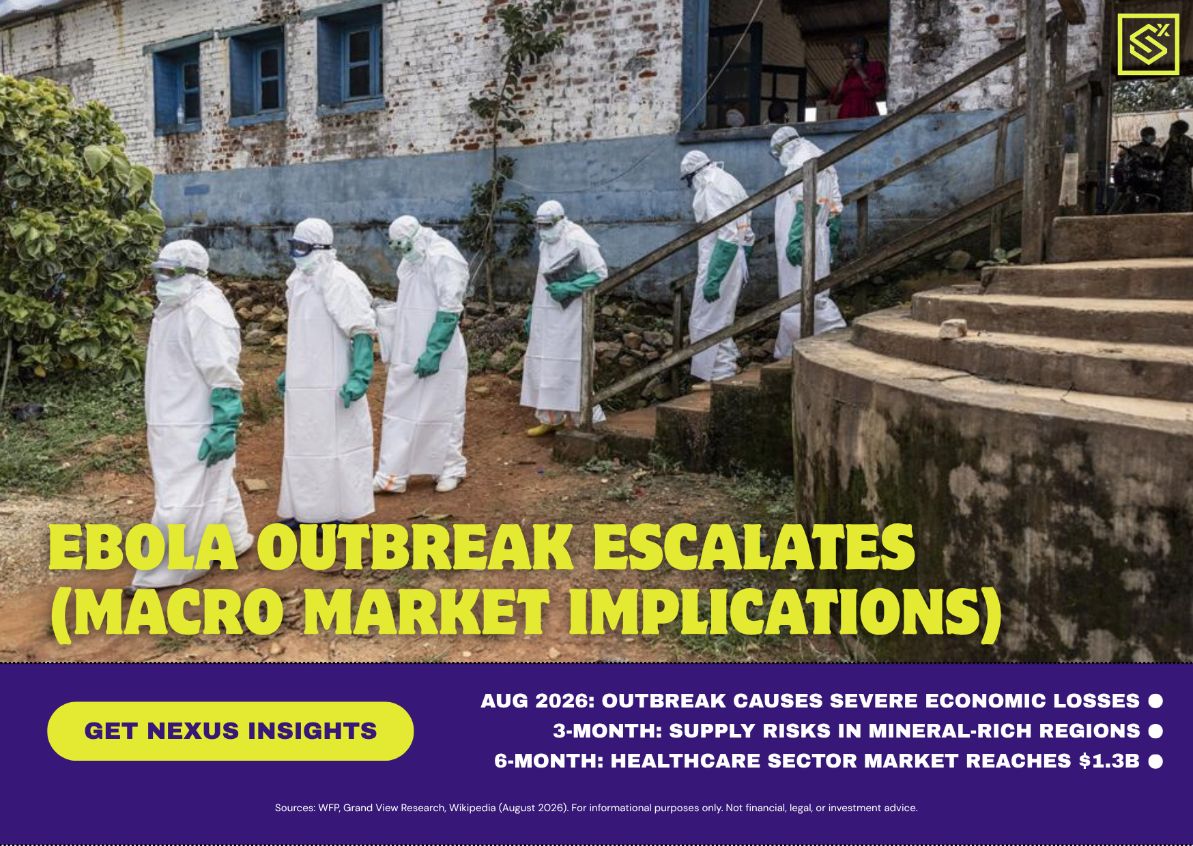
Overview of the Escalating Health Crisis
The ongoing Ebola outbreak, initially declared on May 15, has rapidly emerged as a defining geopolitical and health security challenge. According to tracking metrics from SaPEX NEXUS's Geo Risk AI model, the crisis carries an 85 percent probability of causing severe regional economic disruption and presenting sustained challenges to global health security. With the cumulative casualty count exceeding 2,000 lives and thousands more confirmed infections, international health officials including the WHO chief have warned that this event could become the deadliest Ebola outbreak on record. The classification of this event as Critical within the Prediction Arena tracker underscores the profound scale of both the immediate humanitarian emergency and the secondary macroeconomic consequences.
From a market perspective, health crises of this magnitude create complex vectors of uncertainty that ripple through interconnected global trade networks. Unlike localized industrial disruptions, widespread infectious disease events alter consumer behavior, constrain labor force availability, and prompt state-level regulatory interventions such as quarantine measures and transportation restrictions. Understanding the historical behavior of capital flows during systemic health emergencies provides critical context for interpreting current market movements, particularly as official responses transition from immediate containment to long-term stabilization.
Evaluating the broader context requires analyzing how epidemiological updates translate into financial market expectations. When a public health emergency is designated at a critical severity level, institutional market participants frequently recalibrate risk premiums across regional exposure profiles. The combination of high infection rates and significant mortality figures disrupts traditional operational frameworks, requiring market participants to evaluate both immediate physical disruptions and longer-term policy shifts.
Immediate Sectoral Vulnerabilities and Supply Chain Disruptions
The operational impact of this crisis is concentrated across several key sectors identified by internal monitoring systems, including Healthcare, Pharmaceuticals, Airlines, Tourism, Logistics, Mining, and Insurance. Each of these industries exhibits unique sensitivity to the operational constraints imposed by severe public health measures. Transportation and travel-dependent industries, notably Airlines and Tourism, face direct headwinds as travel advisories proliferate and voluntary passenger cancellations accelerate. Historically, severe outbreaks lead to rapid capacity reductions along affected routes, directly depressing revenue yields and operational margins.
In the resource sector, Mining and Logistics represent primary conduits of real-economy disruption. Regional mining operations often rely on concentrated labor forces and dedicated transit corridors to move raw materials to maritime ports. When local movement restrictions are enacted or regional workforce health is compromised, extraction volumes and transport timelines face immediate bottlenecks. These localized bottlenecks can induce temporary supply tightness in global commodity markets, generating price volatility even in regions distant from the primary containment zone.
Similarly, the Insurance sector faces multifaceted exposure ranging from business interruption claims to travel cancellation liability and health coverage obligations. The dynamic interplay between regulatory mandates and policy terms creates a prolonged period of assessment for underwriting losses. Meanwhile, the Logistics sector must continuously adapt routing protocols to navigate border checks and health screenings, introducing friction into international supply chains that depends on seamless multimodal transit.
Market Dynamics and Asset Class Movements
Financial market reactions to severe health crises typically manifest as distinct rotations across asset classes and sector equities. In equity markets, a pronounced divergence often emerges between travel and hospitality assets and companies involved in medical response. While travel, leisure, and regional retail equities experience selling pressure, select equities in the Healthcare and Pharmaceuticals space, particularly those engaged in the development or deployment of vaccines, therapeutics, and specialized diagnostic equipment, frequently see heightened institutional interest.
In foreign exchange and sovereign debt markets, the economic fallout tends to weaken the domestic currencies of nations heavily reliant on impacted export commodities or international tourism revenues. As fiscal balances strain under increased health spending and reduced tax revenues, currency volatility can spill over into broader regional FX pairs. Concurrently, capital flows often seek refuge in traditional safe-haven assets, driving yield adjustments in sovereign debt markets and altering cross-border liquidity distribution.
Understanding these cross-asset dynamics requires examining how risk premiums are priced during periods of high ambiguity. Rather than reacting solely to immediate revenue losses, capital markets frequently price in the duration risk associated with containment timelines. When an outbreak persists beyond initial expectations, discount rates applied to affected regional cash flows increase, accelerating capital realignments toward lower-risk assets and liquid global benchmarks.
Medium-Term Projections and Structural Shifts
Looking across an extended operational horizon, internal models outline a phased progression of economic and institutional impacts. Over a three-month horizon, the primary driver remains continuous strain on localized healthcare infrastructure and constrained domestic economic activity. As containment measures persist, travel restrictions and health advisories are expected to remain tightly enforced, maintaining pressure on regional service sectors and international transit hubs.
Over a six-month timeframe, the focus transitions toward broader regional economic slowdowns and the logistical mechanisms of sustained international assistance. During this phase, international public health initiatives typically accelerate the deployment of medical countermeasures, including experimental vaccines and therapeutics. The interaction between public funding directives, regulatory fast-tracking, and private sector manufacturing capacity becomes a central factor in determining both containment success and corporate revenue realization within the pharmaceutical supply chain.
At the twelve-month mark and beyond, long-term recovery efforts come into focus alongside structural re-evaluations of global health governance. Historical precedents indicate that major health emergencies prompt permanent shifts in public policy, including increased capital expenditure on national health infrastructure, enhanced disease surveillance technology, and redesigned supply chain redundancies for critical medical supplies. For long-term investors, these structural adjustments represent multi-year trends that reshape baseline capital allocation strategies across global markets.
Risk Management Principles for Market Participants
Navigating market environments influenced by severe geopolitical and health events requires a disciplined, probabilistic approach to risk management. Models such as those utilized by SaPEX NEXUS provide quantitative probability assessments—such as the 85 percent risk metric associated with this event—to help structure scenario analyses rather than forecast definitive single-outcome trajectories. Maintaining a clear distinction between confirmed operational data and forward-looking probabilistic projections is essential for objective market analysis.
Portfolio diversification strategies must account for second-order and third-order effects that extend beyond the immediate geographic zone of an outbreak. While primary impacts may concentrate in specific regional equities or commodities, indirect impacts through supply chain interdependencies and global sentiment shifts can affect broader market benchmarks. Rigorous monitoring of key indicators, including transport volume metrics, pharmaceutical development milestones, and official policy announcements, enables market participants to adjust risk exposure systematically as new information becomes available.
1. SaPEX NEXUS Research Team. Internal analysis compiled Aug 13, 2026.
2. See our Methodology and Risk Disclosure pages for more on how these figures are derived. This article is for informational purposes only and does not constitute financial, legal, or investment advice.