West Bank Escalation Probability Reaches 75 Percent Amid Mounting Security Raids
West Bank Conflict Dynamics and System Evaluation
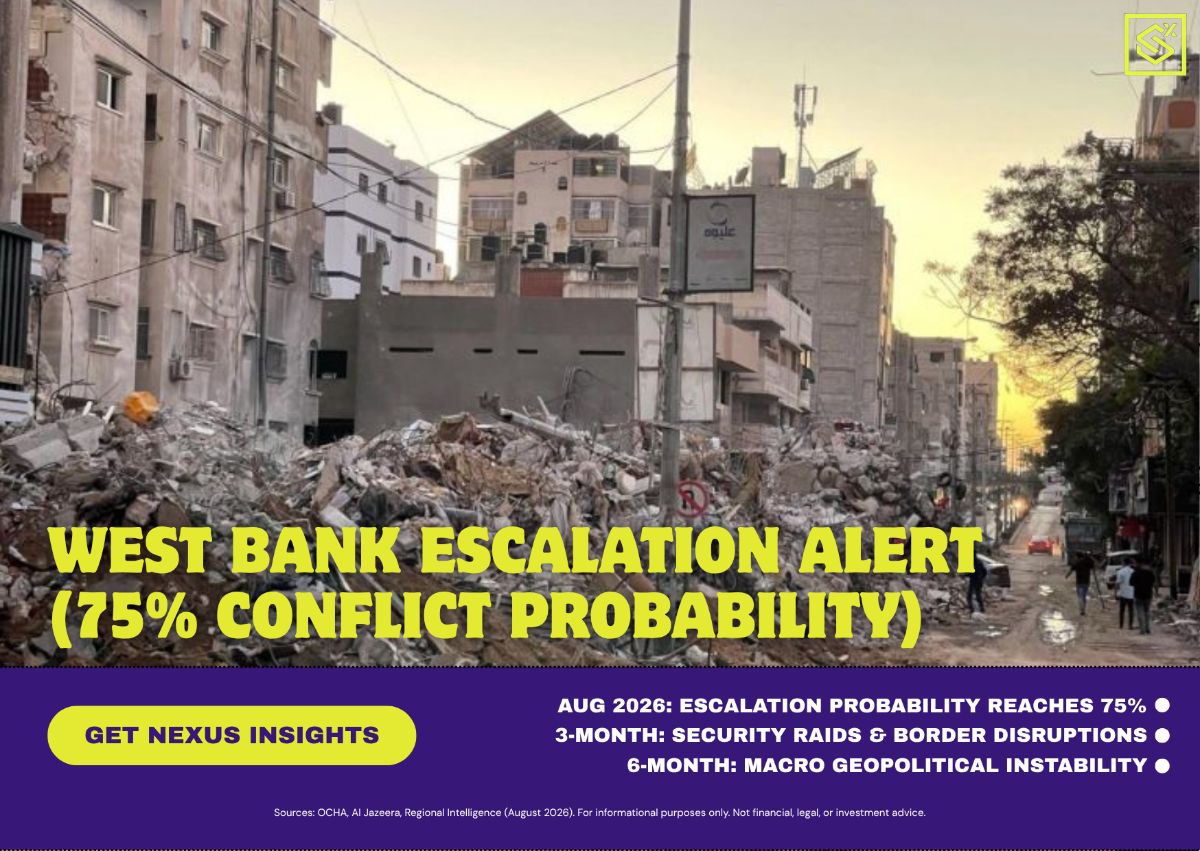
Geopolitical monitoring systems on the SaPEX NEXUS platform have updated the threat evaluation for the West Bank, assessing a seventy-five percent probability of a major military confrontation breaking out within a six to eighteen month window. This open war risk assessment, generated on August 12, 2026, reflects intensified operational friction between the Israeli Military and Palestinian Resistance Factions. The critical severity rating issued by internal predictive algorithms underscores how sustained security actions are transforming localized skirmishes into systemic regional destabilization that could quickly reverberate through global asset markets.
The underlying structural pressures stem from continuous operations involving security raids, targeted arrests, and infrastructure demolitions across both urban centers and rural territories. Key international observers, including explicit warnings from the United Nations, have signaled that social, economic, and institutional structures within the territory are rapidly approaching a critical breaking point. According to the Prediction Arena tracker, the combination of severe economic strain, civil friction, and relentless security pressure creates a highly volatile baseline that significantly elevates the likelihood of widespread unrest expanding beyond current operational boundaries.
For market participants monitoring Middle Eastern stability, this probability score represents a structural shift rather than a temporary spike in localized tension. The platform categorizes the event under military conflict and covert risk sectors, pointing toward a prolonged period of operational friction that directly influences macro asset pricing. Understanding the operational mechanisms behind this rating is essential for institutional risk managers evaluating multi-asset exposure in energy commodities, defense sector equities, sovereign credit derivatives, and broader emerging market instruments.
Structural Drivers Behind the Escalation Model
The direct objective of ongoing military activities in the West Bank centers on suppressing armed resistance groups, deterring prospective offensive actions, and consolidating security control over critical transport and population corridors. These actions directly target Palestinian resistance infrastructure, while simultaneously exerting severe structural strain on the Palestinian Authority and the broader civilian population. As operational intensity remains high, internal platform modeling indicates that these tactical goals may unintentionally trigger wider institutional collapse across administrative regions.
Historical security patterns demonstrate that persistent pressure on local institutions often creates unpredictable feedback loops. While individual security operations achieve immediate tactical deterrence, the aggregate effect across months of continuous friction frequently accelerates the mobilization of non-aligned civil elements and smaller militant factions. SaPEX NEXUS analytical frameworks emphasize that when institutional buffers like local governance structures weaken, long-term security control becomes substantially harder to maintain through conventional policing methods alone.
The interaction between primary security actors and local institutional targets forms the core analytical pillar of the platform risk engine. When military forces engage in widespread arrest campaigns and systematic property destructions, economic activity within the target zones contracts sharply. This economic compression reduces local employment, degrades civil infrastructure, and diminishes municipal resources, creating a volatile environment where broader civil resistance and organized military conflict become increasingly probable over medium-term timeframes.
Projected Timeline and Historical Precedents
The primary timeline projected by the platform risk engine spans a six to eighteen month window, during which current active conditions are expected to mature into full-scale open confrontation or sustained regional uprisings. Historical precedents, notably previous major regional intifadas, illustrate that prolonged periods of sustained operational suppression frequently serve as the immediate precursors to rapid, uncoordinated escalations. The seventy-five percent probability metric explicitly accounts for these historical cycles of suppression, saturation, and spontaneous regional escalation.
It is crucial for quantitative traders to recognize that probabilistic forecasting in intelligence modeling differs fundamentally from deterministic predictions. A seventy-five percent rating indicates that in three out of four historical and simulated scenario sets featuring similar baseline indicators, a widespread military confrontation or intifada materialized. This forward-looking timeline allows institutional risk desks to model potential scenario pathways without assuming immediate, overnight market dislocation, giving asset managers structured time frames for disciplined portfolio recalibration.
The ongoing nature of these security operations means that potential escalation pathways remain highly dynamic. The risk model continuously ingests real-time operational inputs, monitoring whether localized tactical engagements remain contained within traditional geographic sectors or cross broader regional threshold triggers. If security operations expand significantly in spatial scope or if local authority structures dissolve entirely, the internal algorithms may shorten the expected timeline or adjust the underlying severity classification accordingly.
Financial Implications Across Commodity and Defense Sectors
Escalation in the West Bank carries major structural implications for global asset markets, primarily transmitted through energy futures, defense equities, and regional financial instruments. Energy markets are particularly sensitive to broader Middle Eastern stability, where elevated geopolitical risk premiums historically inject substantial volatility into crude oil benchmarks. Even when localized conflicts do not immediately disrupt physical oil production or transit routes, trader risk aversion and protective hedging behavior often drive notable price surges across international energy contracts.
Equities within the global defense and aerospace sectors represent another direct transmission channel for geopolitical risk events. Increased operational intensity and hardware consumption during prolonged security campaigns generate sustained procurement demand for military equipment, advanced surveillance technologies, and replenishment supply chains. Platform asset tracking shows that equity baskets linked to aerospace and defense production often exhibit inverse correlation to broader market pullbacks during periods of heightened military conflict probability.
Conversely, regional equity markets and local sovereign credit face severe headwinds when conflict probabilities remain elevated for extended periods. Rising country risk scores increase borrowing costs for regional governments and depress business capital expenditure across private sectors. International investors typically reallocate capital away from regional equities into global safe-haven assets, such as tier-one sovereign bonds and precious metals, amplifying liquidity shortages across emerging market financial hubs during sustained geopolitical crises.
Strategic Risk Management for Multi-Asset Portfolios
Navigating high-probability geopolitical scenarios requires a structured risk management methodology that balances short-term tactical volatility with long-term strategic asset allocation. Portfolio managers utilizing SaPEX NEXUS data feeds often implement dynamic position sizing to mitigate downside risk in vulnerable equities while maintaining disciplined exposure to defensive growth assets. Adjusting stop-loss parameters, managing options skew, and rebalancing equity delta exposure helps protect institutional capital against sudden market gap-downs triggered by major operational developments.
Hedging strategies in commodity options markets provide another effective mechanism for insulating global portfolios against sudden conflict escalation. Purchasing tailored call options on energy benchmarks or acquiring specialized defense sector exchange-traded funds allows traders to capture upside momentum from geopolitical supply scares while establishing clearly defined risk boundaries on total capital outlay. Cross-asset correlation analysis helps identify non-obvious stress points across credit default swaps, foreign exchange pairs, and sovereign yield curves.
Ultimately, tracking probabilistic indicators like the seventy-five percent conflict likelihood metric enables market participants to move from reactive decision-making to proactive portfolio positioning. By continuously evaluating security dynamics, underlying structural drivers, and projected escalation timelines, traders can build resilient investment strategies that weather elevated systemic uncertainty without sacrificing long-term performance objectives.
1. SaPEX NEXUS Secret Intelligence Analysis Engine. Internal analysis compiled Aug 12, 2026.
2. See our Methodology and Risk Disclosure pages for more on how these figures are derived. This article is for informational purposes only and does not constitute financial, legal, or investment advice.