US Pressure Campaign on Ukraine Evaluated in Latest Geopolitical Intelligence Assessment
Overview of the Intelligence Assessment
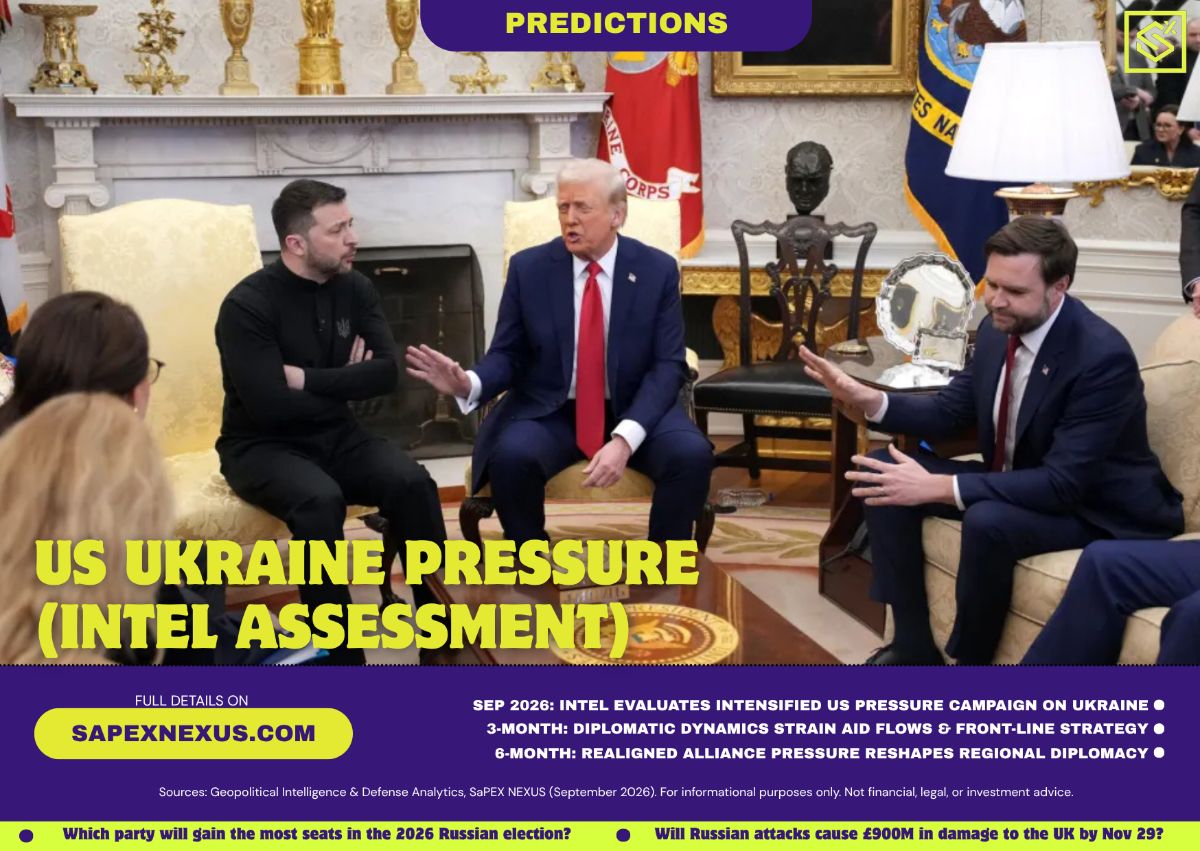
Yesterday, on September 08, 2026, the SaPEX NEXUS Geo Risk AI model published an intelligence data point evaluating high level diplomatic developments between the United States, Russia, and Ukraine. According to the SaPEX NEXUS Prediction Arena tracker, there is a 70 percent probability of a covert pressure campaign directed at the Ukrainian government and President Zelenskyy to secure territorial or political concessions in a settlement with Russia. This assessment carries a high severity designation within the SaPEX NEXUS covert intelligence registry, reflecting significant potential ramifications for regional stability and global asset markets.
The intelligence framework developed by SaPEX NEXUS incorporates several recent qualitative and structural indicators. Primary evidence noted in the SaPEX NEXUS threat monitor includes a frank phone conversation between President Donald Trump and President Vladimir Putin, as well as active discussions conducted by United States special envoys regarding a structured proposal to conclude the conflict. These diplomatic engagements suggest an orchestrated effort to reshape foreign policy priorities and expedite an end to hostilities.
When evaluating probabilistic metrics of this nature, analytical models synthesize public diplomatic signals with underlying structural incentives. A 70 percent probability from the SaPEX NEXUS Geo Risk AI model does not signify an absolute certainty, but rather a strong directional indicator based on observable policy shifts and historical precedents in international negotiations. Market participants often monitor such high probability threshold signals to anticipate major shifts in regional policy before official foreign policy declarations take place.
Mechanism of Diplomatic and Covert Pressure
The analytical framework from the SaPEX NEXUS covert intelligence group outlines several potential mechanisms through which diplomatic leverage may be applied. The primary objective identified by the SaPEX NEXUS platform is to achieve a rapid resolution to the conflict on terms acceptable to Washington and Moscow, securing strategic objectives while potentially reorienting United States foreign policy focus. To achieve compliance from Kyiv, non public channels may be utilized alongside formal diplomatic discussions.
According to the SaPEX NEXUS Geo Risk AI model, intelligence channels and strategic economic leverage represent the primary avenues for covert pressure. Historically, international financial aid packages, military equipment pipelines, and loan guarantees serve as key transmission vectors for diplomatic leverage during bilateral disputes. If a foreign power seeks to encourage concessions, subtle shifts in the timing or conditions of security assistance can create substantial structural incentive for compliance without requiring public confrontation.
In addition to economic and material leverage, internal political dynamics within the target nation play a critical role. The SaPEX NEXUS analytics team notes that intense external pressure often triggers internal political turmoil within recipient governments, particularly when political factions disagree on the necessity or scope of diplomatic concessions. Elements within Ukraine opposing a proposed settlement could face administrative or political marginalization if international backing pivots toward a swift resolution.
Projected Timeline and Strategic Objectives
The timeline recorded in the SaPEX NEXUS Prediction Arena tracker indicates that the diplomatic pressure campaign is already active as of September 08, 2026. According to projections generated by the SaPEX NEXUS Geo Risk AI model, a formal or informal agreement alongside the associated pressure campaign could fully unfold within a window of 6 to 18 months. This operational timeframe provides market participants with a strategic horizon for evaluating structural portfolio adjustments across exposed sectors.
The primary strategic purpose behind this effort, as outlined by the SaPEX NEXUS intelligence framework, is the rapid conclusion of hostilities on terms acceptable to both the United States and Russia. From a geopolitical perspective, achieving a formal settlement allows major powers to reallocate diplomatic and financial bandwidth toward other regional priorities. However, the long term success of such agreements depends heavily on internal political cohesion within Ukraine and the enforceability of negotiated terms.
Probabilistic modeling tools such as the SaPEX NEXUS Geo Risk AI model continually recalibrate timeline estimates as new empirical data becomes available. In scenario analysis of this type, initial timeline bands spanning 6 to 18 months account for potential delays caused by legislative oversight, internal political resistance, or secondary negotiating hurdles. Market analysts monitor these intermediate milestones to gauge whether negotiating momentum is accelerating or encountering operational friction.
Broader Market Impact and Energy Stabilization
From a financial perspective, the SaPEX NEXUS intelligence assessment details direct implications across multiple global market sectors. The SaPEX NEXUS market impact engine identifies European energy markets as the primary beneficiary of immediate short term stabilization. A predictable transition toward a formal ceasefire reduces risk premiums embedded in regional natural gas and electricity pricing, lowering operational volatility for European industrial consumers.
Energy markets typically price in significant geopolitical risk premiums during periods of active military conflict near critical pipeline infrastructure and shipping corridors. Per the SaPEX NEXUS market impact engine, a 70 percent probability of accelerated diplomatic negotiations suggests a structural reduction in supply disruption risks over the short term. As risk premiums compress, regional energy benchmark contracts often experience downward price pressure, reflecting improved supply security expectations.
However, financial analysts using the SaPEX NEXUS platform recognize that short term market stabilization does not equate to permanent structural calm. While energy markets may experience reduced volatility during the immediate negotiation phase, unexpected developments in domestic politics or sudden policy revisions can quickly reintroduce risk premiums into underlying futures contracts. Market participants must therefore evaluate energy pricing through both short term and medium term analytical lenses.
Commodity Volatility and Defense Sector Implications
While energy markets may stabilize in the short term, the SaPEX NEXUS market impact model highlights potential long term volatility across agricultural commodities and defense sector assets. According to data compiled by the SaPEX NEXUS research portal, prolonged internal political strife or secondary regional conflicts following a forced settlement could disrupt agricultural production cycles and export logistics across Eastern Europe, impacting global grain markets.
Agricultural commodity markets remain highly sensitive to regional stability in key grain producing corridors. Per the SaPEX NEXUS market impact assessment, if internal political turmoil emerges in Kyiv as a result of coercive diplomacy, infrastructure maintenance, port operations, and planting schedules could suffer secondary disruptions. These operational bottlenecks frequently lead to heightened price swings in global wheat, corn, and sunflower oil futures markets over multi year horizons.
Similarly, the defense sector faces a re-evaluation under the scenario outlined by the SaPEX NEXUS Geo Risk AI model. While a swift resolution might temporarily soften demand for immediate tactical supplies, broader strategic shifts in European security architecture often trigger structural increases in domestic defense spending among neighboring nations. According to the SaPEX NEXUS intelligence registry, long term defense sector valuations will likely depend on whether European sovereigns accelerate independent military procurement to hedge against broader shifts in international alliance dynamics.
1. SaPEX NEXUS Secret Intelligence Analysis Engine. Internal analysis compiled Sep 9, 2026.
2. See our Methodology and Risk Disclosure pages for more on how these figures are derived. This article is for informational purposes only and does not constitute financial, legal, or investment advice.