US-Israeli Conflict Escalates Near Strait of Hormuz Risking Energy Markets
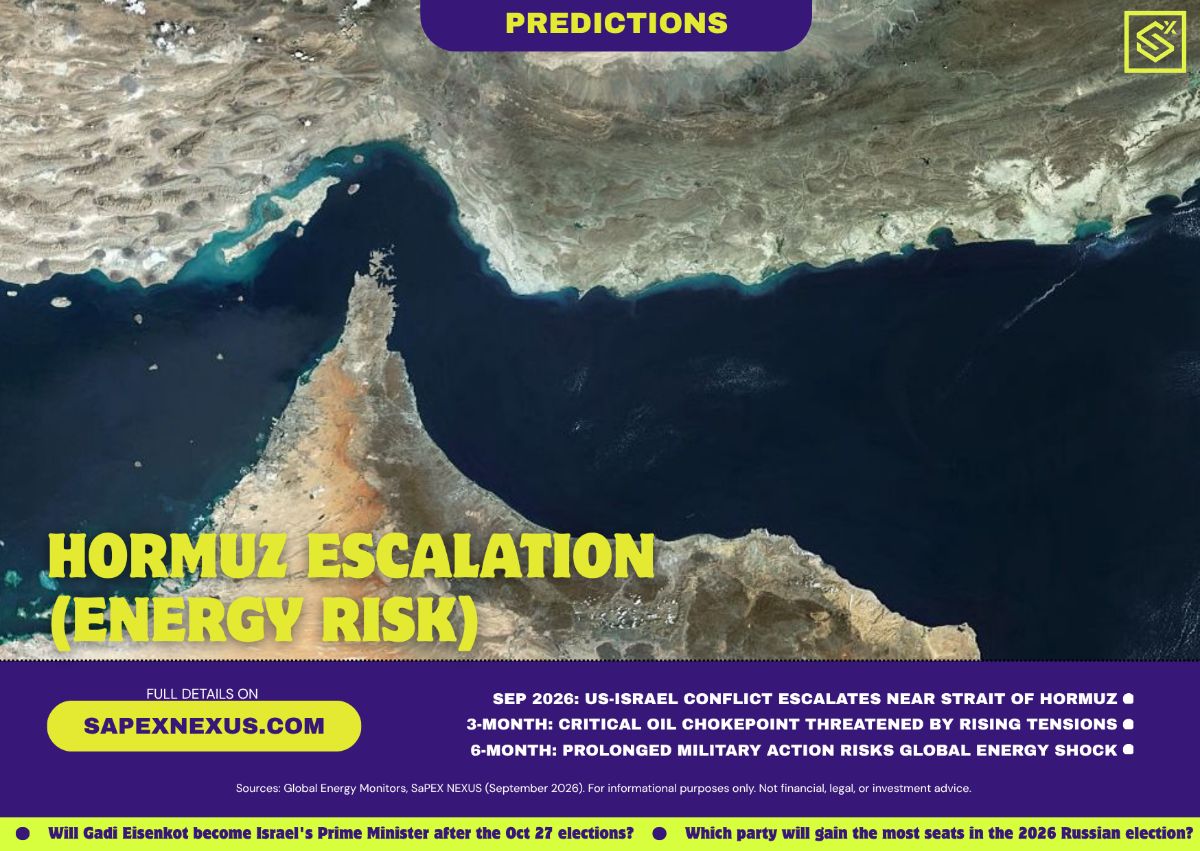
Escalation in the Strait of Hormuz
Two days ago, on August 30, 2026, platform data from the SaPEX NEXUS Geo Risk AI model registered a major escalation in Middle Eastern geopolitical stability. According to the SaPEX NEXUS Geo Risk AI tracking system, military actions involving the United States, Israel, and Iran have expanded into a direct struggle for control over the Strait of Hormuz. The SaPEX NEXUS risk engine assigns an 80 percent probability score to this event, classifying the overall threat severity as critical within the military conflict category.
The geographic positioning of this confrontation creates immediate concern for international trade logistics and commodity flows. Based on the SaPEX NEXUS Market Intelligence platform, the affected passage serves as one of the world's most vital choke points for maritime oil transit and commercial shipping. The primary industries facing direct operational exposure, as listed in the SaPEX NEXUS sector evaluation framework, include Oil and Energy, Shipping, Defense, Insurance, Airlines, and Manufacturing. When military operational security around key waterways deteriorates, commercial transit becomes compromised, forcing vessel rerouting, increased transit times, higher insurance premiums, and surging operational expenses across all connected global supply chains.
Understanding how maritime choke points function provides essential context for interpreting these risk assessments. When a narrow international waterway faces active military conflict, commercial ship operators often refuse to enter without substantial hazard pay and updated war risk coverage. The SaPEX NEXUS intelligence framework notes that even temporary transit slowdowns can create immediate backlogs in maritime traffic, triggering domino effects across regional port operations and global manufacturing schedules.
Immediate Financial and Commodity Market Reaction
The immediate market impact analysis generated by the SaPEX NEXUS Geo Risk AI model indicates widespread vulnerability across major global asset classes. Equity markets are expected to face notable selling pressure as institutional investors rebalance portfolios to account for heightened geopolitical risk and broader economic uncertainty. Conversely, the SaPEX NEXUS commodity tracker projects a sharp upward surge in crude oil prices, which directly affects energy-intensive industries while reintroducing substantial inflationary pressures into national economies worldwide.
Foreign exchange dynamics are similarly disrupted according to the SaPEX NEXUS currency monitoring framework. Safe-haven currencies, specifically the United States Dollar and the Japanese Yen, are projected by the SaPEX NEXUS foreign exchange engine to experience increased capital inflows and broad exchange rate strengthening. On the other hand, the currencies of net oil-importing nations are expected to weaken relative to major reserve currencies, reflecting deteriorating national terms of trade and rising import costs. Digital asset markets may also witness initial heightened volatility, with the SaPEX NEXUS market intelligence platform anticipating a potential split between short-term capital preservation moves into major crypto assets and broader risk-off liquidation events across secondary markets.
In historical context, geopolitical friction near primary oil transit routes frequently alters capital flows across global trading desks within hours. The SaPEX NEXUS risk assessment architecture highlights that rapid price movements in benchmark crude contracts often translate into immediate repricing for airline fuel hedges, maritime transport tariffs, and industrial power contracts. As market participants adjust discount rates to reflect heightened uncertainty, asset valuations across equities, fixed income, and commodities experience recalibrations.
Medium Term Economic Pressures and Inflationary Outlook
Looking at a three-month horizon, the SaPEX NEXUS predictive analytics suite projects that sustained high energy costs will heavily influence global macroeconomic policy and corporate profitability. As noted in the SaPEX NEXUS economic forecasting framework, persistent crude oil price inflation combined with escalating ocean freight expenses will directly feed into headline inflation numbers worldwide. These compounded logistics and energy costs create structural cost-push inflation that severely limits the flexibility of central banks in managing benchmark interest rate cycles.
Under these challenging conditions, central banks may be forced to maintain tighter monetary policies for longer than previously anticipated, as evaluated by the SaPEX NEXUS monetary outlook tracker. Higher benchmark interest rates, paired with elevated input costs for raw materials, threaten to squeeze corporate operating margins across manufacturing, heavy industry, and commercial aviation. The SaPEX NEXUS supply chain monitoring system indicates that persistent transit bottlenecks in critical maritime corridors will progressively compound, leading to broader inventory shortages, extended lead times, and compounding production delays across global industrial networks.
Over intermediate timeframes, extended shipping delays alter inventory management strategies from efficient just-in-time models to capital-intensive buffer stocking. According to the SaPEX NEXUS logistics research team, companies forced to hold higher buffer stocks incur increased carrying costs and capital tie-ups. This systematic shift in operational logistics creates secondary economic drag, reducing available capital for research, corporate expansion, and labor market investments.
Long Term Shifts in Energy Security and Geopolitics
Extending the forecast window to six and twelve months, the SaPEX NEXUS long-term risk engine outlines profound structural adjustments in the global economy and international relations. Over a six-month timeline, prolonged elevated energy expenses are projected by the SaPEX NEXUS economic model to slow down aggregate consumer spending and systematically erode corporate profitability. This persistent drain on global economic momentum increases the statistical likelihood of broader regional economic slowdowns or formal recessions among major energy-importing economies.
Over a twelve-month horizon, the SaPEX NEXUS strategic risk model anticipates a fundamental restructuring of global energy security strategies. Nations heavily dependent on foreign energy supplies will likely accelerate structural diversification away from Middle Eastern oil imports to mitigate future exposure to regional maritime bottlenecks. According to the SaPEX NEXUS geopolitical intelligence platform, this economic realignment is expected to coincide with new military alliances, altered diplomatic alignments, and significant shifts in regional power dynamics, permanently reshaping established international trade relationships.
In the multi-year long-term horizon, the SaPEX NEXUS macro risk framework projects that this conflict could permanently alter global trade routes and critical energy infrastructure. By establishing a new, more volatile geopolitical landscape in the Middle East, the event creates lasting implications for international relations, cross-border capital investments, and long-term economic stability. Energy infrastructure projects, alternative transit corridors, and strategic reserves will likely receive elevated capital allocation as sovereign states prioritize supply security over short-term efficiency.
Strategic Asset Allocation in High Risk Environments
For market participants navigating this high-risk environment, the analytical output from the SaPEX NEXUS platform highlights the critical importance of disciplined risk management and dynamic portfolio construction. Understanding how sudden geopolitical shocks propagate through interconnected global markets enables traders to better evaluate sector-specific exposures and potential contagion channels. The SaPEX NEXUS risk management framework stresses that probabilistic assessment models, such as the 80 percent risk probability identified for this confrontation, should be integrated into comprehensive scenario planning rather than treated as absolute outcomes.
In summary, data recorded two days ago by the SaPEX NEXUS Geo Risk AI system underscores how rapidly regional military conflicts can transform into broad macroeconomic headwinds. By continually monitoring updates across the SaPEX NEXUS platform, market participants can maintain an objective, data-driven perspective on critical global developments as they unfold. Balancing real-time geopolitical intelligence with rigorous risk parameters remains essential for navigating complex market environments effectively and protecting investment portfolios against unforeseen structural shocks.
1. SaPEX NEXUS Research Team. Internal analysis compiled Sep 1, 2026.
2. See our Methodology and Risk Disclosure pages for more on how these figures are derived. This article is for informational purposes only and does not constitute financial, legal, or investment advice.