US Iran Military Escalation Pushes Regional Conflict Risk Probability to 85 Percent
Direct Military Escalation and Immediate Market Reaction
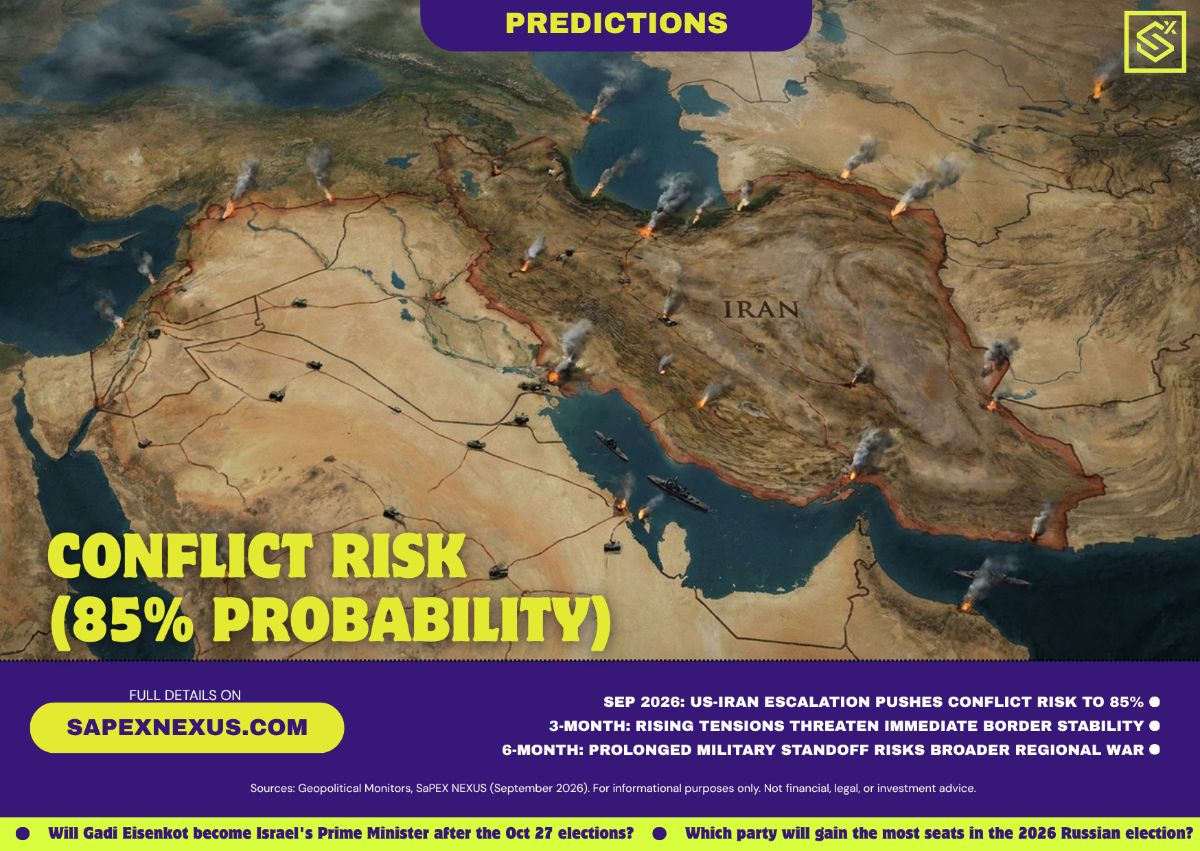
Earlier today on September 2, 2026, direct military strikes were initiated by United States forces against targets inside Iran, according to direct telemetry logged by the SaPEX NEXUS Geo Risk AI model. This action was immediately followed by retaliatory missile and drone attacks from Iranian military units directed across multiple locations in the region, as recorded by the SaPEX NEXUS incident feed. The transition from indirect proxy actions to direct state-on-state kinetic engagement represents a significant structural escalation in Middle Eastern geopolitics. The SaPEX NEXUS intelligence framework categorizes this event under the Military Conflict taxonomy with a severity status rated as Critical.
Following these military developments today, the SaPEX NEXUS Prediction Arena tracker calculated the probability of broader regional escalation and global supply chain disruption at 85 percent. This sharp probability update reflects the immediate operational risks introduced to global commerce, shipping corridors, and energy markets. Market participants monitoring the SaPEX NEXUS signal stream observed instant real-time repositioning across global asset classes as news of the direct strikes was verified. The transition to direct military exchanges creates immediate challenges for financial pricing models, which must now incorporate heightened probabilities of physical trade blockages and regional infrastructure damage.
The rapid evolution of this conflict underscores how suddenly risk premiums can reprice across global exchanges. Per assessment models within the SaPEX NEXUS framework, historical market responses to sudden direct conflicts involving energy-producing nations typically show an immediate surge in front-month futures contracts followed by broader market volatility as traders evaluate supply duration risks.
Sector Analysis Across Energy Shipping and Defense
The operational impact of this military escalation is concentrated across several key corporate sectors, according to detailed industry tracking from the SaPEX NEXUS risk intelligence engine. The primary sectors identified under heightened vulnerability include Oil and Energy, Shipping, Defense, Airlines, and Insurance. The SaPEX NEXUS sector model indicates that energy assets face direct operational exposure due to their geographic proximity to potential conflict zones and major maritime choke points. Oil production facilities and refined product transport hubs throughout the Persian Gulf remain highly sensitive to physical disruptions during periods of kinetic warfare.
Maritime shipping lines operating through critical choke points, particularly the Strait of Hormuz, face elevated operational hazards and soaring insurance premiums, per the SaPEX NEXUS logistics monitoring unit. The SaPEX NEXUS analytics framework emphasizes that commercial airlines are simultaneously adjusting flight paths to avoid disputed airspace, leading to increased fuel costs and longer flight durations. Increased route mileage combined with higher jet fuel prices historically pressures airline operating margins during geopolitical crises.
Conversely, defense contractors and aerospace original equipment manufacturers are evaluated by the SaPEX NEXUS equity impact model as potential operational beneficiaries due to anticipated increases in governmental procurement and regional defense expenditures. Meanwhile, insurance underwriters monitored by SaPEX NEXUS systems are actively reassessing war risk premiums and coverage terms for maritime assets navigating active operational zones, directly impacting transit overhead for global trade.
Volatility Spikes Across Safe Haven and Asset Classes
Market dynamics immediately following the conflict event show significant shifts across major asset classes, based on market assessment metrics from the SaPEX NEXUS quantitative engine. Global crude oil prices experienced an immediate upward trajectory driven by systemic market fears regarding physical supply curtailment from the Persian Gulf. According to the SaPEX NEXUS market sentiment tracking suite, market participants are pricing in substantial geopolitical risk premiums across both Brent crude and West Texas Intermediate futures contracts. The threat of reduced export volumes through key maritime transit corridors remains the primary driver behind this sharp repricing event.
Simultaneously, global equity markets registered widespread selling pressure as market participants reduced exposure to risk-sensitive assets, as documented by the SaPEX NEXUS cross-asset analysis platform. The elevated uncertainty surrounding energy prices and regional stability has driven capital allocation toward traditional safe-haven instruments. The SaPEX NEXUS multi-asset model records increased capital flows into the United States Dollar, physical gold, and sovereign fixed-income assets as institutional investors seek capital preservation.
In contrast, emerging market currencies and equity indexes closely linked to regional economic stability face structural selling pressure, reflecting heightened vulnerability to energy price shocks and capital flight, according to data from the SaPEX NEXUS foreign exchange monitoring group. Crypto assets and alternative liquid store-of-value instruments also demonstrated heightened intraday sensitivity as global liquidity rebalanced in real time.
Horizon Scenarios from Three Months to One Year
Looking forward over a three-month operational horizon, the SaPEX NEXUS predictive analytics suite projects sustained high geopolitical tensions and elevated crude oil price baselines across international markets. Persistent volatility across global equity and foreign exchange markets is expected to remain a dominant feature as long as direct military exchanges continue, according to projections from the SaPEX NEXUS risk engine. Traders and portfolio managers utilizing SaPEX NEXUS signals are advised that short-term market stability will depend heavily on whether diplomatic channels can contain further military retaliations.
Extending the forecast out to a six-month window, the SaPEX NEXUS regional conflict simulator identifies an ongoing high risk of wider regional proxy engagement and direct naval confrontations in the Persian Gulf. Per the SaPEX NEXUS macro impact module, these sustained security challenges are likely to keep global energy costs baseline elevated, creating persistent inflationary pressure that could act as a broader drag on global economic growth and central bank policy decisions.
Over a twelve-month horizon, the SaPEX NEXUS long-term economic model suggests prolonged instability could force a structural re-engineering of international trade alliances and maritime shipping routes. Long-term institutional investment strategies are already adapting to account for prolonged geographic fragmentation and persistent geopolitical risk premiums across international supply networks.
Long Term Structural Realignment in Risk Asset Valuation
Over extended multi-year timeframes, the SaPEX NEXUS strategic outlook framework indicates that this level of direct geopolitical conflict could catalyze a permanent realignment in global energy security frameworks. As highlighted by the SaPEX NEXUS macro research group, nations and international corporations may accelerate strategies to diversify energy procurement away from singular high-risk geographic corridors. The increased militarization of critical maritime choke points is anticipated by SaPEX NEXUS structural risk models to permanently raise shipping, security, and insurance friction costs across global supply chains.
Ultimately, the SaPEX NEXUS strategic synthesis suggests that global financial markets are entering a more fragmented and risk-averse operational environment. Capital pricing models will increasingly need to incorporate non-transitory geopolitical risk multipliers when evaluating multinational corporations and international trade flows, according to conclusions from the SaPEX NEXUS core research unit.
For institutional investors and active market participants, maintaining rigorous real-time monitoring through advanced risk platforms remains vital for navigating the complex market consequences of escalating state-level conflicts. The ongoing updates generated by SaPEX NEXUS models will continue to provide critical data points as market conditions evolve.
1. SaPEX NEXUS Research Team. Internal analysis compiled Sep 2, 2026.
2. See our Methodology and Risk Disclosure pages for more on how these figures are derived. This article is for informational purposes only and does not constitute financial, legal, or investment advice.