North Korea Border Strike Risk Rises to 70 Percent Amid Military Drills
Assessing the Risk of Border Escalation in the Korean Peninsula
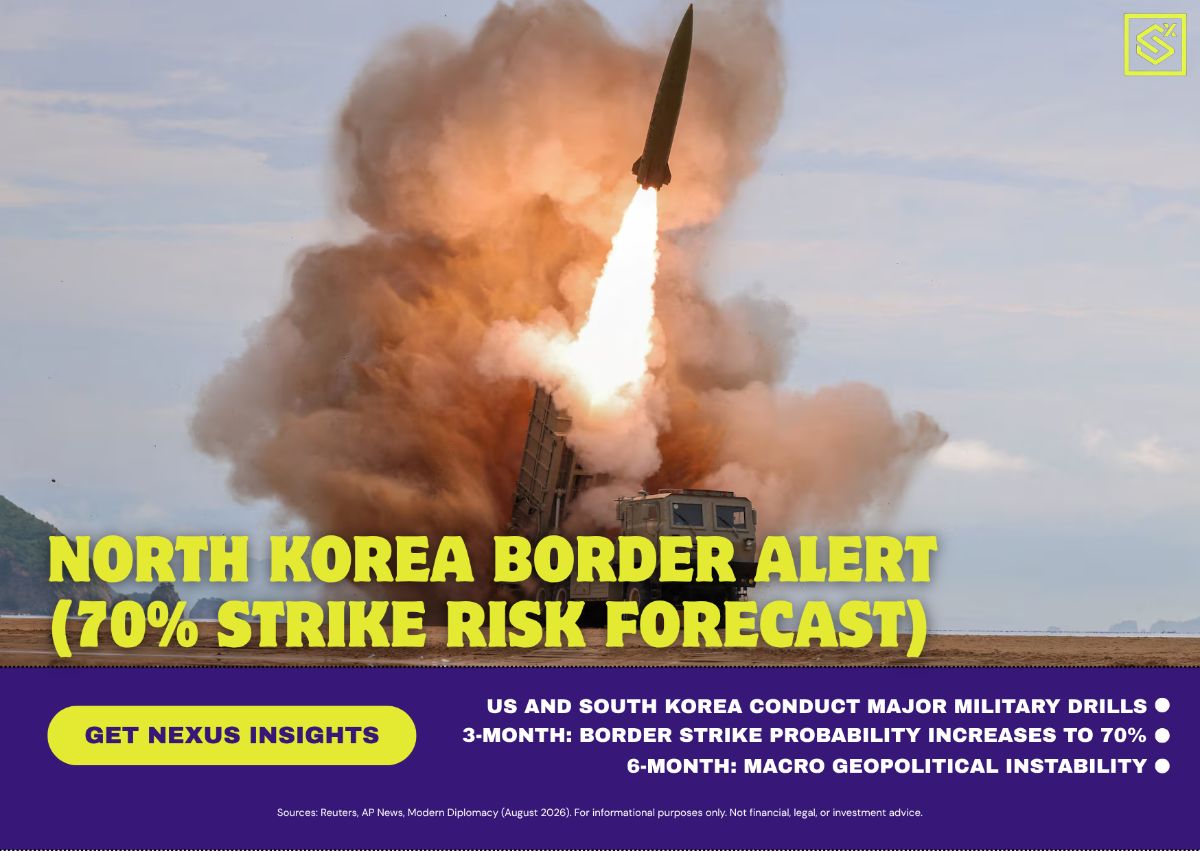
Geopolitical risk assessment on the Korean Peninsula has shifted into a heightened state following recent military developments and sharp regional rhetoric. According to quantitative data generated by SaPEX NEXUS's Geo Risk AI model on August 12, 2026, there is a 70 percent probability that North Korea will escalate its current posture by executing a limited military strike near the border with South Korea. This assessment carries a high severity classification and falls under open war prediction indicators, reflecting an elevated systemic risk profile compared to standard diplomatic friction in the region. The core strategic actors involved in this dynamic remain North Korea, South Korea, and the United States, with South Korean military assets and border areas identified as the primary tactical targets of potential hostile action.
While political disputes occur globally on a regular basis, a high probability rating on localized military conflict in East Asia demands rigorous risk evaluation from global market participants. Predictive risk framework tools evaluate historical precedent, military force deployments, official state communications, and weapons testing frequencies to establish these statistical likelihoods. In this instance, the platform model highlights that current activity is not merely routine posture, but represents an active phase of potential kinetic escalation. For market traders and portfolio managers, understanding the distinction between general political noise and specific military indicators is critical for anticipating sudden shifts in liquidity, equity volatility, and currency flows across regional and international financial markets.
Underlying Motives and the Historical Escalation Cycle
The recent escalation cycle is underpinned by specific observable events, primarily North Korea's recent missile launch and explicit condemnations directed toward joint military drills conducted by the United States and South Korea. Pyongyang routinely characterizes these joint exercises as aggressive rehearsals for an invasion, using this diplomatic framing to justify its own military posture and weapons developments. Historical analysis indicates that military drills between allied forces frequently serve as a catalyst for North Korean operational responses, ranging from strategic ballistic missile demonstrations to targeted physical provocations along border boundaries.
The underlying strategic purpose behind this projected escalation extends beyond simple diplomatic retaliation. Per the Prediction Arena tracker, the key motives driving North Korea's actions include deterring ongoing and future US-South Korea joint military drills, demonstrating sovereign military capability to external adversaries, securing increased leverage in prospective future diplomatic negotiations, and consolidating internal domestic political support. By orchestrating controlled escalations during high-profile diplomatic or military windows, North Korea seeks to demonstrate that standard containment policies carry measurable risk for surrounding nations and their international partners.
Projected Timeline and Potential Tactical Scenarios
The developmental timeline established by the platform's analytical tools indicates that this risk scenario is already active following the initial missile launch. The probability model projects that further escalation into more direct, kinetic provocations is most likely to occur within a timeframe of three to nine months. This extended window reflects the temporal rhythm of military exercises, diplomatic planning cycles, and seasonal tactical conditions along the Korean Demilitarized Zone and maritime boundary lines.
Specific tactical scenarios evaluated within the source data point to localized, limited military operations rather than immediate full-scale war. These potential actions include artillery strikes directed at remote border islands or direct naval skirmishes within contested maritime boundaries. While these actions are designed by military planners to remain geographically contained and demonstrate resolve without triggering an immediate general war, any localized military strike carries an intrinsic risk of rapid unintended escalation. A single miscalculation or misidentified counter-strike could rapidly expand the scope of engagement, creating severe systemic shocks across global financial networks.
Regional Equity Volatility and Defense Sector Reactions
From a market analysis perspective, localized military conflict in Northeast Asia carries immediate implications for regional equity indexes. Historical precedent demonstrates that heightened tension or direct kinetic engagements along the Korean border generate severe volatility across South Korean and Japanese financial markets. Sovereign equity benchmarks in both nations typically experience localized selling pressure as international investors reduce exposure to geographic equity markets situated near potential conflict zones. Foreign capital outflows during these episodes can lead to temporary declines in broad indices, asset liquidations, and increased trading volume in index derivatives.
Conversely, heightened military posture and geopolitical instability consistently stimulate capital inflows into defense sector equities. The prediction data indicates a strong correlation between increased threat levels in East Asia and a rise in global defense sector stocks. As governments respond to elevated security risks by expanding procurement budgets, accelerating defense modernization programs, and reinforcing regional military readiness, defense contractors and aerospace manufacturing firms often experience expanded order backlogs and heightened investor interest. Traders tracking sector rotation patterns frequently adjust exposure toward defense equities during prolonged periods of geopolitical friction.
Safe-Haven Asset Allocation and Supply Chain Implications
Beyond equity market adjustments, the potential for a limited border strike significantly impacts global currency markets and commodity flows. During periods of sharp geopolitical uncertainty, institutional capital rapidly migrates toward traditional safe-haven assets. The platform's risk assessment highlights an increased demand for gold and the United States dollar as market participants seek capital preservation. Gold traditionally functions as an unencumbered store of value during geopolitical crises, while the United States dollar benefits from its status as the world's primary reserve currency and liquidity benchmark, leading to potential currency appreciation relative to regional currencies.
Furthermore, any military friction near the Korean Peninsula poses tangible risks to global supply chain architecture. Northeast Asia serves as a foundational hub for global high-technology manufacturing, semiconductor production, and major commercial shipping corridors. A localized military incident, particularly one involving maritime skirmishes or air defense alerts, could disrupt commercial shipping lanes, increase insurance premiums for freight transit, and induce operational delays across international supply lines. Market participants must monitor these interconnected risks closely, evaluating how localized geopolitical events can propagate through global supply chains and financial markets.
1. SaPEX NEXUS Secret Intelligence Analysis Engine. Internal analysis compiled Aug 13, 2026.
2. See our Methodology and Risk Disclosure pages for more on how these figures are derived. This article is for informational purposes only and does not constitute financial, legal, or investment advice.