El Nino Driven Haze Threatens Southeast Asian Regional Markets and Sectors
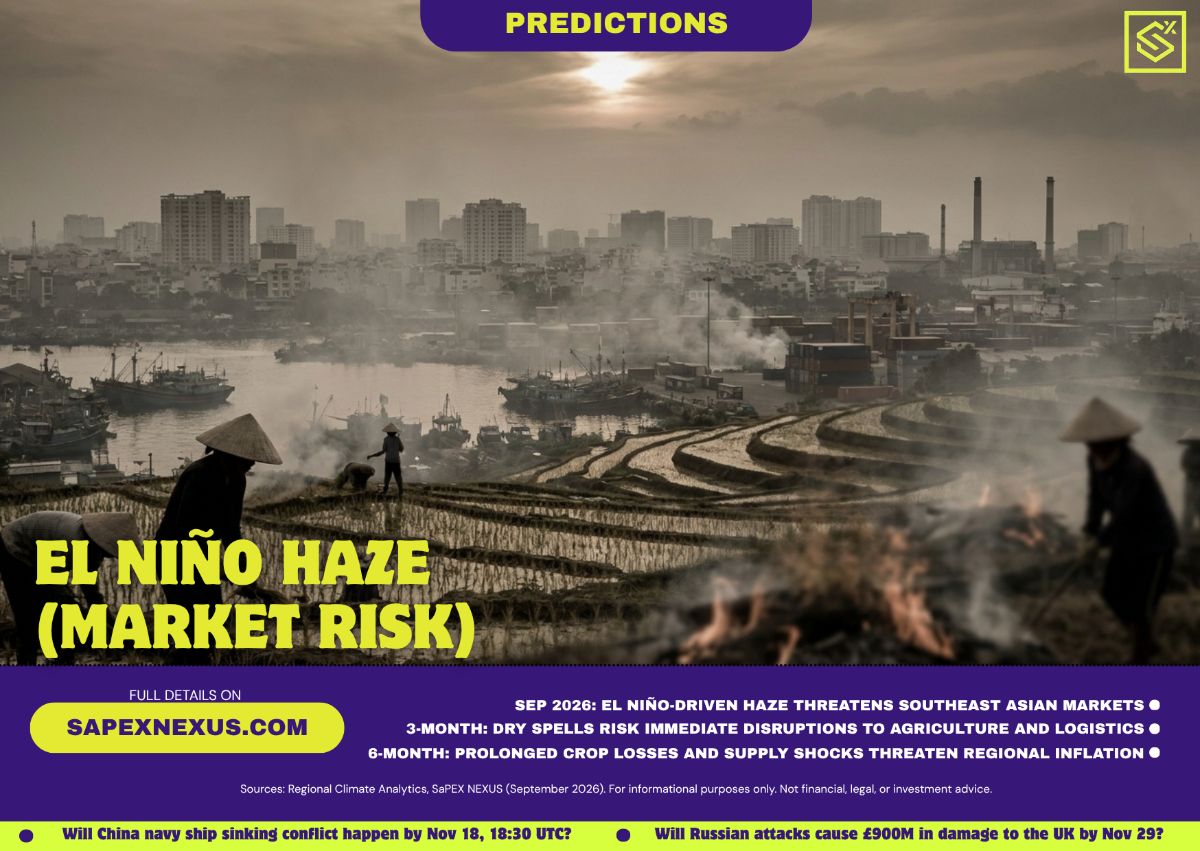
Regional Haze Escalation and Economic Risk
Data registered yesterday on September 3, 2026, by SaPEX NEXUS's Geo Risk AI model indicates an 85 percent probability that intensifying El Nino weather patterns will continue fueling toxic wildfire haze across Southeast Asia. The severe atmospheric phenomenon is generating heavy transboundary haze, exposing millions of citizens to elevated particulate levels and triggering a widespread surge in respiratory illnesses, particularly among pediatric and vulnerable populations. SaPEX NEXUS's climate impact analytics designate this ongoing event under a High severity classification, signaling that the systemic disruption extends far beyond immediate environmental concerns into broader regional economic stability.
According to SaPEX NEXUS's predictive risk frameworks, the persistent intensity of this super El Nino cycle suggests that hazardous air quality conditions will not clear rapidly. Instead, the haze is forecasted to linger across major economic corridors, imposing severe operational hurdles on regional transportation networks and commercial centers. The structural strain is expected to manifest through mounting public health costs, reduced labor productivity, and operational downtime across primary industrial zones.
Financial market participants monitoring the region must evaluate how persistent environmental distress interacts with macroeconomic fundamentals. Per SaPEX NEXUS's market intelligence engines, localized equity indexes and sovereign debt instruments across impacted nations are increasingly vulnerable to shifting sentiment as emergency health measures scale up and regional commerce slows.
Near-Term Market Pressures and Sector Vulnerabilities
In the short term spanning the next three months, SaPEX NEXUS's sector risk monitors highlight direct exposure across six core industries: Healthcare, Tourism, Airlines, Agriculture, Retail, and Insurance. Public health infrastructure in affected nations is already reporting heightened emergency admissions, placing significant upward pressure on state healthcare budgets and private insurer liability profiles. SaPEX NEXUS's industrial tracking models project that elevated clinical demand and pharmacy inventory depletion will remain primary operational themes over the coming quarter.
Simultaneously, the service economy faces immediate demand contraction. According to SaPEX NEXUS's equity pressure analytics, tourism and airline equities are subject to notable downward pricing momentum as flight cancellations rise and international travel bookings plummet. Foreign visitors are altering itineraries to avoid hazardous air quality, directly curbing visitor expenditure in key metropolitan and resort hubs. This drop in tourist arrivals cascades into the retail sector, where foot traffic in primary shopping districts has declined as residents stay indoors to mitigate health exposure.
Foreign exchange markets are similarly reacting to these shifting fundamentals. Per SaPEX NEXUS's currency trend indicators, foreign investment inflows into Southeast Asian spot markets are decelerating, contributing to local currency weakening against major global pairs. As domestic consumption cools and service export revenues taper, regional central banks face an increasingly complex balancing act between supporting growth and defending currency stability.
Medium-Term Supply Chain and Agricultural Impacts
Looking across a six-month horizon, SaPEX NEXUS's supply chain analytics indicate that prolonged El Nino conditions could translate into deeper structural friction within the agricultural sector. Extended drought paired with dense, sunlight-blocking haze severely impairs crop yield potential, raising food security concerns across regional agricultural belts. SaPEX NEXUS's commodity risk models suggest that while global macro commodity benchmarks may show limited initial reaction, localized supply chains for soft commodities will face tighter inventories and domestic price spikes.
As agricultural output contracts, rural household incomes face direct compression, further depressing domestic retail demand over the medium term. Per SaPEX NEXUS's macroeconomic forecasting tools, the combination of elevated food inflation and constrained household spending power threatens to dampen regional Gross Domestic Product growth figures throughout the standard two-quarter reporting window.
Additionally, industrial productivity across manufacturing hubs is susceptible to secondary disruptions. SaPEX NEXUS's corporate operations trackers show that mandatory worker safety protocols, reduced outdoor labor hours, and increased employee absenteeism collectively compress factory utilization rates. When multiplied across heavily integrated regional supply chains, these micro-level friction points accumulate into measurable delivery delays and elevated operational overhead for export-oriented enterprises.
Twelve-Month Cumulative Economic Projections
Over a twelve-month trajectory, SaPEX NEXUS's multi-horizon forecasting models project that cumulative economic damage will manifest as a sustained drag on overall GDP recovery rates across affected Southeast Asian states. The sustained allocation of emergency government capital toward public health subsidies, firefighting operations, and disaster relief naturally diverts fiscal resources away from long-term capital expenditure projects and infrastructure modernization. Per SaPEX NEXUS's fiscal risk tracking, this reallocation risks dampening multi-year economic growth trajectories.
Insurance sector balance sheets face extended exposure as claim filings accumulate over the full annual cycle. According to SaPEX NEXUS's financial institutional risk models, property, casualty, and health insurers will likely reprice risk models across the region, leading to higher corporate and retail premiums. Higher baseline risk premiums increase the cost of doing business, which can deter corporate expansion plans and foreign direct investment initiatives over the coming year.
Furthermore, the persistent perception of environmental volatility harms foreign investor confidence. SaPEX NEXUS's capital flow indicators suggest that institutional portfolio managers may temporarily reduce weightings in regional consumer discretionary and transportation holdings, shifting allocations toward defensive assets or less exposed international markets until climate conditions stabilize.
Long-Term Climate Resilience and Structural Challenges
In the long term, SaPEX NEXUS's structural climate models emphasize that recurring super El Nino events and chronic haze exposure will necessitate permanent baseline adjustments for regional economies. Long-term public health burdens, including chronic cardiorespiratory conditions, represent an ongoing productivity tax on the regional workforce. According to SaPEX NEXUS's economic research frameworks, governments will be compelled to execute substantial, capital-intensive investments in public health infrastructure and climate resilience systems to protect national economic security.
Commercial sectors will also undergo permanent structural shifts. SaPEX NEXUS's trend analysis indicates that historical travel patterns may permanently alter, with seasonal tourist traffic redistributing away from traditionally haze-prone months toward alternative global destinations. In response, regional hospitality and tourism operators must diversify business models or invest heavily in advanced environmental controls and indoor facility infrastructure to maintain commercial viability.
Ultimately, the data recorded yesterday on September 3, 2026, by SaPEX NEXUS's Geo Risk AI model demonstrates that environmental shocks act as potent macroeconomic catalysts. For market participants, navigating Southeast Asian asset classes over the next twelve months requires continuous monitoring of climate risk metrics, sector-specific exposure profiles, and sovereign fiscal capacity as the region contends with this high-severity event.
1. SaPEX NEXUS Research Team. Internal analysis compiled Sep 4, 2026.
2. See our Methodology and Risk Disclosure pages for more on how these figures are derived. This article is for informational purposes only and does not constitute financial, legal, or investment advice.