China Taiwan Conflict Risk Assessed at 65 Percent Over 3-5 Year Horizon
Assessing the Sixty-Five Percent Conflict Probability
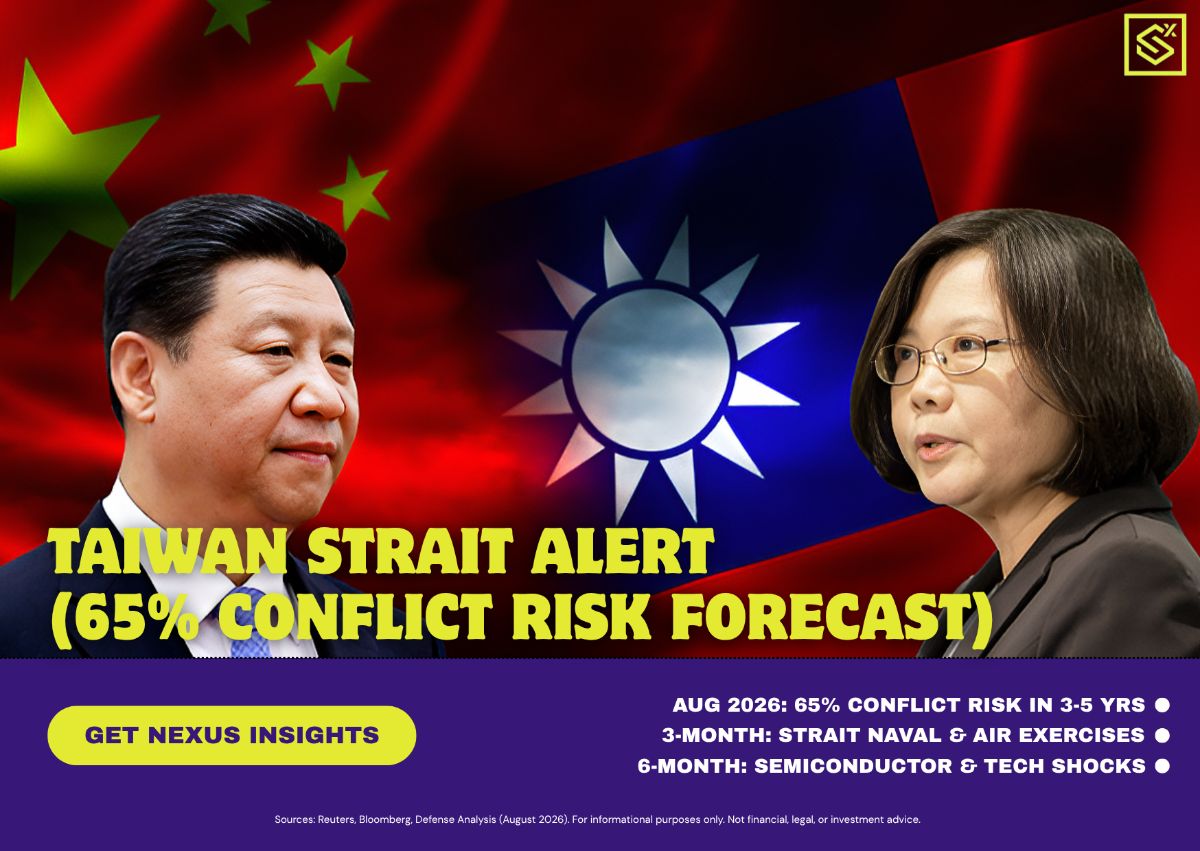
Geopolitical risk tracking within modern financial markets relies on synthesizing military preparations and strategic declarations into actionable metrics. The SaPEX NEXUS Geo Risk AI model recently updated its evaluation, assigning a sixty-five percent probability to a major military conflict involving China and Taiwan within a three to five year timeline. Classified under a critical severity rating in the platform Prediction Arena tracker on August 10, 2026, this metric reflects a notable shift in strategic baseline expectations. For traders and institutional portfolio managers, a probability score above sixty percent in a critical conflict category represents a structural threshold requiring integration into multi-year asset allocation models.
Probabilistic forecasting tools on trading platforms do not treat conflict as an inevitability, but quantify how military deployments and political posture align relative to historical baselines. In this assessment, the model evaluates Beijing's stated goal of forced unification alongside observable hardware accumulation to gauge real-world readiness. A timeframe extending across three to five years suggests that while immediate kinetic activity is not deemed imminent in the immediate weeks, the multi-year trajectory points toward heightened strategic vulnerability. Traders monitoring macro risk factors must understand that probabilities of this magnitude typically cause continuous risk-premia repricing long before any physical event takes place.
When a geopolitical metric enters a critical probability band, capital markets historically build systemic buffers across dependent sectors. Rather than waiting for formal conflict initiation, institutional capital shifts gradually away from localized equity exposure toward defensive sovereign debt and alternative supply chains. Recognizing how these platform probability scores are constructed enables market participants to differentiate between short-term diplomatic noise and sustained structural escalation over multi-year horizons.
Observational Signals and Simulation Evidence
The empirical foundation behind the sixty-five percent rating stems from several convergent observation vectors tracked across defense and security databases. Primary among these indicators is Taiwan's recent execution of a large-scale military simulation designed specifically to replicate defense responses against a hypothetical Chinese attack. This extensive exercise underscores a growing institutional conviction within Taipei that offensive ambitions from mainland China are intensifying. By running detailed defense scenarios, military planners in Taiwan are actively testing societal resilience, civil defense protocols, and critical infrastructure endurance against aggressive military force.
Complementing Taiwan's internal defense preparations are continuous operational maneuvers executed by mainland forces near the island. The Prediction Arena tracker highlights consistent People's Liberation Army air and naval incursions crossing baseline defense zones as key tangible evidence. These persistent incursions allow forces to gather intelligence while normalizing a persistent military presence around Taiwan. When combined with Beijing's consistent One China policy and ongoing broad-based military buildup, these physical incursions demonstrate a structured pattern of escalating preparation rather than mere diplomatic posturing.
In quantitative risk modeling, repetitive military incursions act as high-frequency inputs that continuously elevate baseline friction scores. As naval and aerial sorties increase in frequency, the margin for error diminishes, creating elevated probabilities for miscalculation or unintended operational triggers. Market participants must monitor these operational exercises, as sustained military pressure gradually erodes regional commerce stability and increases maritime transit insurance costs across adjacent trade lanes.
Potential Escalation Paths from Blockade to Action
Understanding how a theoretical risk translates into concrete market outcomes requires analyzing the specific operational mechanisms through which forced unification might be attempted. China's stated primary purpose centers on asserting complete sovereignty and regional dominance through the forced unification of Taiwan with mainland China. To achieve this objective within the projected three to five year window, military planners consider multiple escalation pathways. The intelligence data points toward a spectrum of potential actions, with a maritime blockade or targeted limited military action representing high-probability intermediate steps prior to or alongside a full-scale invasion.
A maritime or aerial blockade represents a particularly potent disruption mechanism because it directly targets Taiwan's connectivity with global commercial networks without necessarily requiring immediate amphibious landings. By restricting maritime access, an escalating power can test international resolve and create severe domestic economic strain while maintaining operational flexibility. Conversely, a limited military strike might target specific defense installations to degrade command infrastructure. While a full-scale invasion remains a tangible and high-risk scenario, intermediate measures like blockades are frequently evaluated as adaptable strategic tools.
For global investors, each step along this escalation pathway carries a distinct market impact profile. An economic blockade immediately halts commercial shipping traffic and interrupts just-in-time manufacturing schedules, whereas limited kinetic strikes trigger instantaneous spikes in global commodity pricing and cross-border currency volatility. Evaluating these distinct potential mechanics allows market participants to map out scenario-specific hedging strategies long before physical disruptions reach full intensity.
Semiconductor Supply Chains and Economic Transmission
The economic transmission channels of a potential Taiwan conflict are uniquely severe due to the island's central position in global manufacturing and technology supply chains. Taiwan is the world's primary manufacturing hub for advanced semiconductors, producing microchips essential for modern computing, automotive electronics, telecommunications, and artificial intelligence infrastructure. Per the market impact assessment provided by the SaPEX NEXUS analytics engine, any physical interruption or maritime blockading of Taiwan would inflict catastrophic damage on global supply chains, precipitating a severe global economic recession.
The vulnerability of advanced technology networks lies in their extreme concentration and lack of immediate redundancy. Replacing lost semiconductor manufacturing capacity requires multi-year capital investment, specialized equipment, and highly skilled engineering talent, meaning production losses cannot be offset by alternative regions in the short term. Consequently, a prolonged interruption would trigger severe production halts across the global technology sector, forcing down earnings expectations and leading to massive sell-offs across equity markets. Shipping sectors would similarly face severe operational gridlock as vital East Asian shipping lanes become restricted.
When advanced manufacturing supply chains experience a structural shock, downstream economic consequences ripple rapidly through peripheral industries. Consumer electronics, industrial automation, and automotive manufacturing would experience severe component shortages, leading to widespread operational shutdowns and reduced output worldwide. The compounding effect of supply destruction and reduced industrial output is the classic trigger for a severe global recession, characterized by declining gross domestic product across major developed and emerging economies alike.
Strategic Market Positioning and Volatility Dynamics
Financial market responses to critical geopolitical events are rarely linear, often transitioning rapidly from muted concern to extreme volatility as key threshold events materialize. The platform prospective impact assessment highlights the likelihood of extreme market volatility across asset classes, with pronounced structural weakness in technology equities and shipping sectors. Simultaneously, energy markets face potential price spikes driven by rerouted tanker traffic, altered regional demand patterns, and broader geopolitical instability affecting global energy transit routes.
During periods of heightened geopolitical probability, risk management protocols dictate a re-evaluation of portfolio leverage, counterparty exposure, and liquidity reserves. Traders evaluating a sixty-five percent risk projection over a three to five year horizon must consider how systemic risk factors interact across derivative markets. Implied volatility options skew typically steepens, reflected in higher premiums for downside protection on tech-heavy equity indices and specialized logistics funds. Managing risk effectively under these conditions involves stress-testing portfolios against multi-month supply chain freezes, sharp interest rate adjustments, and abrupt capital shifts into safe-haven assets.
By tracking probabilistic risk metrics like those calculated by the SaPEX NEXUS Geo Risk AI engine, market participants gain clear analytical visibility into evolving geopolitical dynamics. While predictive metrics highlight possibility rather than absolute certainty, quantifying critical risks allows institutional and retail traders to build disciplined risk mitigation strategies. As military buildup and strategic simulations continue in the region, staying informed through structured data platforms remains essential for navigating complex global markets.
1. SaPEX NEXUS Secret Intelligence Analysis Engine. Internal analysis compiled Aug 10, 2026.
2. See our Methodology and Risk Disclosure pages for more on how these figures are derived. This article is for informational purposes only and does not constitute financial, legal, or investment advice.