Afghan Resistance Intelligence Model Signals Rising Geopolitical Risk
Evaluating the Latest Covert Intelligence Assessment
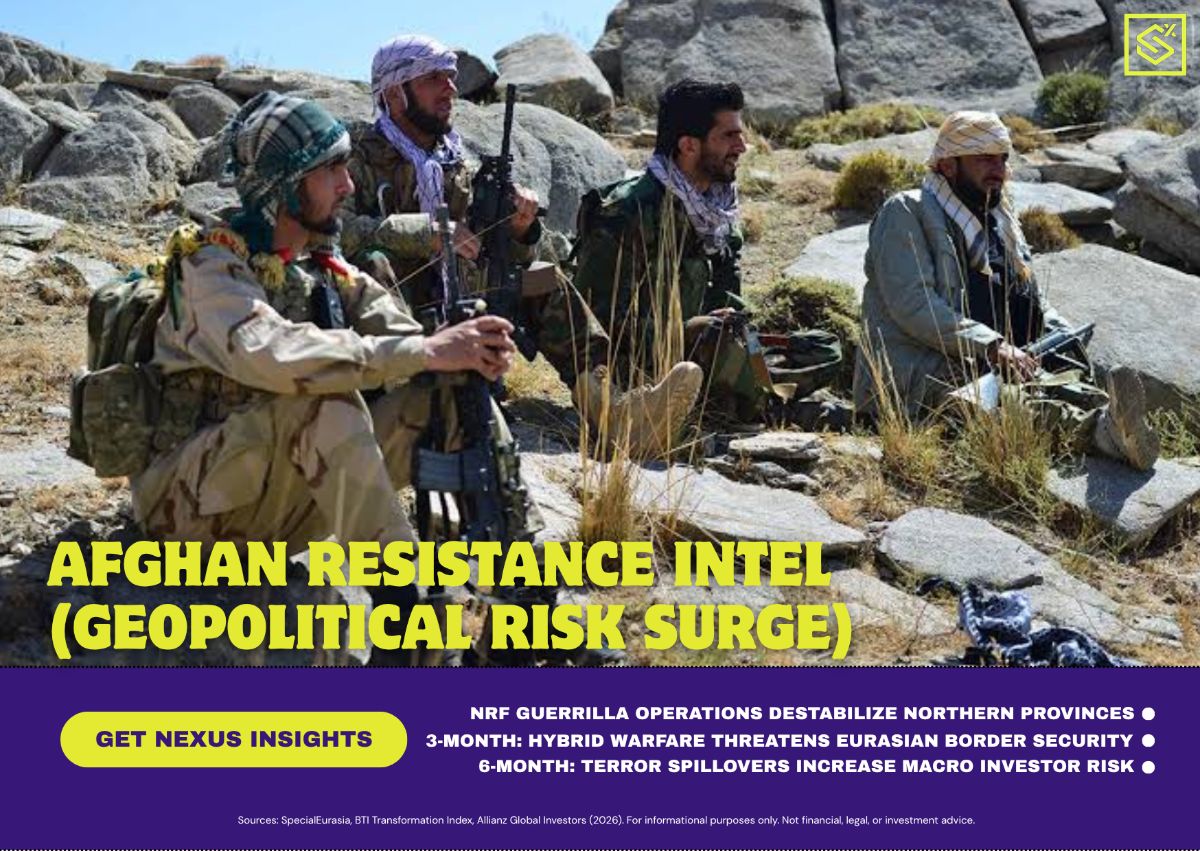
Today, quantitative data logged in SaPEX NEXUS indicates an elevated probability regarding covert intelligence dynamics in Central Asia. Specifically, the SaPEX NEXUS Geo Risk AI model assigned a 70 percent probability score to covert operations involving external actors supporting Afghan resistance groups. The assessment highlights that foreign intelligence agencies, likely including the CIA, MI6, and various regional intelligence services, may be providing clandestine support to nascent opposition movements to pressure the Taliban regime in Afghanistan.
This intelligence assessment was generated today, August 15, 2026, marking exactly five years into the Taliban rule following the withdrawal of international forces. The intelligence entry classifies the threat severity as high, reflecting the potential for covert maneuvers to disrupt existing political and security structures across the broader region. Rather than indicating direct conventional military intervention, the data model points toward an asymmetric proxy strategy. Clandestine backing serves as a low-visibility mechanism aimed at gradually eroding authority without incurring the massive political, logistical, and economic costs associated with full-scale external deployment.
For traders and financial market participants, probabilistic modeling of this nature provides an essential early indicator of shifting macroeconomic and geopolitical friction. Risk metrics generated by predictive engines like the SaPEX NEXUS Geo Risk AI model are interpreted as dynamic risk indicators rather than deterministic operational guarantees. A 70 percent probability score signifies that multi-factor evidence strongly aligns with historical operational signatures, suggesting that active monitoring of regional asset classes, energy corridors, and currency markets is fully warranted.
Internal Fragilities and Foreign Strategic Objectives
The core thesis captured by the Prediction Arena tracker focuses on the internal vulnerabilities within the current administration in Kabul. Despite five years of consolidated control, the Taliban regime faces persistent structural challenges including widespread internal dissent, economic strain, severe governance issues, and an ongoing humanitarian crisis. These structural weaknesses create fertile ground for external intelligence services to exploit existing tribal divisions, localized grievances, and political fractures.
The strategic purpose behind these alleged covert efforts encompasses several distinct geopolitical goals. Primary among them is preventing the country from serving as an unhindered sanctuary for international terrorist organizations. Additionally, external powers seek to counter competing regional rivals while potentially fostering conditions for a more internationally compliant governing structure over time. By leveraging local resistance groups, foreign entities attempt to achieve strategic objectives while minimizing their own direct operational footprint and open military exposure.
In quantitative financial analysis, assessing political fragility relies on evaluating how internal dissent interacts with external leverage and funding channels. When internal economic conditions deteriorate and social stress increases, the cost of maintaining a unified national security apparatus rises significantly. This makes local factions far more receptive to external financial and logistical assistance. Market analysts closely monitor these structural pressure points because sudden regime instability in landlocked operational hubs can rapidly spill over into neighboring economic systems, directly altering regional trade dynamics, sovereign risk profiles, and energy transit security.
Historical Dynamics and the Geopolitical Timeline
The timeline recorded in the platform data notes that covert activity is already active, with the potential for noticeable escalation developing within a one to three year horizon. Historical patterns in Central and South Asia demonstrate that proxy conflicts rarely remain contained within narrow chronological windows. Instead, covert assistance programs typically follow multi-phase operational arcs, moving from initial logistical establishment and intelligence gathering to active coordination and eventual open regional confrontation.
Historically, regional proxy engagements in this geographic zone have involved prolonged periods of low-intensity operational buildup before manifest market impacts become visible. External powers historically utilize well-documented playbooks, establishing covert communication links, supplying non-lethal and financial resources, and coordinating with localized opposition networks. Understanding this historical context helps traders evaluate the pace at which geopolitical risk translates into real-world asset pricing. An escalation timeline spanning one to three years suggests that market impacts may manifest gradually over extended market cycles rather than as an immediate, isolated price shock.
The data framework categorizes the current state not as a sudden crisis that emerged overnight, but as an evolving structural posture. With the five-year mark of Taliban rule reached today, the persistence of internal friction indicates that baseline regional stability remains fundamentally fragile. Trackers within the platform continuous monitoring suite update these timeline projections as new operational indicators emerge, allowing market participants to adjust long-term portfolio hedging strategies accordingly.
Market Implications Across Commodities and Defense
The primary market impact highlighted by the SaPEX NEXUS analytical engine centers on broad regional instability, potential surges in refugee flows, heightened volatility in regional commodity markets, and increased defense spending among neighboring nations. Central Asia sits adjacent to crucial transit corridors for global energy products, including vital oil and natural gas pipelines that supply major consumer markets across Asia and Europe. Any heightened instability that threatens surrounding infrastructure can introduce substantial risk premiums into global energy pricing.
Neighboring countries facing heightened security risks and potential border spillovers typically respond by expanding national defense budgets and reinforcing border security infrastructure. This systemic shift in fiscal allocation often boosts long-term revenue expectations for major defense contractors and aerospace manufacturing entities. Concurrently, increased defense spending can alter regional fiscal balances, directly influencing sovereign debt valuations, credit spreads, and foreign exchange rates for nations bordering the conflict zone.
Furthermore, potential disruptions to regional trade routes can impact localized transport equities and agricultural commodities. When geopolitical friction destabilizes vital overland trade hubs, regional supply chains experience bottlenecks, raising transport costs, elevating insurance premiums, and delaying delivery schedules. Financial models incorporate these interconnected factors by adjusting volatility expectations across energy futures, agricultural contracts, and regional equity indexes to reflect broader tail risks.
Risk Management Frameworks for Volatile Scenarios
Navigating geopolitical risk requires a structured analytical framework that balances speculative intelligence signals against concrete market execution. Platform tools like the Prediction Arena tracker provide continuous updates to help traders contextualize probabilistic events within broader cross-asset portfolio strategies. Because covert operations are inherently opaque and confidential, financial asset pricing often lags behind real-world covert developments until visible operational disruptions or diplomatic friction occur.
Traders utilizing this platform data typically deploy robust cross-asset hedging techniques to mitigate potential tail risk. This includes maintaining exposure to traditional safe-haven assets, such as precious metals and foreign reserve currencies, while adjusting position sizing in volatile commodity markets. Monitoring real-time probability shifts in the SaPEX NEXUS Geo Risk AI model allows market participants to scale tactical hedges dynamically as underlying risk metrics escalate or subside over time.
Ultimately, evaluating intelligence data within a trading environment is an exercise in risk management rather than pure directional prediction. By analyzing the direct intersection of covert intelligence indicators, regional economic dependencies, and historical conflict patterns, investors can better prepare for potential market disruptions. Maintaining a disciplined, systematic approach to portfolio exposure ensures that market participants remain resilient against sudden shifts in the global geopolitical landscape.
1. SaPEX NEXUS Secret Intelligence Analysis Engine. Internal analysis compiled Aug 15, 2026.
2. See our Methodology and Risk Disclosure pages for more on how these figures are derived. This article is for informational purposes only and does not constitute financial, legal, or investment advice.