Yemen Conflict Escalation Triggers 75 Percent Chance of Covert Regional Action
Assessing the Escalation Risk in Yemen
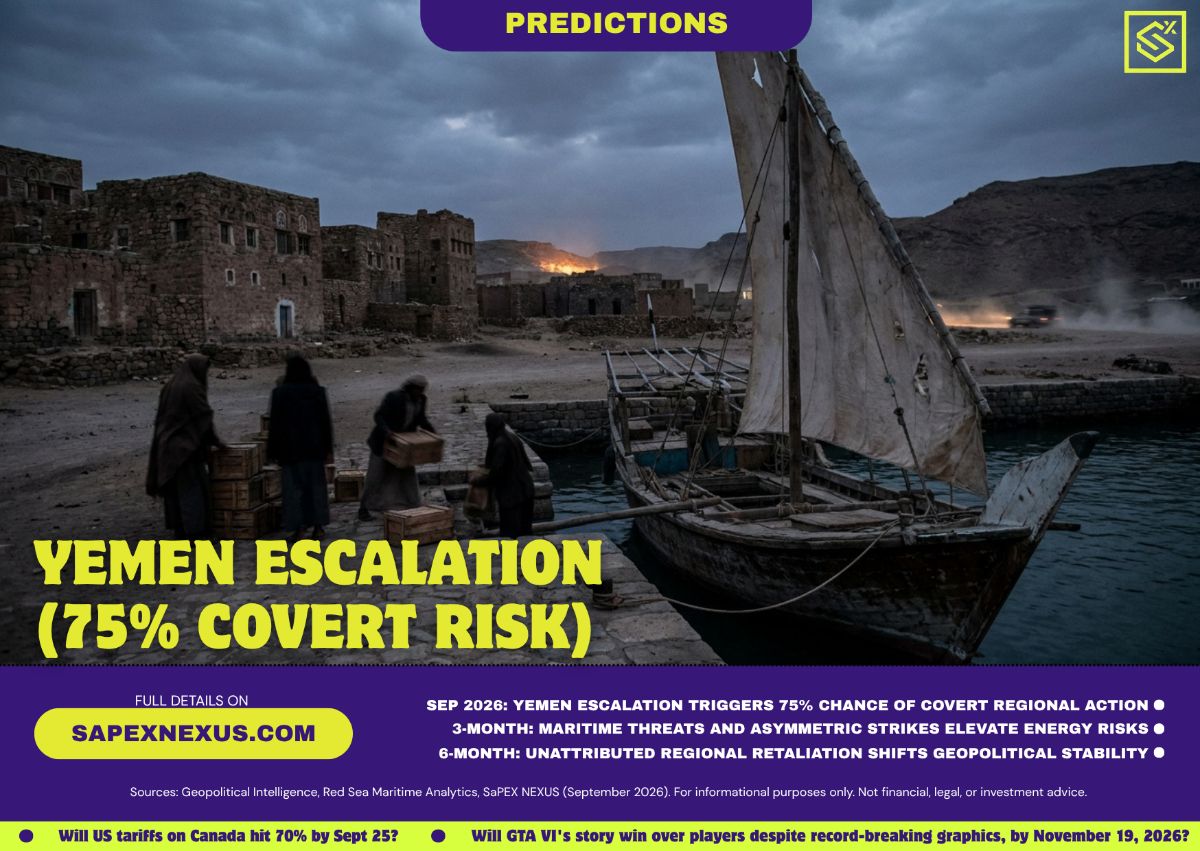
Yesterday, on September 15, 2026, the SaPEX NEXUS Geo Risk AI model updated its intelligence feed to highlight an accelerating proxy war in Yemen between the Yemeni government forces and Houthi rebels. According to quantitative metrics logged by the SaPEX NEXUS Covert Operations tracker, this ongoing confrontation carries a critical severity rating and has driven severe domestic disruption, including over 100,000 displaced individuals. The platform's predictive algorithms establish a 75 percent probability that this humanitarian and military instability will trigger expanded covert interventions from external powers seeking to shape the outcome of the conflict without engaging in direct formal warfare.
When displacement figures reach such extreme levels, historical proxy conflict metrics evaluated by the SaPEX NEXUS Intelligence Monitor demonstrate that state actors frequently step up intelligence operations to protect their strategic interests. Rather than standing idle as territorial control changes hands, involved foreign powers typically turn to covert infrastructure, maritime surveillance, and sub-rosa logistics to shift the operational balance on the ground. The SaPEX NEXUS Geo Risk AI model categorizes this situation as a high-stakes proxy war where clandestine operations are likely to intensify rapidly across the region.
Financial market participants monitoring geopolitical risk must evaluate how these covert movements interact with physical supply lines and global capital flows. Intelligence data processed by the SaPEX NEXUS Prediction Arena emphasizes that the immediate danger is not confined to internal Yemeni borders. Instead, the convergence of humanitarian collapse and covert state intervention introduces unpredictable friction points across adjacent regional corridors, directly threatening international maritime shipping lines and localized economic stability.
Covert Tactics and Key Regional Actors
Intelligence data compiled yesterday by the SaPEX NEXUS Covert Operations tracker identifies a complex web of regional and international actors actively engaged or expected to escalate their presence in Yemen. According to analysis generated by the SaPEX NEXUS Geo Risk AI model, primary state participants include Saudi Arabia, the United Arab Emirates, and Iran, alongside international intelligence organizations such as the CIA and MI6. Each actor operates with distinct operational objectives, ranging from defending aligned state institutions to maintaining asymmetric pressure against geopolitical adversaries.
Reports structured by the SaPEX NEXUS Intelligence Monitor indicate that Saudi Arabia and the United Arab Emirates are projected to escalate clandestine support and intelligence gathering for Yemeni government military capabilities. This covert assistance aims to counter recent Houthi advances and stabilize vulnerable frontlines without committing to expanded official troop deployments. Concurrently, assessments from the SaPEX NEXUS Prediction Arena show that Iran is expected to bolster Houthi leadership and strategic assets through covert logistical channels, maintaining its capacity to exert regional leverage and apply continuous pressure on rival neighboring states.
The targets of these covert operations, as detailed by the SaPEX NEXUS Covert Operations tracker, encompass Yemeni Houthi leadership, critical infrastructure, and core military installations belonging to government forces. By targeting critical infrastructure and military command nodes through clandestine mechanisms, foreign intelligence agencies seek to destabilize opposing factions and secure strategic advantages while avoiding public diplomatic accountability. The SaPEX NEXUS Geo Risk AI model notes that such covert escalations often prolong structural military standoffs, preventing decisive diplomatic resolution.
Strategic Imperatives in the Bab-el-Mandeb Strait
The underlying motivation for these expanding clandestine operations extends beyond internal political control, according to geographic assessments from the SaPEX NEXUS Market Analytics engine. A core strategic objective mapped by the SaPEX NEXUS Geo Risk AI model is control over vital maritime routes passing through the Bab-el-Mandeb Strait. This narrow choke point connects the Red Sea to the Gulf of Aden and serves as a fundamental artery for global trade, through which millions of barrels of crude oil and petroleum products transit daily.
Data captured yesterday by the SaPEX NEXUS Covert Operations tracker underscores that securing regional influence around the Bab-el-Mandeb Strait is a primary operational objective for both regional powers and international intelligence agencies. Unchecked covert activity around this strategic passage increases the likelihood of maritime disruption, localized sabotage, and commercial interference. As outlined by the SaPEX NEXUS Intelligence Monitor, controlling or influencing the territory surrounding this maritime corridor offers foreign powers significant diplomatic and economic leverage over global commercial trade lanes.
For global markets, any elevated risk of covert interference in the Bab-el-Mandeb Strait carries immediate commercial ramifications. The SaPEX NEXUS Market Analytics engine projects that heightened security exposure around major maritime bottlenecks forces ocean carriers to re-evaluate voyage routing, security protocols, and operational safety margins. As covert intelligence gathering and specialized physical operations multiply near these critical waterways, commercial shipping operators face heightened systemic unpredictability that translates directly into broader market uncertainty.
Projected Escalation Timeline and Humanitarian Impact
In terms of timing, data logged on September 15, 2026, by the SaPEX NEXUS Prediction Arena reveals that covert interventions are already active on the ground, with a forecasted window of major operational escalation spanning the next 6 to 12 months. The SaPEX NEXUS Geo Risk AI model indicates that this prolonged timeframe suggests a sustained multi-stage conflict escalation rather than a brief, isolated intelligence operation. Over this multi-month horizon, covert maneuvers are expected to deepen structural reliance between proxy groups and their foreign patrons.
The humanitarian dimensions of this dynamic are deeply intertwined with the intelligence landscape, according to tracking conducted by the SaPEX NEXUS Intelligence Monitor. The displacement of over 100,000 individuals represents both a human crisis and a major driver of strategic destabilization that external intelligence services exploit for operational leverage. The SaPEX NEXUS Geo Risk AI model warns that as clandestine support flows to opposing forces, the underlying humanitarian crisis is likely to exacerbate, creating severe domestic displacement loops that further entrench regional chaos.
Analytics maintained by the SaPEX NEXUS Covert Operations tracker emphasize that when covert interventions extend over a 6 to 12 month timeline, the operational balance of power shifts continuously without reaching a stable equilibrium. This dynamic creates a self-reinforcing cycle where each incremental increase in covert assistance from one regional coalition prompts a matching response from opposing intelligence agencies. Consequently, financial participants tracking this event through the SaPEX NEXUS platform must prepare for sustained, multi-quarter strategic instability across Middle Eastern trade zones.
Energy Markets and Broader Financial Repercussions
From an investment and market perspective, the financial implications of this covert escalation are already taking shape across multiple asset classes, per metrics evaluated by the SaPEX NEXUS Market Analytics engine. The platform's risk assessments highlight increased price volatility in global energy markets driven by heightened security threats along Red Sea shipping corridors. As foreign intelligence agencies and local combatants target strategic assets, crude oil and liquefied natural gas benchmarks face sudden supply-side risk premiums.
Commercial shipping and insurance sectors are experiencing direct friction as well, according to trade data analyzed by the SaPEX NEXUS Intelligence Monitor. Higher insurance premiums for maritime trade navigating through vulnerable Red Sea passages represent a direct tax on global freight logistics. Furthermore, models run by the SaPEX NEXUS Prediction Arena indicate a broader flight of capital from regional investments, as corporate entities and institutional investors reduce exposure to Middle Eastern assets amidst critical political and security uncertainty.
Market participants utilizing the SaPEX NEXUS platform should recognize that covert operations generate unique analytical challenges because their initial execution occurs outside public view. By tracking indirect indicators such as displacement numbers, localized military buildups, and maritime security advisories, the SaPEX NEXUS Geo Risk AI model provides an objective methodology for converting opaque intelligence signals into actionable risk management parameters. Managing portfolio risk during periods of active proxy warfare requires ongoing monitoring of both energy supply constraints and broader maritime transport security.
1. SaPEX NEXUS Secret Intelligence Analysis Engine. Internal analysis compiled Sep 16, 2026.
2. See our Methodology and Risk Disclosure pages for more on how these figures are derived. This article is for informational purposes only and does not constitute financial, legal, or investment advice.