US Rhetoric on Strait of Hormuz Signals Rising Military Conflict Risk
Assessing the Escalation Risk
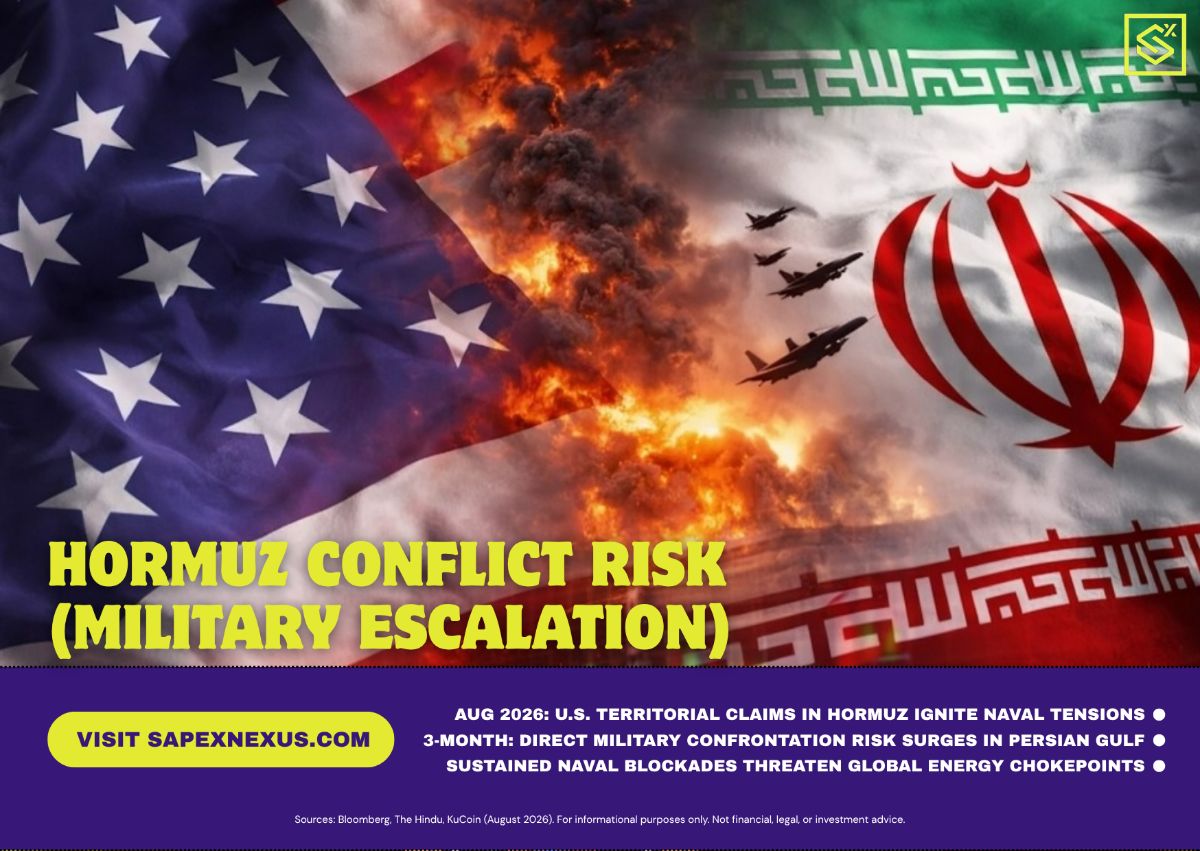
Today, automated monitoring from SaPEX NEXUS's Geo Risk AI model flagged a major shift in strategic risk assessments, placing a 65 percent probability on a direct confrontation between the United States and Iran over control of the Strait of Hormuz. The primary driver of this update involves explicit political rhetoric suggesting a potential assertion of American authority or control over the critical waterway. While analysts often characterize statements of this nature as rhetorical exaggeration, platform models evaluate such communication as a significant signal within a broader geopolitical environment characterized by persistent tensions and an absence of clear diplomatic resolution. The stated focal point of this developing situation centers on Iran's regional influence and its historic control over access to the Persian Gulf. In response to potential efforts aimed at restricting or aggressively monitoring maritime movement, Iranian military forces would almost certainly take defensive or counter-assertive measures, given their deep strategic interest in the waterway. The assessment categorized the overall severity of this geopolitical development at a critical level, reflecting the severe consequences that a direct naval encounter would produce across the region.
Strategic Importance of the Waterway
The Strait of Hormuz is widely recognized as the single most critical choke point in global energy infrastructure. Situated between Oman and Iran, the narrow channel connects the Persian Gulf with the Gulf of Oman and the Arabian Sea, serving as the essential transit route for a vast percentage of the world's seaborne petroleum exports. Because alternative bypass pipelines offer limited capacity relative to total regional production, any operational threat to free navigation through the strait presents immediate structural risks to global energy security. According to data tracked today in the system, the projected timeline for this potential military escalation spans a window of 6 to 18 months. Over this operational period, strategic objectives focus on applying maximum pressure against Iranian economic capabilities, disrupting petroleum export operations, and asserting maritime dominance throughout the Persian Gulf basin. In similar historical contexts, even informal threats of maritime closure or restricted passage have triggered immediate shifts in commercial shipping routes, increased transit times, and led to rapid adjustments in maritime insurance rates as underwriters recalibrate their risk exposure.
Market Impact and Economic Transmission
From a market perspective, a major escalation or military confrontation within the Strait of Hormuz acts as a severe macroeconomic shock across multiple asset classes. Platform analysis highlights that global oil prices would experience immediate and aggressive upward momentum, as market participants rush to price in potential supply shortfalls and delivery delays. Extreme surges in energy benchmarks historically spread rapidly through the broader economy, elevating production and transport costs for industrial sectors worldwide. When key energy inputs become significantly more expensive, consumer purchasing power contracts, raising the systemic probability of broader economic slowdowns or severe recessions in energy-importing nations. Beyond raw commodity pricing, the global logistics sector faces immediate structural strain. Commercial shipping operations must account for soaring bunker fuel costs alongside escalating war-risk premiums demanded by maritime insurers. When physical security in major shipping lanes is compromised, the broader supply chain experiences compounding delays, driving up freight rates and ultimately inflating consumer prices across diverse merchandise categories.
Analytical Framework and Methodology
To properly utilize probability metrics generated by systems like SaPEX NEXUS's Geo Risk AI, traders must understand the underlying methodology governing geopolitical risk quantification. Rather than attempting deterministic predictions, advanced risk platforms process continuous streams of structured indicators, including diplomatic statements, military movements, trade flows, and historical conflict dynamics, to yield dynamic probability scores. A 65 percent assessment indicates that conditions have crossed a major threshold where the likelihood of direct conflict outweighs baseline stability, converting geopolitical risk into a primary driver of asset pricing. Market participants routinely integrate these quantified risk metrics into algorithmic models, dynamic hedging strategies, and portfolio stress tests. By observing how probability scores fluctuate over time, institutional investors can systematically evaluate whether market prices adequately reflect underlying geopolitical exposure or whether asset classes are mispricing the potential for sudden disruption. This objective quantitative framework helps traders eliminate emotional bias during periods of intense media focus and geopolitical uncertainty.
Macroeconomic Implications and Global Trade
When high-severity geopolitical risks materialize along major maritime trade corridors, the macroeconomic consequences spill over well beyond energy markets into global monetary policy and trade balances. Major central banks frequently face complex policy dilemmas when energy-driven supply shocks occur. Rapidly rising energy prices push headline inflation upward, while simultaneously depressing overall economic growth by squeezing household budgets and corporate margins. In such stagflationary environments, traditional monetary policy tools become less effective, increasing market uncertainty across fixed income and equity markets. Furthermore, major industrial economies that rely heavily on energy imports often see their current account balances deteriorate rapidly as their fuel import bills expand. Conversely, net energy-exporting nations may experience temporary revenue windfalls, leading to rapid capital reallocations across international currency markets. Understanding these secondary and tertiary economic transmission channels allows investors to anticipate broader cross-asset re-pricings before they fully manifest in quarterly financial results and broad market indices.
Implications for Portfolio Management
For institutional traders and private investors monitoring updates from the Prediction Arena tracker, translating geopolitical risk assessments into actionable portfolio management requires a structured approach. When probability metrics point toward severe potential disruptions in critical maritime channels over a 6 to 18 month timeframe, market participants typically evaluate their net exposure across multiple asset classes. In equity portfolios, capital often rotates away from consumer-discretionary and transport-heavy sectors toward energy producers and defense contractors that may exhibit greater resilience during geopolitical friction. In fixed income and foreign exchange markets, traders closely monitor sovereign yield curves and safe-haven currencies, preparing for flight-to-quality flows if military tension escalates into physical engagement. By utilizing platform data as an objective baseline, investors can establish clear risk parameters, adjust position sizing, and implement tailored hedging strategies well before potential market dislocations occur, ensuring portfolio structures remain resilient against long-dated geopolitical risks.
1. SaPEX NEXUS Secret Intelligence Analysis Engine. Internal analysis compiled Aug 16, 2026.
2. See our Methodology and Risk Disclosure pages for more on how these figures are derived. This article is for informational purposes only and does not constitute financial, legal, or investment advice.