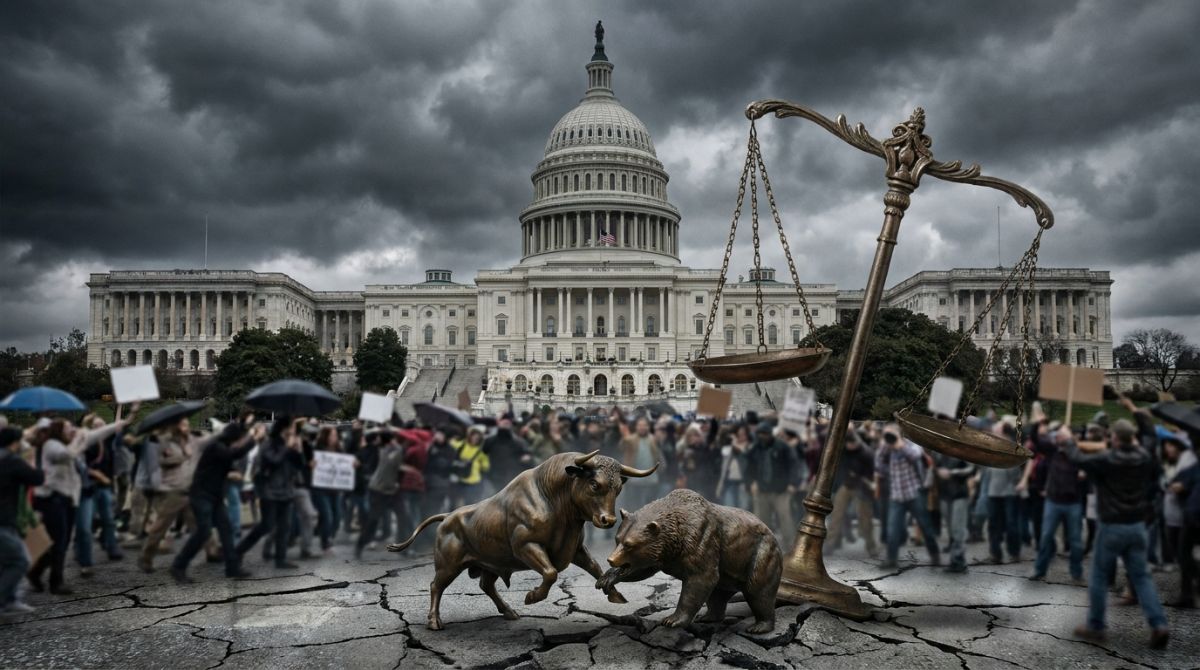
US Midterm Election Risks Point to Market Volatility Across Key Sectors
Midterm Outlook and Market Positioning
Two days ago, on October 06, 2026, data logged by the SaPEX NEXUS Geo Risk AI model flagged the upcoming United States midterm elections on November 3rd as a high severity event for global financial markets. According to the SaPEX NEXUS Geo Risk AI model, there is a 95 percent probability that this electoral cycle will introduce substantial shifts in domestic and foreign policy. As voters prepare to head to the polls, financial institutions and retail market participants are evaluating how changes in legislative power could affect presidential initiatives, specifically regarding the agenda of Donald Trump. The SaPEX NEXUS Risk Assessment Engine indicates that when control of Congress hangs in the balance, market participants frequently price in a wider distribution of potential policy outcomes.
The source analysis provided by the SaPEX NEXUS Intelligence Network stresses that the potential for political realignment creates an environment of heightened uncertainty. When congressional leadership changes, the likelihood of legislative gridlock increases significantly, directly altering the timeline and execution of federal programs. According to metrics tracked by the SaPEX NEXUS Prediction Arena tracker, geopolitical event risks rated at a high severity level historically correlate with elevated variance in broad market indexes. Market participants are watching closely as the November 3rd date approaches, seeking to position portfolios ahead of potential governance changes that could redefine fiscal priorities, international trade stance, and regulatory oversight.
Legislative Dynamics and Sector Sensitivity
The impact of these political developments is expected to reverberate across multiple specific corporate sectors. Per the SaPEX NEXUS Geo Risk AI model, seven core industries are positioned directly in the line of potential policy changes, including technology, manufacturing, finance, healthcare, energy, agriculture, and trade. According to sector risk evaluations generated by the SaPEX NEXUS Market Analytics platform, each of these fields possesses distinct exposure vectors to legislative activity. For instance, regulatory oversight in finance and healthcare often fluctuates dramatically depending on which party holds committee leadership, while energy and technology remain sensitive to antitrust enforcement and environmental policy mandates.
Manufacturing and agriculture face direct exposure to foreign trade policy and international tariff negotiations. As noted in assessments from the SaPEX NEXUS Risk Assessment Engine, changes in congressional oversight can modify funding allocations, tax incentives, and cross-border trade framework agreements. In the technology sector, pending policy debates regarding data privacy, international supply chains, and artificial intelligence safety could experience dramatic shifts in legislative momentum depending on election outcomes. The SaPEX NEXUS Intelligence Network reports that institutional capital allocation across these seven named industries often slows during the weeks immediately preceding a major midterm election, as fund managers await concrete legislative clarity before committing capital to long term ventures.
Short to Medium Term Volatility Vectors
In the immediate timeframe following the election, markets are likely to experience noticeable swings as traders process election results. According to the three month projection metrics maintained by the SaPEX NEXUS Risk Assessment Engine, immediate market volatility is expected as investors react to election returns and evaluate the practical implications for future policy and legislative priorities. Data from the SaPEX NEXUS Prediction Arena tracker highlights that equity indexes, currency pairs, and foreign exchange rates frequently reflect rapid realignments during the first ninety days post-election, particularly when early vote tallies lead to contested results or slim congressional margins.
Looking further along the timeline, the six month outlook generated by the SaPEX NEXUS Geo Risk AI model indicates an intensification of policy debates. According to this six month projection from the SaPEX NEXUS Geo Risk AI model, heightened political friction is expected to produce legislative stalemates or abrupt pivots in critical focus areas, including trade policy, healthcare regulation, and national infrastructure spending. As noted by the SaPEX NEXUS Market Analytics platform, prolonged legislative stalemates directly affect corporate earnings outlooks by creating capital expenditure delays and altering long term revenue projections for publicly traded firms operating in heavily regulated sectors.
Long Term Strategic and Regulatory Shifts
Extending the forecast horizon to twelve months, the political landscape for the remainder of the presidential term will become firmly established. Based on the twelve month trajectory detailed by the SaPEX NEXUS Intelligence Network, this post-midterm environment will set the political backdrop leading into the 2020 election cycle, continuously influencing long term investment decisions due to ongoing regulatory and fiscal uncertainty. According to the SaPEX NEXUS Risk Assessment Engine, persistent uncertainty over federal tax structures, federal spending programs, and regulatory agency appointments forces corporate leadership teams to adopt defensive financial strategies, including delaying major capital investments and increasing liquidity reserves.
On a long term horizon, the structural consequences of the November 3rd elections could alter global economic relationships. According to long term strategic models developed by the SaPEX NEXUS Geo Risk AI model, a fundamental shift in political power carries the potential to set an entirely new trajectory for United States domestic and foreign policy. The SaPEX NEXUS Market Analytics team notes that such shifts can rewrite global trade relationships, reshape international military and economic alliances, and alter global economic strategies for years to come. When domestic policy mechanisms stall or reorient, foreign trade partners and international capital markets must recalculate risk models to accommodate changing commercial realities.
Implications for Asset Classes and Market Participants
The broad spectrum of political possibilities creates targeted risks across specific asset classes. According to data published by the SaPEX NEXUS Geo Risk AI model, direct shifts in trade policy, fiscal spending, or regulatory oversight act as immediate primary catalysts for commodity prices and sovereign currency valuations. The SaPEX NEXUS Risk Assessment Engine observes that energy commodities, agricultural futures, and industrial metals display heightened sensitivity to political shifts due to their direct link to international trade treaties and domestic federal subsidies.
For equity investors, the combination of political gridlock and regulatory uncertainty generally induces caution across major market participants. Per evaluations from the SaPEX NEXUS Prediction Arena tracker, investor sentiment is expected to remain disciplined and risk-averse until official policy directions are established post-election. As outlined by the SaPEX NEXUS Intelligence Network, professional market participants utilize structured risk models during these transition periods to balance equity risk exposure, hedge against downside currency fluctuations, and identify relative value opportunities emerging from temporary sector mispricings. Understanding these fundamental mechanics enables market participants to navigate complex geopolitical landscapes with increased analytical clarity.
1. SaPEX NEXUS Research Team. Internal analysis compiled Oct 8, 2026.
2. See our Methodology and Risk Disclosure pages for more on how these figures are derived. This article is for informational purposes only and does not constitute financial, legal, or investment advice.