US-Iran Tensions Rise as MoU Expires: Assessing Strait of Hormuz Risk
Expiration of the Memorandum and Immediate Escalation
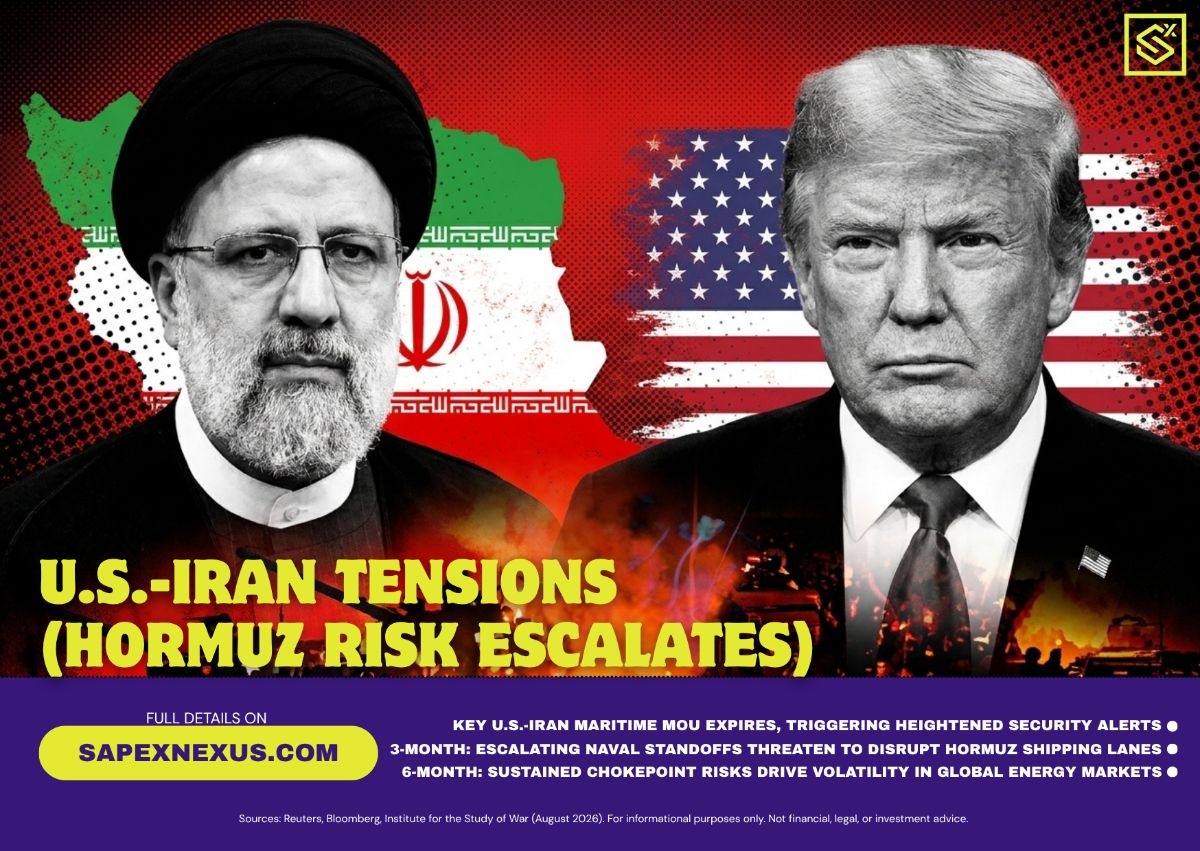
Yesterday, on August 18, 2026, the Memorandum of Understanding between the United States and Iran officially expired, marking a significant transition in geopolitical dynamics across the Middle East. Following the lapse of the agreement, public rhetoric from President Trump intensified, with statements demanding Iran's surrender and asserting United States authority over the Strait of Hormuz. According to analytical evaluations from SaPEX NEXUS's Geo Risk AI model, these developments have driven the estimated probability of conflict or major disruption in the critical maritime corridor to 70 percent, placing the event in the critical severity category.
The Strait of Hormuz serves as one of the world's primary energy transit chokepoints, handling a substantial share of daily global petroleum shipments. When agreements governing maritime stability or diplomatic channels expire without renewal, market participants routinely reassess the likelihood of physical supply interruptions. The transition from diplomatic engagement to active posturing creates immediate uncertainty for commercial shipping operators, energy producers, and international financial markets. While probabilistic indicators reflect heightened exposure rather than guaranteed military confrontation, the convergence of an expired framework and direct claims of territorial control alters baseline assumptions for global trade.
When analyzing geopolitical assessment scores from internal platform analytics, a 70 percent probability benchmark denotes a high likelihood of operational friction, heightened military posture, or localized trade impediments. Historical observations of similar geopolitical risk levels suggest that markets typically move from passive observation to active risk hedging. Understanding how these probability metrics function enables traders to distinguish between temporary verbal friction and structural shifts in regional stability, helping position portfolios before price movement fully materializes across interconnected asset classes.
Short-Term Volatility Across Energy and Financial Markets
The immediate market transmission of elevated geopolitical friction primarily affects energy commodities, foreign exchange markets, and risk assets. Internal tracking from the platform indicates that an escalation in the Strait of Hormuz typically triggers a rapid repricing of crude oil futures due to fear of immediate supply contraction. As risk aversion spreads through global exchanges, broad equity indexes face severe downward pressure, while capital flows rapidly into traditional safe-haven instruments such as gold and the United States dollar.
Foreign exchange dynamics during periods of heightened Middle Eastern tension demonstrate a pronounced divergence between currency pairs. The United States dollar tends to strengthen significantly against currencies of energy-importing nations and emerging market economies. Countries heavily dependent on external energy supplies face deteriorating trade balances as imported fuel costs rise, compounding downward pressure on their domestic currencies. Conversely, digital assets and cryptocurrency markets often display heightened volatility and overall downward pressure as broader institutional risk appetite contracts across global liquidity channels.
The multi-asset impact extends directly to equities tied to specific economic sectors. Industries such as airlines, global trade logistics, and consumer discretionary sectors face immediate headwinds from rising fuel expenses and broader macroeconomic uncertainty. On the other hand, defense contractors and domestic energy producers frequently see relative outperformance as market participants reallocate capital into sectors perceived as insulated from or beneficial to elevated security spending and higher benchmark energy prices.
Mid-Term Pressures on Shipping, Insurance, and Global Trade
Looking across a three-month operational window, the structural consequences of the expired agreement begin to manifest directly in maritime trade infrastructure. Internal analytical models project that oil prices will remain structurally elevated, driven not only by primary supply fears but also by friction within supply chains passing through the Persian Gulf. Commercial vessel operators navigating the Strait of Hormuz must account for escalating security concerns and operational adjustments, including altered routing protocols and slower transit speeds.
A major driver of increased operational costs during geopolitical standoffs is the insurance industry. Maritime underwriters rapidly adjust war risk premiums and cargo coverage rates for vessels transiting sensitive waterways. Higher insurance premiums directly inflate the total cost of delivered crude oil and liquefied natural gas, creating secondary inflationary pressures for destination markets worldwide. These compounding expenses ripple through global supply chains, increasing freight costs for general commercial shipping alongside primary energy commodities.
Over a six-month timeline, prolonged standoffs elevate economic pressure on energy-dependent national economies and increase the baseline risk of localized naval confrontations. Even minor incidents or brief maritime detentions can trigger sudden price spikes in energy markets, preventing normal risk premia from unwinding. As energy costs remain elevated over two consecutive quarters, corporate profit margins in energy-intensive industries experience sustained margin compression, influencing global earnings expectations and broader economic growth trajectories.
Long-Term Strategic Shifts and Supply Route Diversification
Looking further ahead to a twelve-month horizon, persistent geopolitical tension in the Persian Gulf acts as a catalyst for structural realignment in global energy trade and defense policy. Internal data synthesis suggests that nations vulnerable to supply interruptions will likely accelerate strategic initiatives to diversify energy sources and pipeline transit routes. Governments and state-backed energy enterprises routinely expand strategic petroleum reserves, invest in bypass pipelines, and seek alternative bilateral energy partnerships to reduce single-point dependency on the Strait of Hormuz.
Simultaneously, defense spending across the Middle East is expected to increase as regional powers and international coalitions reinforce naval deployments and coastal defense infrastructure. Elevated security expenditures alter national budget allocations and create prolonged procurement cycles for military hardware and surveillance technology. Furthermore, long-term policy responses may include the implementation of expanded economic sanctions against Iran, seeking to isolate its trade networks and constrain regional influence through regulatory and financial mechanisms.
Over a multi-year timeframe, these ongoing friction points fundamentally reshape global energy security strategies. A permanent increase in naval presence within the Persian Gulf establishes a higher baseline cost for maintaining maritime passage, while shifting regional trade alliances and security pacts. Energy importers structurally reduce their long-term exposure to volatile transit points, permanently altering trade flow patterns between producing nations and major industrial consumption centers across Europe and Asia.
Navigating Portfolio Risk in Geopolitical Uncertainty
For platform users evaluating these probabilistic data points, interpreting geopolitical indicators requires a disciplined approach to asset allocation and risk management. Rather than reacting to individual headlines or isolated statements, systematic traders monitor multi-factor risk scores, such as the 70 percent probability flag identified by SaPEX NEXUS, to evaluate cross-asset correlation shifts. Recognizing how energy surges interact with broader equity weakness, currency realignments, and insurance rate increases allows for proactive portfolio adjustment.
Sector-specific exposure management becomes vital during periods of critical geopolitical risk. While broad market indices may experience general drawdowns, targeted allocations across defense, safe-haven currencies, precious metals, and energy producers can provide structural balance against volatility in transport, airline, and broad retail equities. Monitoring timeline-based impact projections—from three-month operational cost increases to twelve-month structural realignments—helps traders separate transient price spikes from long-lasting macroeconomic trends.
Ultimately, navigating events following the expiration of diplomatic agreements requires continuous monitoring of objective metrics and verified data feeds. By tracking real-time risk scores, institutional market responses, and multi-horizon economic impacts through the platform's analytical tools, traders remain equipped to hedge potential downside risks while identifying emerging opportunities across energy, commodities, foreign exchange, and equity markets.
1. SaPEX NEXUS Research Team. Internal analysis compiled Aug 19, 2026.
2. See our Methodology and Risk Disclosure pages for more on how these figures are derived. This article is for informational purposes only and does not constitute financial, legal, or investment advice.