UAE Halts Trade with Iran as Geopolitical Pressure Escalates
UAE Halts Trade with Iran
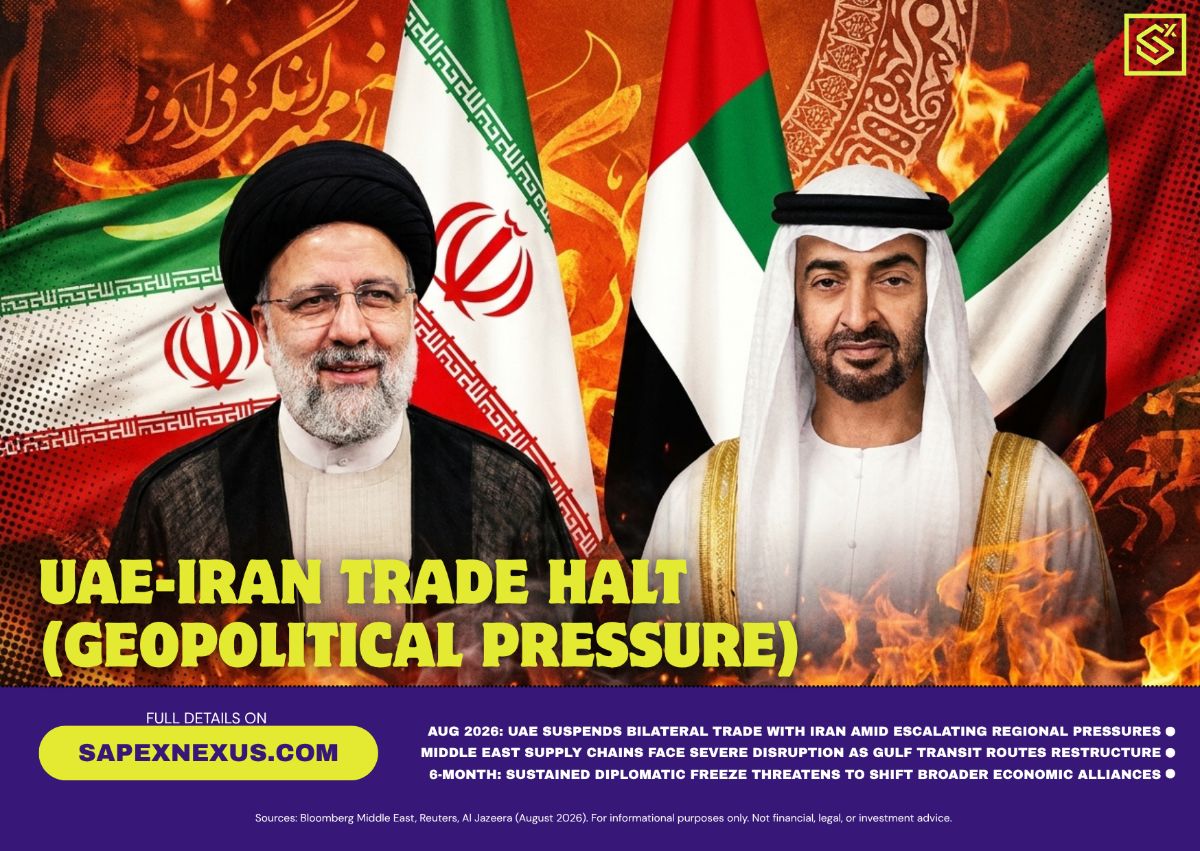
Yesterday, on August 19, 2026, data logged by the platform's Geo Risk AI model flagged a critical shift in Middle Eastern trade dynamics. According to the SaPEX NEXUS system, the United Arab Emirates reportedly terminated all trade and financial transactions with Iran. This development marks a significant escalation in regional economic pressure, particularly given that the UAE has historically functioned as Iran's second-largest trading partner. The shift coincides with intensified efforts by the United States to enforce unprecedented economic isolation on Tehran, following reports of Iranian missile strikes in the region.
The SaPEX NEXUS Geo Risk AI model currently assigns an 85 percent probability score to this critical event trajectory. For market participants, a disruption of this magnitude between key Middle Eastern commercial partners signals immediate structural shifts in energy distribution, maritime trade, and cross-border settlement channels. When major regional commercial hubs restrict transactional flows, the economic fallout rarely remains localized. Instead, the friction reverberates across global financial institutions, energy clearinghouses, and supply chain logistics networks.
Understanding the mechanics behind such an abrupt trade termination is crucial for assessing its broader market footprint. In international trade, the UAE has long served as a vital re-export hub and financial conduit for Iranian commerce. A total cessation of transactional activity effectively severs a major economic lifeline, forcing commercial entities to re-route capital flows or face severe regulatory penalties. As US-led diplomatic and economic measures converge with bilateral trade halts, global markets must recalibrate risk premiums across multiple asset classes.
Direct Impact on Key Global Sectors
The intelligence feed from SaPEX NEXUS highlights five primary sectors facing direct operational and financial disruption: Oil and Energy, Shipping, Finance, Defense, and Airlines. Each of these industries sits at the intersection of Middle Eastern logistics and global commodity clearing, making them particularly sensitive to abrupt policy shifts and heightened geopolitical friction.
In the Oil and Energy sector, supply uncertainty immediately translates into higher risk premiums for crude benchmark contracts. When a primary regional trading hub halts commerce with a major producer, energy traders must price in potential supply bottlenecks, sanctions enforcement friction, and prospective disruptions along export routes. Even without a direct physical reduction in crude output, the logistical burden of re-routing trade and securing compliant financial clearing creates structural upward pressure on crude prices.
The Shipping and Finance sectors face equal measures of friction. Maritime operators navigating regional sea lanes, particularly near strategic maritime bottlenecks like the Strait of Hormuz, face steep increases in hull and machinery coverage alongside surging war risk insurance premiums. Simultaneously, global financial institutions must navigate heightened compliance mandates. When trade halts occur under the threat of severe international sanctions, banks operating within regional financial centers typically freeze non-compliant credit lines and suspend clearing services to avoid secondary sanctions, further freezing commercial liquidity.
Near-Term Market Volatility and Asset Reallocation
The short-term horizon, covering the next three months, presents a landscape defined by market volatility and rapid capital reallocation. Per the Prediction Arena tracker, heightened geopolitical uncertainty typically triggers an immediate flight to quality among institutional investors. As risk aversion spreads through equities and regional assets, capital moves decisively into established safe-haven holdings, including the US dollar and physical gold.
Equity markets with high exposure to energy import costs or regional transport networks are especially vulnerable during these periods. Corporate earnings projections for airlines and logistics firms often contract rapidly when jet fuel prices spike and flight paths require rerouting around contested airspace. Conversely, defense contractors and domestic energy producers may experience defensive capital inflows as investors seek structural hedges against lingering regional instability.
Furthermore, regional currencies and emerging market assets frequently face mounting downward pressure during periods of acute geopolitical stress. Capital flight from perimeter markets into primary reserve currencies can tighten financial conditions globally, elevating borrowing costs and complicating debt service for vulnerable economies. As short-term uncertainty persists, energy prices are projected to remain elevated, acting as an implicit tax on global consumer demand and complicating central bank inflation management.
Medium to Long-Term Geopolitical Realignment
Looking beyond the initial three-month window, the six-to-twelve-month projections generated by SaPEX NEXUS indicate sustained structural pressure across regional trade networks and energy markets. Over a six-month timeframe, persistent economic isolation carries substantial potential to destabilize regional trade frameworks. Prolonged commercial restrictions increase the risk of asymmetric escalation, including cyber disruptions or localized maritime friction along critical global trade corridors.
Over a twelve-month evaluation period, the continued isolation of a major regional economy typically drives a fundamental realignment of trade partnerships and diplomatic alliances. Denied access to traditional commercial hubs and western-aligned financial centers, isolated states often seek alternative economic partnerships, attempting to establish parallel clearing channels and non-standard trade mechanisms. This dynamic accelerates the fragmentation of the global financial architecture, encouraging the creation of localized trade blocs and alternative currency settlement frameworks.
For energy markets, a twelve-month period of sustained geopolitical realignment ensures prolonged price volatility. Rather than settling into predictable trading ranges, energy contracts remain subject to sharp supply shocks driven by policy updates, sanction enforcement actions, and unexpected maritime disruptions. Supply chain managers are increasingly forced to prioritize supply security over cost optimization, leading to permanent structural shifts in global commodity flows.
Long-Term Structural Shift in Global Trade
In the long-term outlook, the systemic impact of severe trade halts extends far beyond temporary market fluctuations. As highlighted by the SaPEX NEXUS model, the permanent loss of established commercial conduits encourages a broader transition toward a fractured global economic system. Multi-national corporations and sovereign entities are increasingly forced to re-evaluate their reliance on volatile supply routes and concentrated regional clearing centers.
This long-term shift manifests in enhanced emphasis on supply chain redundancy, near-shoring, and secure trade corridors. While these structural adjustments build systemic resilience over time, they also introduce permanent friction into global commerce. Higher baseline operational costs, elevated insurance benchmarks, and fragmented regulatory environments become accepted structural norms for international traders.
Ultimately, the events flagged on August 19, 2026, serve as a stark reminder of how rapidly geopolitical policy can redefine global market dynamics. As the situation continues to unfold, market participants relying on platform risk metrics like SaPEX NEXUS can better evaluate the multi-layered impacts across asset classes. Tracking these interconnected shifts across energy, finance, and shipping remains essential for maintaining disciplined risk management in an increasingly complex global trade environment.
1. SaPEX NEXUS Research Team. Internal analysis compiled Aug 20, 2026.
2. See our Methodology and Risk Disclosure pages for more on how these figures are derived. This article is for informational purposes only and does not constitute financial, legal, or investment advice.