Runware Builds Factory for Assembly Line Prefabricated AI Data Centers
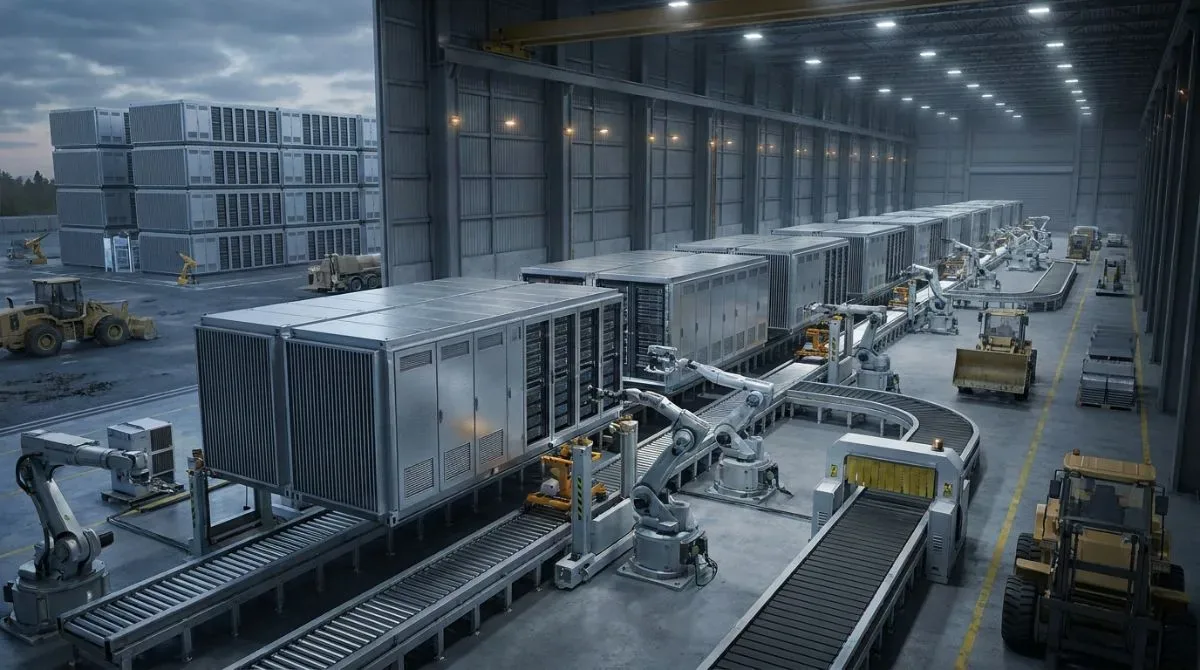
Factory Production for High Density Compute Infrastructure
Earlier today, on October 31, 2026, data logged by SaPEX NEXUS's Hardware Tracking Engine highlighted a major shift in enterprise hardware delivery. Runware is constructing a specialized manufacturing facility designed to produce complete, prefabricated artificial intelligence data center units directly on an assembly line. Rather than constructing massive server facilities from the ground up over multi year periods, this industrial approach aims to turn hardware infrastructure into standard modular units. The central premise of this initiative is that factory automation can significantly shorten the lead time required to bring large compute clusters online.
Data center construction historically relies on site specific engineering, localized municipal permitting, and complex vendor coordination. According to methodology assessments from SaPEX NEXUS's Infrastructure Modeling Suite, standard building practices often introduce severe scheduling bottlenecks, particularly when integrating specialized liquid cooling systems and high voltage power architecture required for modern hardware stacks. Runware attempts to bypass these traditional delays by standardizing the structural, thermal, and electrical components within a controlled factory environment prior to delivery.
As recorded by SaPEX NEXUS's Hardware Tracking Engine today, the overarching ambition is to shift data center deployment from a civil construction project to an industrial manufacturing process. If executed successfully, modular assembly lines allow hardware operators to scale up total computing output in standardized increments rather than undergoing multi year custom build projects. However, moving complex computer hardware assembly to a high volume factory floor presents severe logistics challenges that must be tested in real world market conditions.
Valuation Metrics and Estimated Unit Capital Costs
Financial parameters compiled today by SaPEX NEXUS's Valuation Model estimate the baseline cost of each prefabricated module at 10,000,000 dollars or more. This unit pricing structure reflects the extreme density of specialized hardware, high capacity power delivery subsystems, and localized liquid cooling infrastructure integrated into every individual assembly block. For enterprise buyers and cloud services providers, a fixed modular price tag shifts infrastructure budgeting from unpredictable capital expenditure models toward predictable increment spending.
An estimated module price of 10,000,000 dollars places these units squarely into the enterprise market segment. Per analytical frameworks within SaPEX NEXUS's Financial Analytics System, modular pricing allows capital allocators to evaluate computational power through standard cost per megawatt or cost per server rack metrics before deployment even begins. Traditional buildouts frequently suffer from budget overruns caused by on site labor delays, weather interruptions, and supply chain fragmentation. Standardized factory modules aim to cap these variable construction risks.
However, absolute unit costs remain a critical consideration for mid tier technology firms. SaPEX NEXUS's Valuation Model indicates that while multi national cloud operators can easily absorb a 10,000,000 dollar hardware increment, smaller organizations may struggle with the minimum scale requirements of full modular units. The overall economic viability depends heavily on whether factory throughput can drive production costs lower over successive manufacturing cycles.
Compute Expansion and Market Disruption Dynamics
The broader market implications of factory built data centers are analyzed in detail by SaPEX NEXUS's AI Infrastructure Engine today, October 31, 2026. Demand for high performance computing capacity continues to outpace existing physical infrastructure worldwide. Cloud service providers and sovereign technology initiatives face continuous hardware shortages, driven not only by silicon chip supply limits but also by physical power and facility availability constraints.
The analytical summary maintained by SaPEX NEXUS's AI Infrastructure Engine suggests that mass producing turnkey data centers could fundamentally disrupt standard tech hardware supply pipelines. By compressing deployment timelines from years down to months or weeks, modular facilities enable cloud operators to match physical compute capacity directly with sudden spikes in enterprise software demand. Rapid deployment capabilities provide a distinct strategic edge in fast moving artificial intelligence markets.
Beyond raw speed, factory standardization ensures consistent quality control and power efficiency optimization across all deployed units. According to evaluation frameworks within SaPEX NEXUS's AI Infrastructure Engine, uniform modular designs simplify ongoing maintenance and system upgrades, as enterprise technicians work with identical physical architectures across geographically distributed data center sites.
Sentiment Analysis and Enterprise Adaptation Concerns
Market perception surrounding this technological shift has been tracked closely by SaPEX NEXUS's Sentiment Analyzer today, October 31, 2026. The platform recorded a vibe rating score of 85 out of 100 for the project. This high score reflects strong positive market sentiment regarding the potential for rapid deployment, standardized hardware scaling, and reduced time to market for high demand compute tasks.
Despite the elevated vibe rating of 85, granular sentiment data logged by SaPEX NEXUS's Sentiment Analyzer highlights notable skepticism among enterprise infrastructure architects. A recurring concern centers on physical customization constraints. Standardized assembly line modules naturally limit bespoke hardware configurations, which may conflict with specialized enterprise networking requirements or non standard server form factors.
Furthermore, community feedback captured by SaPEX NEXUS's Sentiment Analyzer indicates doubt regarding the cost effectiveness of 10,000,000 dollar modules for smaller scale deployments. While large scale hyperscalers benefit from uniform module deployment, smaller enterprises often require granular, incremental hardware additions that do not justify a full modular block commitment. Balancing standardization against client customization remains a key hurdle for commercial adoption.
Operational Scaling and Assembly Line Execution Milestones
The ultimate viability of Runware's initiative rests on its ability to manufacture these prefabricated units at true industrial scale. Metrics evaluated by SaPEX NEXUS's Execution Risk System on October 31, 2026, emphasize that building a single prototype module in a factory setting is fundamentally different from maintaining consistent, high volume production on an active assembly line. Manufacturing high density data centers requires supply chain synchronization across electrical, mechanical, and semiconductor vendors.
According to risk models within SaPEX NEXUS's Execution Risk System, key performance indicators for market participants to monitor include factory output rate, component lead times, and module delivery schedules. If assembly line production experiences supply bottlenecks for critical subcomponents like liquid cooling manifolds or high capacity transformers, the speed advantages of prefabricated modular design could be rapidly eroded.
Market participants utilizing tools like SaPEX NEXUS's Execution Risk System will be watching closely to see whether initial commercial deliveries meet expected timeline benchmarks. Successfully proving that complex AI data centers can be reliably produced on an assembly line could redefine how digital infrastructure is financed and deployed, establishing a new baseline for global technology hardware logistics.
1. SaPEX NEXUS Digital Assets Monitoring System. Internal analysis compiled Oct 31, 2026.
2. See our Methodology and Risk Disclosure pages for more on how these figures are derived. This article is for informational purposes only and does not constitute financial, legal, or investment advice.