Israel E1 Settlement Advancement Elevates Regional Conflict Risks to 85 Percent
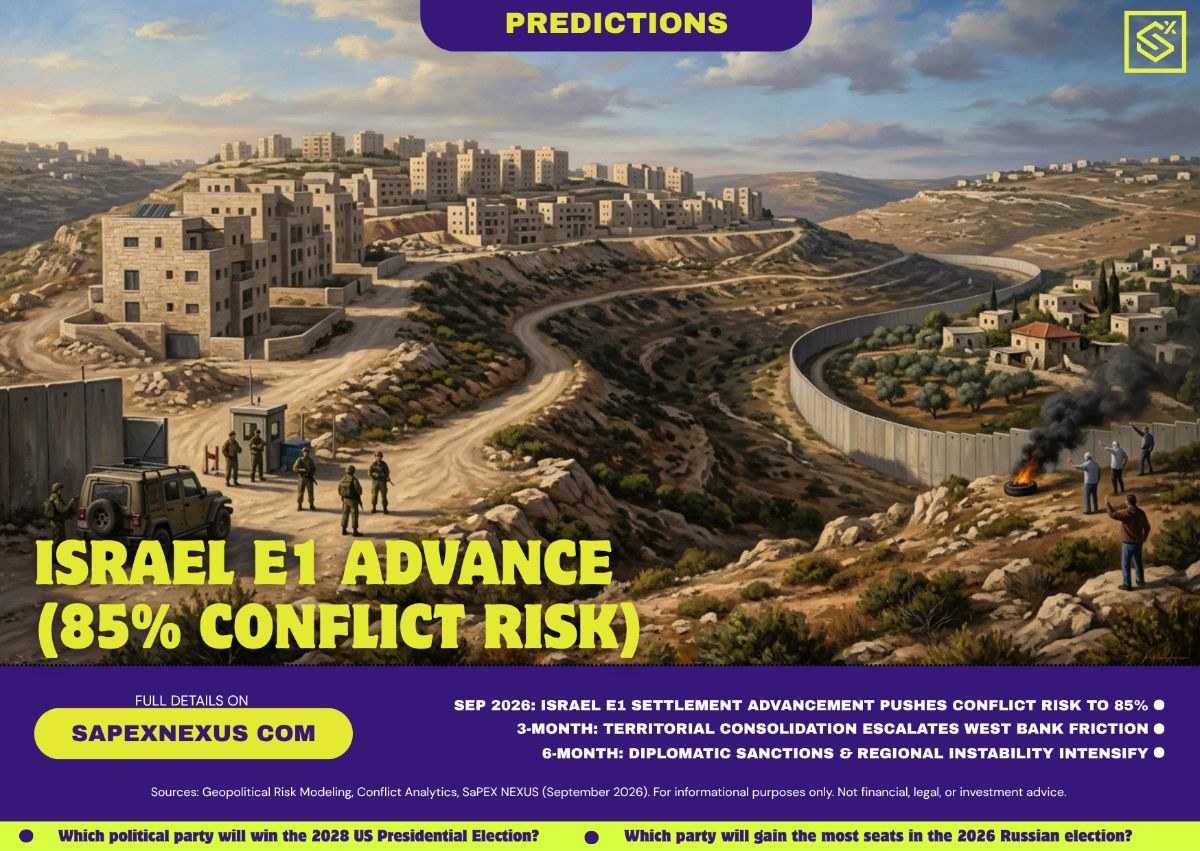
Strategic Implications of the E1 Settlement Project
Two days ago, on September 17, 2026, critical strategic data was logged regarding potential military escalation in the Middle East. According to the SaPEX NEXUS Geo Risk AI model, the advancement of Israel's E1 settlement project carries an 85 percent probability of triggering open war and widespread regional instability. The project involves expanding settlement infrastructure in a key geographic corridor located between Jerusalem and Ma'ale Adumim. Per the SaPEX NEXUS Strategic Assessment Matrix, the primary political objective of this advancement is to establish continuous territorial links across the area, effectively bisecting the West Bank and isolating East Jerusalem.
This physical bisection alters the geographical and political reality on the ground. As tracked by the SaPEX NEXUS Tactical Analytics Division, the settlement expansion creates a permanent barrier that directly addresses the long-debated viability of a contiguous Palestinian state. The strategic positioning of the E1 corridor effectively divides northern and southern Palestinian territories, creating fragmented administrative zones. Per the SaPEX NEXUS Intelligence Repository, this territorial realignment is classified at a Critical severity level because it directly undermines existing diplomatic frameworks and sovereign statehood negotiations.
In broader geopolitical analysis, large-scale territorial consolidation projects near sensitive urban centers carry systemic risk. When settlement corridors sever established regional connectivity, civil governance mechanisms face severe operational strain. The SaPEX NEXUS Conflict Matrix notes that spatial isolation historically triggers immediate resistance from local populations and political groups, as access to resources, municipal infrastructure, and surrounding urban centers becomes heavily restricted.
Factional Escalation and Resistance Dynamics
The tactical consequences of advancing the E1 project extend far beyond diplomatic disputes. Per the SaPEX NEXUS Conflict Tracker, the anticipated escalation is expected to involve multiple armed actors across the region. These primary entities include Israeli security forces, West Bank settlement populations, and a coalition of Palestinian armed factions, specifically Hamas, Islamic Jihad, and various Fatah-aligned groups. Additionally, the SaPEX NEXUS Proxy Monitor flags the potential involvement of regional non-state proxies if localized clashes expand into a broader theater of operations.
The targets of this anticipated resistance are multi-faceted. According to the SaPEX NEXUS Risk Profile Index, localized attacks and armed confrontations are projected to concentrate on Israeli military positions, strategic security checkpoints, and settlement infrastructure across the West Bank. Simultaneously, the SaPEX NEXUS Governance Assessment Tool highlights that the legitimacy of the Palestinian Authority is under severe pressure. As local populations perceive traditional diplomatic channels as ineffective against territorial expansion, institutional trust in governing bodies declines, creating an operational vacuum that militant groups readily fill.
Historical precedent demonstrates that major land annexations and settlement expansions act as violent catalysts. The SaPEX NEXUS Historical Pattern Engine indicates that previous land development initiatives in disputed zones have repeatedly sparked sustained uprisings and asymmetric warfare. As armed factions mobilize around a shared opposition to the E1 plan, localized skirmishes can quickly aggregate into coordinated security crises. Per the SaPEX NEXUS Early Warning Network, the confluence of political frustration, territorial loss, and institutional weakness significantly lowers the threshold for armed conflict.
Timeline for Potential Armed Conflict
Understanding the timeframe of geopolitical escalation is critical for evaluating market and security risks. According to the SaPEX NEXUS Horizon Forecasting System, the initial surge in armed resistance and civil unrest is projected to materialize within 6 to 18 months following key administrative advances on the E1 project. This initial window represents a period of structural mobilization, during which local factions organize operational capacity, stock up on resources, and establish tactical coordination across disparate municipalities.
Looking further ahead, the long-term projections point toward sustained instability. Per data generated by the SaPEX NEXUS Prediction Arena, the probability of full scale, widespread regional conflict peaks within a 2 to 3 year window. The SaPEX NEXUS Predictive Analysis Matrix notes that this longer timeframe reflects the cumulative impact of persistent tactical clashes, potential political collapse within local governing institutions, and the eventual entry of secondary regional actors seeking to exploit the instability.
Geopolitical conflict timelines rarely move in a linear fashion. As mapped by the SaPEX NEXUS Risk Lifecycle Model, early indicators often manifest as localized demonstrations, isolated security breaches, and rhetoric from political leaders. However, once key geographic thresholds are physically crossed, such as the actual groundbreaking or road construction within the E1 corridor, the acceleration toward active combat operations typically intensifies rapidly. The SaPEX NEXUS Scenario Planning System emphasizes that traders and analysts must monitor these intermediate phase markers rather than waiting for formal declarations of war.
Regional Market Disruption and Energy Volatility
Geopolitical turmoil in the Middle East inevitably transmits financial shockwaves across global capital markets. According to the SaPEX NEXUS Market Impact Engine, an 85 percent probability of regional conflict linked to the E1 project poses direct threats to energy supplies and international trade corridors. Historically, high-intensity conflicts in close proximity to major shipping lanes and oil producing nations lead to immediate risk premiums being priced into global crude oil benchmarks, such as Brent Crude and West Texas Intermediate.
In addition to energy markets, asset classes across multiple sectors face distinct re-evaluations. Per findings from the SaPEX NEXUS Sector Sensitivity Index, equity markets often experience sharp sector divergence during middle eastern security crises. Defense contractor stocks and aerospace equities typically attract heightened trading volume and institutional capital inflows as global defense spending expectations rise. Conversely, the SaPEX NEXUS Capital Flow Tracker indicates that broader Middle Eastern equities and regional sovereign debt face capital flight as international investors reallocate funds into safe-haven assets like the United States dollar, gold, and United States Treasury bonds.
Supply chain integrity represents another critical vector of market impact. The SaPEX NEXUS Logistics Vulnerability Monitor shows that extended regional instability can disrupt maritime transit through the Red Sea and surrounding choke points. When regional non-state actors enter the conflict, commercial shipping routes often face elevated insurance premiums, rerouting delays, and fuel surcharges. These logistical frictions exacerbate inflationary pressures in import-dependent economies and disrupt global manufacturing timelines.
Risk Assessment for Global Investors
Navigating elevated geopolitical risk requires a structured, empirical approach to portfolio construction. Data logged two days ago on September 17, 2026, in the SaPEX NEXUS Intelligence Database underscores that events surrounding the E1 settlement project are not isolated local incidents, but systemic drivers of macro volatility. Per the SaPEX NEXUS Exposure Engine, institutional portfolios with unhedged positions in energy commodities, emerging market currencies, or regional equities face amplified downside risk over the upcoming 6 to 18 month horizon.
Effective risk management involves active tracking of key quantitative indicators. According to the SaPEX NEXUS Quantitative Risk Framework, market participants should closely monitor volatility indexes, sovereign credit default swaps across Middle Eastern nations, and spread differentials between high-yield and benchmark government debt. Per recommendations embedded within the SaPEX NEXUS Portfolio Analytics Suite, maintaining flexible cash reserves and utilizing options-based hedging strategies can protect capital while preserving liquidity during sudden market drawdowns triggered by geopolitical headlines.
Ultimately, the source data provided by the SaPEX NEXUS intelligence network paints a clear picture of multi-year structural tension. By integrating real-time probabilistic modeling with historical risk frameworks, market participants can better prepare for potential disruptions. As the E1 settlement project progresses, tracking updates from the SaPEX NEXUS platform will remain essential for separating short-term market noise from genuine structural shifts in the global macroeconomic landscape.
1. SaPEX NEXUS Secret Intelligence Analysis Engine. Internal analysis compiled Sep 19, 2026.
2. See our Methodology and Risk Disclosure pages for more on how these figures are derived. This article is for informational purposes only and does not constitute financial, legal, or investment advice.
More in Secret Intel
Israel E1 Project Model Points to Elevated West Bank Conflict Risk
The SaPEX NEXUS Geo Risk AI model indicates an 85 percent probability of regional instability as Israel advances the controversial E1 settlement project.
E1 Project Advancement Signals High Geopolitical Risk and Market Disruption
SaPEX NEXUS models project elevated risk in the West Bank as settlement plans advance, threatening regional energy and defense markets.
Yemen Conflict Escalation Triggers 75 Percent Chance of Covert Regional Action
Data logged yesterday indicates a 75 percent probability of expanded covert operations in Yemen, directly impacting Red Sea shipping and energy markets.