Iran Outlines War-End Conditions as Oil Breaks 100 Dollars Amid Escalation
Emerging Conditions and Market Immediate Reaction
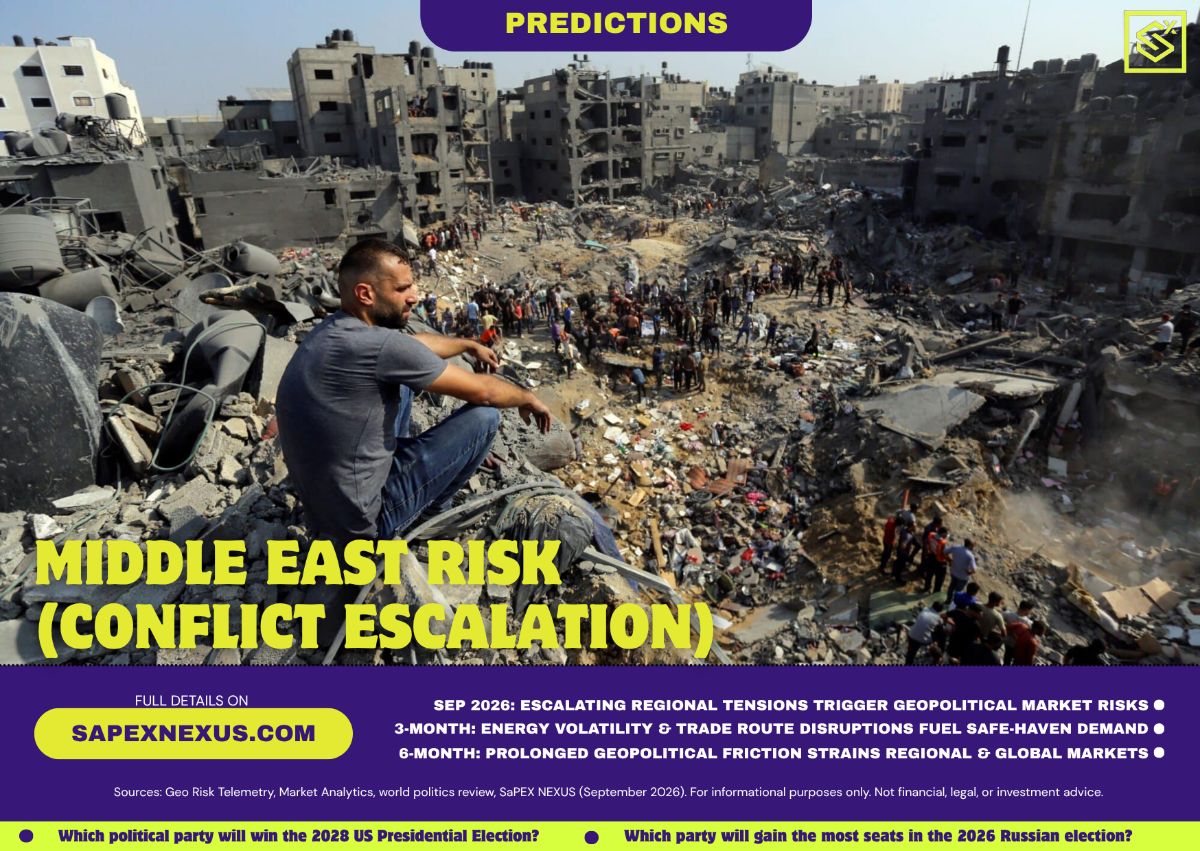
On September 20, 2026, Iran put forth a new set of conditions aimed at resolving its ongoing conflict with the United States, according to data processed by SaPEX NEXUS's Geo Risk AI model. This diplomatic proposal arrives during a period of acute escalation across the Middle East, an environment that the SaPEX NEXUS Severity Index currently categorizes as Critical. The immediate financial reflex across global capital markets has been swift and severe, with global crude oil prices breaking above the 100 dollar per barrel threshold on September 20, 2026, as tracked directly by the SaPEX NEXUS Commodities Monitor.
The emergence of these negotiation parameters marks a pivotal moment for international markets, which have been pricing in elevated risk premiums across multiple asset classes for several weeks. Analysis from the SaPEX NEXUS Prediction Arena tracker assigns a 75 percent probability to the continued relevance and market-moving impact of these war-end conditions. As global market participants digest the specific details of the Iranian proposal, energy pricing remains exceptionally sensitive, with the SaPEX NEXUS Energy Analytics model indicating that Brent crude benchmark prices could experience additional upward surges well beyond the 100 dollar level if diplomatic dialogue falters.
Understanding how these diplomatic terms interact with current market pricing requires evaluating both immediate sentiment and broader institutional liquidity flows. According to the SaPEX NEXUS Volatility Matrix, the rapid move in oil past 100 dollars reflects instant adjustments in derivative hedging strategies across major energy desks today, September 20, 2026. The response of international leaders to Iran's conditions will serve as the primary operational catalyst determining whether regional stability stabilizes or deteriorates further in the coming days, as highlighted by the SaPEX NEXUS Diplomatic Assessment Matrix.
Multi-Asset Volatility and Sector Vulnerabilities
The geopolitical shock wave is radiating through multiple global industries, with the SaPEX NEXUS Industry Exposure Tracker identifying six primary sectors facing immediate operational and financial disruption: Oil and Energy, Shipping, Defense, Airlines, Insurance, and Global Trade. Global equity markets are undergoing broad risk-off repositioning today, September 20, 2026, as reported by the SaPEX NEXUS Equities Monitor, with energy-intensive sectors and companies with direct Middle East exposure enduring substantial equity market downturns.
Cross-asset dynamics exhibit a classic safe-haven flight pattern across key financial centers, per findings from the SaPEX NEXUS Currency Intelligence System. The United States Dollar is experiencing notable strengthening against a broad basket of foreign currencies, while the national currencies of major oil-importing nations are facing selling pressure due to deteriorating terms of trade and higher energy import bills. Simultaneously, gold and other traditional safe-haven commodities are rallying as market participants seek shelter from equity market downside, according to the SaPEX NEXUS Safe-Haven Index.
Alternative financial markets are also displaying heightened sensitivity to these broader macroeconomic shifts, with cryptocurrency markets experiencing increased price volatility that directly mirrors broader risk-off sentiment in traditional finance, as observed by the SaPEX NEXUS Digital Asset Monitor. Meanwhile, specialized equity segments are displaying sharp divergence, with defensive equity sectors and defense contractors absorbing net portfolio inflows while global trade, transport, and airline shares face severe margin compression, based on metrics from the SaPEX NEXUS Sector Heatmap.
The Three-Month Outlook and Intermediate Risks
Looking ahead over a three-month horizon, the SaPEX NEXUS Horizon Monitor indicates that market uncertainty will persist as the international community continuously evaluates the viability and sincerity of Iran's war-end conditions. Energy prices are projected to remain at elevated levels throughout this entire quarterly period, as modeled by the SaPEX NEXUS Medium-Term Analytics Engine. The ongoing regional tension creates a persistent baseline risk premium that prevents energy markets from returning to historical price averages in the short term.
Maritime trade channels face compounding operational friction and logistical hurdles over this three-month window, according to data from the SaPEX NEXUS Freight Risk Tracker. Heightened security concerns across key Middle Eastern waterways are expected to push regional shipping costs significantly higher, as maritime transport operators incur elevated transit surcharges, rerouting costs, and increased war-risk insurance premiums. These transportation friction costs directly affect supply chain efficiency and product delivery timelines across international trade corridors.
Financial markets typically adjust to such sustained intermediate uncertainty by recalibrating corporate earnings expectations and risk discount rates across affected industry sectors. Per the SaPEX NEXUS Market Liquidity Tracker, the three-month period following a Critical geopolitical event requires heightened risk management regarding corporate debt spreads, commercial paper issuance, and trade financing availability, particularly for import-dependent regional economies facing inflated energy expenditures.
Six to Twelve Month Geopolitical and Macroeconomic Consequences
If diplomatic negotiations fail to materialize or Iran's terms are rejected over the next six months, the SaPEX NEXUS Macro Projection Model warns that regional tensions could intensify substantially. Such an escalation would trigger severe supply chain disruptions and maintain global energy costs at sustained high levels through early 2027. According to calculations from the SaPEX NEXUS Inflation Radar, prolonged elevated energy input costs over a six-month duration would feed directly into global headline inflation metrics, dampening central bank monetary easing cycles and slowing overall economic expansion.
Extending the analytical horizon to twelve months, the SaPEX NEXUS Scenario Matrix projects that a prolonged diplomatic stalemate or further military escalation could lead to an entrenched regional conflict. This prolonged scenario would inflict severe damage on global trade routes and fundamental energy security structures, as mapped by the SaPEX NEXUS Global Trade Flow Monitor.
The macroeconomic fallout from a year-long stalemate would be widespread and enduring, with the SaPEX NEXUS Economic Impact Index showing a high likelihood of sustained inflation acting as a persistent drag on global Gross Domestic Product growth. Under these conditions, international central banks would face the challenging stagflationary environment of slowing economic growth paired with stubborn, energy-driven price pressures.
Long-Term Structural Realignment and Strategic Positioning
In the long term, persistent instability in the Middle East is expected to fundamentally transform global energy and supply chain architecture, according to analysis from the SaPEX NEXUS Strategic Energy Monitor. Extended geopolitical risk acts as a structural catalyst that accelerates the global transition toward alternative energy sources while compelling multinational corporations to aggressively diversify their supply chains away from geographically volatile regions.
These structural realignments also extend to global defense policies and international diplomatic frameworks, as highlighted by the SaPEX NEXUS Geopolitical Foresight Engine. Over multi-year horizons, recurring conflict risks prompt nation-states to re-align geopolitical alliances, secure vital strategic corridors, and increase baseline defense spending priorities to protect critical energy infrastructure and maritime trade access points.
For market participants interpreting the 75 percent probability score assigned by the SaPEX NEXUS Geo Risk AI model on September 20, 2026, these long-term projections emphasize that geopolitical events are rarely isolated occurrences. Instead, high-probability geopolitical risk events recorded in the SaPEX NEXUS database serve as early signals of structural economic regime shifts, reshaping asset class correlations, corporate capital allocation, and long-term portfolio construction strategies for years to come.
1. SaPEX NEXUS Research Team. Internal analysis compiled Sep 20, 2026.
2. See our Methodology and Risk Disclosure pages for more on how these figures are derived. This article is for informational purposes only and does not constitute financial, legal, or investment advice.