Gaza Conflict Escalation Triggers Risk Off Sentiment and Sector Volatility
Humanitarian Crisis and Conflict Escalation
Today, September 19, 2026, intelligence updates monitored by SaPEX NEXUS's Geo Risk AI model reveal a major escalation in the Gaza military conflict, placing the overall systemic risk indicator at a high severity tier with an eighty-eight percent probability assessment. Platform feeds from SaPEX NEXUS's Geo Risk AI model confirm that ongoing Israeli strikes across Gaza have resulted in widespread Palestinian casualties, specifically noting fatalities among civilians including a child, alongside separate air attacks striking central refugee camps. Health authorities cited in tracking logs from SaPEX NEXUS's Geo Risk AI model warn that Gaza's public health infrastructure is on the immediate brink of complete collapse due to severe material shortages, continuous bombardment, and overwhelming trauma patient volume.
This rapid worsening of the humanitarian conditions documented by SaPEX NEXUS's Geo Risk AI model is generating profound regional instability and exacerbating diplomatic tension across international institutions. Risk metrics maintained within SaPEX NEXUS's Geo Risk AI model highlight that the combination of ongoing direct violence and structural health sector collapse severely elevates the danger of wider military contagion across neighboring territories. Analysts reviewing signal streams from SaPEX NEXUS's Geo Risk AI model observe that severe humanitarian crises of this magnitude historically act as primary catalysts for sudden geopolitical realignments, military escalation cycles, and heightened border security readiness across neighboring sovereign nations.
The heightened probability score of eighty-eight percent calculated by SaPEX NEXUS's Geo Risk AI model reflects both the immediate kinetic severity of current military actions and the broader vulnerability of local civilian survival systems. As detailed by SaPEX NEXUS's Geo Risk AI model, when essential municipal services and emergency medical facilities hit critical failure thresholds, the likelihood of broader regional instability rises substantially. The quantitative tracking in SaPEX NEXUS's Geo Risk AI model underlines that humanitarian degradation cannot be separated from financial and geopolitical risk analysis, as human displacement and regional instability frequently precede broader market disruptions.
Global Financial Asset Responses and Sentiment
In response to the eighty-eight percent escalation probability reported by SaPEX NEXUS's Market Intelligence System, global capital markets are adjusting risk pricing mechanisms across multiple asset classes. Historical analytical models deployed within SaPEX NEXUS's Market Intelligence System demonstrate that high-severity military conflicts consistently trigger broad risk-off sentiment, prompting rapid capital reallocation out of growth-oriented equities and regional market indices. Equities with direct commercial, supply chain, or geographic exposure to Middle Eastern operations are identified by SaPEX NEXUS's Market Intelligence System as particularly susceptible to near-term selling pressure and valuation downgrades.
Foreign exchange and commodity trading channels are simultaneously registering increased activity driven by flight-to-safety dynamics tracked by SaPEX NEXUS's Market Intelligence System. Model output from SaPEX NEXUS's Market Intelligence System indicates that safe-haven capital flows historically fortify the US Dollar while exerting strong depreciatory force on regional Middle Eastern currencies. Concurrently, precious metals metrics logged in SaPEX NEXUS's Market Intelligence System show elevated purchasing interest in gold as institutional investors seek hedges against sovereign risk, currency volatility, and geopolitical fallout. In digital asset markets, data recorded by SaPEX NEXUS's Market Intelligence System highlights heightened volatility in cryptocurrency pairs as market participants digest shifting liquidity conditions.
Understanding these broad asset responses through SaPEX NEXUS's Market Intelligence System provides investors with vital context regarding global portfolio positioning during geopolitical crises. System alerts from SaPEX NEXUS's Market Intelligence System emphasize that traditional correlations between asset classes can shift abruptly when geopolitical tail risks materialize. As monitored by SaPEX NEXUS's Market Intelligence System, portfolio managers frequently rebalance holdings away from speculative equity sectors and toward defensive capital preservation strategies until political clarity and baseline stability are restored across impacted regions.
Multi-Sector Commercial and Energy Market Exposure
The broad macro impact mapped by SaPEX NEXUS's Sector Impact Tracker spans eight primary industry verticals, reflecting the deep interconnectedness of regional stability and global commerce. Systems at SaPEX NEXUS's Sector Impact Tracker identify Defense, Healthcare, Oil and Energy, Shipping, Logistics, Tourism, Investment, and Insurance as the principal business sectors confronting operational and financial disruptions. Strategic commodity analytics provided by SaPEX NEXUS's Sector Impact Tracker reveal that crude oil and natural gas benchmarks are highly sensitive to Middle Eastern conflicts, as potential supply curtailments and transit bottlenecks introduce immediate upward price pressure across energy futures.
Maritime transport and global trade logistics face similar elevated risks, with risk modeling from SaPEX NEXUS's Sector Impact Tracker pointing to increased war risk insurance premiums and extended vessel rerouting protocols. Analysis generated by SaPEX NEXUS's Sector Impact Tracker notes that defense industry entities often experience shifting valuation multiples during extended regional armed conflicts as governments reevaluate procurement timelines and inventory stockpiles. Meanwhile, cross-border investment flows and regional tourism sectors tracked by SaPEX NEXUS's Sector Impact Tracker experience immediate demand destruction, illustrating how military conflicts swiftly generate negative feedback loops across interconnected global service industries.
The commercial ripple effects cataloged by SaPEX NEXUS's Sector Impact Tracker demonstrate how localized conflict creates systemic friction throughout global supply chains. According to data models in SaPEX NEXUS's Sector Impact Tracker, healthcare supply chains in conflict zones experience immediate collapse, while international healthcare providers face resource reallocation pressures. Insurance underwriters monitored by SaPEX NEXUS's Sector Impact Tracker are forced to reassess geopolitical risk categories, leading to altered policy terms and higher premium structures across energy infrastructure, marine freight, and corporate assets located near conflict zones.
Medium-Term Geopolitical and Economic Outlook
Projecting market parameters over a three-month horizon, dynamic simulation algorithms within SaPEX NEXUS's Global Impact Monitor indicate a high likelihood of a deepening humanitarian emergency in Gaza. Predictive modeling from SaPEX NEXUS's Global Impact Monitor shows that sustained regional instability will keep global energy markets in a persistent state of price volatility during this ninety-day frame. Although international diplomatic initiatives are projected by SaPEX NEXUS's Global Impact Monitor to intensify markedly over the quarter, algorithmic assessments indicate that immediate diplomatic resolutions or durable ceasefires are likely to yield limited short-term success.
Extending the outlook to a six-month duration, analytical models operated by SaPEX NEXUS's Global Impact Monitor warn that the Gaza conflict risks becoming a protracted regional engagement. According to extended forecasts from SaPEX NEXUS's Global Impact Monitor, a drawn-out conflict significantly heightens the danger of wider proxy warfare involving regional powers and places cumulative stress on international alliances. Furthermore, long-range economic projections from SaPEX NEXUS's Global Impact Monitor demonstrate that persistent energy price inflation and trade corridor friction could evolve from temporary market anomalies into entrenched structural cost burdens for global import dependent economies.
These medium-term evaluations generated by SaPEX NEXUS's Global Impact Monitor highlight the critical timeline over which temporary price shocks transition into structural macroeconomic challenges. Data from SaPEX NEXUS's Global Impact Monitor suggests that if diplomatic friction remains unresolved through the six-month mark, corporate capital expenditure plans across energy and transport sectors may undergo downward revisions. Tracking figures from SaPEX NEXUS's Global Impact Monitor emphasize that prolonged regional instability progressively degrades consumer confidence and business investment across vulnerable surrounding economies.
Long-Term Horizon and Systemic Macro Risk Assessment
Evaluating the one-year horizon, advanced forecasting modules at SaPEX NEXUS's Geopolitical Analytics Engine project that the ongoing conflict risks solidifying into a long-term humanitarian catastrophe with far-reaching consequences. Quantitative models from SaPEX NEXUS's Geopolitical Analytics Engine indicate that a twelve-month conflict duration would trigger profound geopolitical realignments across the Middle East while driving lasting realignments in global trade corridors. Long-term risk monitors at SaPEX NEXUS's Geopolitical Analytics Engine warn that global supply chains and energy procurement networks could suffer sustained operational friction, keeping freight rates, hedging costs, and raw material expenses elevated well above baseline historical averages.
Over the ultra-long-term strategic horizon, macro research published by SaPEX NEXUS's Geopolitical Analytics Engine suggests that the ongoing hostilities could fundamentally reorder the Middle East geopolitical landscape. Structural studies conducted by SaPEX NEXUS's Geopolitical Analytics Engine point to the potential establishment of a permanent humanitarian crisis alongside the eventual emergence of entirely new regional security architectures. Ultimately, predictive tracking from SaPEX NEXUS's Geopolitical Analytics Engine highlights how an uncontained escalation in Gaza threatens to deepen global ideological divisions, alter institutional foreign policy frameworks, and fundamentally challenge prevailing international legal paradigms.
The long-term trajectory detailed by SaPEX NEXUS's Geopolitical Analytics Engine underscores why institutional risk managers closely track high-severity geopolitical alerts. As indicated by scenario planning tools at SaPEX NEXUS's Geopolitical Analytics Engine, multi-year geopolitical realignments alter fundamental cost models for international trade, energy security, and cross-border capital investment. By synthesizing these multi-temporal risk vectors, SaPEX NEXUS's Geopolitical Analytics Engine enables market participants to prepare for both immediate volatility spikes and enduring structural shifts in the global economic architecture.
1. SaPEX NEXUS Research Team. Internal analysis compiled Sep 19, 2026.
2. See our Methodology and Risk Disclosure pages for more on how these figures are derived. This article is for informational purposes only and does not constitute financial, legal, or investment advice.
More in Geo Risk
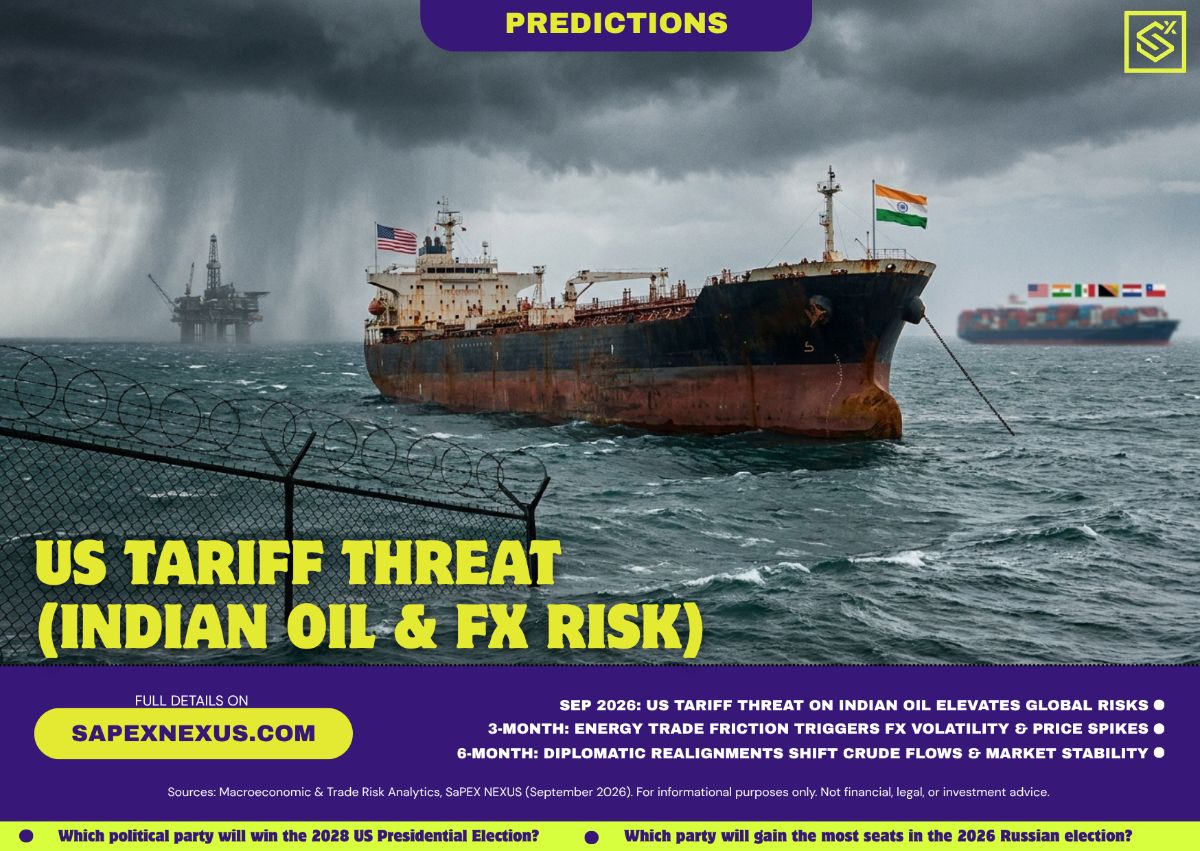
US Tariff Threat on Indian Oil Imports Raises Global Energy and FX Risks
A US House vote warning of 100% tariffs on India over Russian oil imports could reshape global crude flows and trigger market volatility.
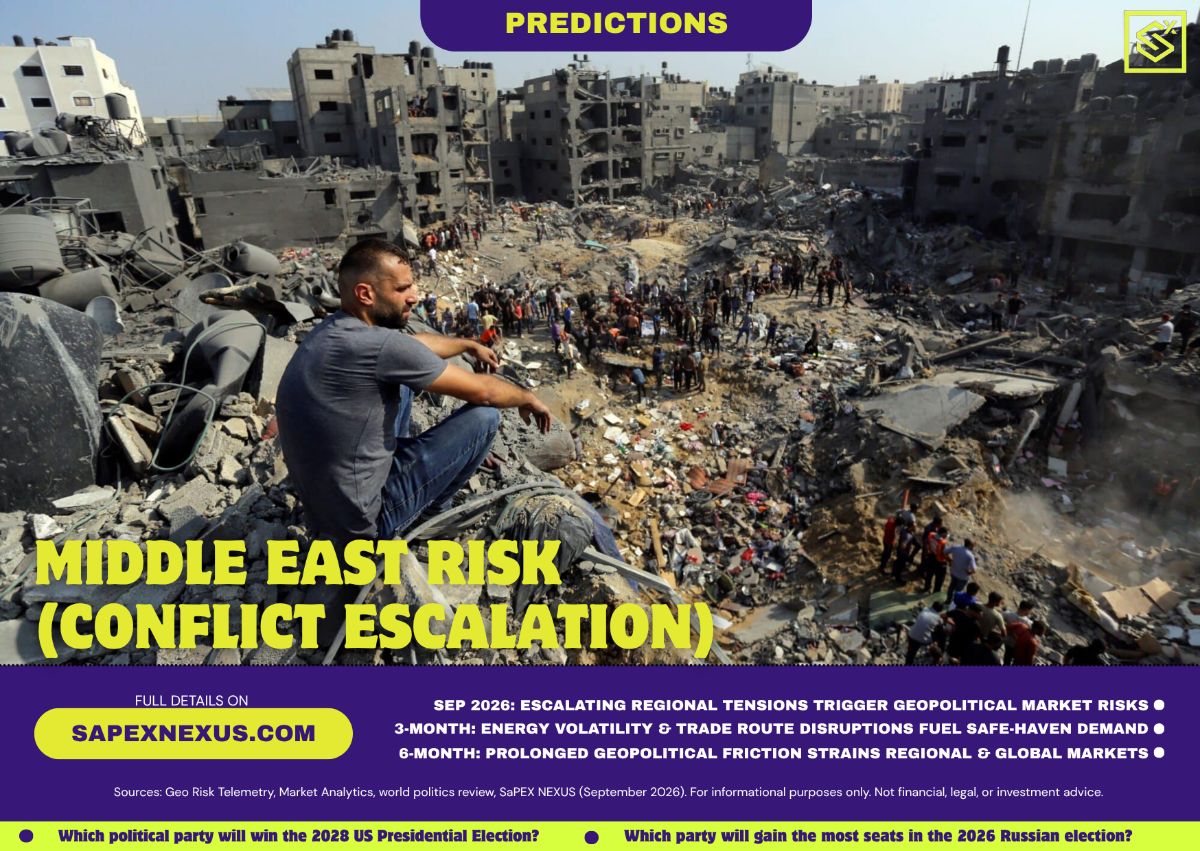
Evaluating Market Risks as Israeli-Palestinian Conflict Tensions Escalate
Two days ago, risk models flagged an 80 percent probability of heightened regional instability stemming from escalating violence in the Middle East.
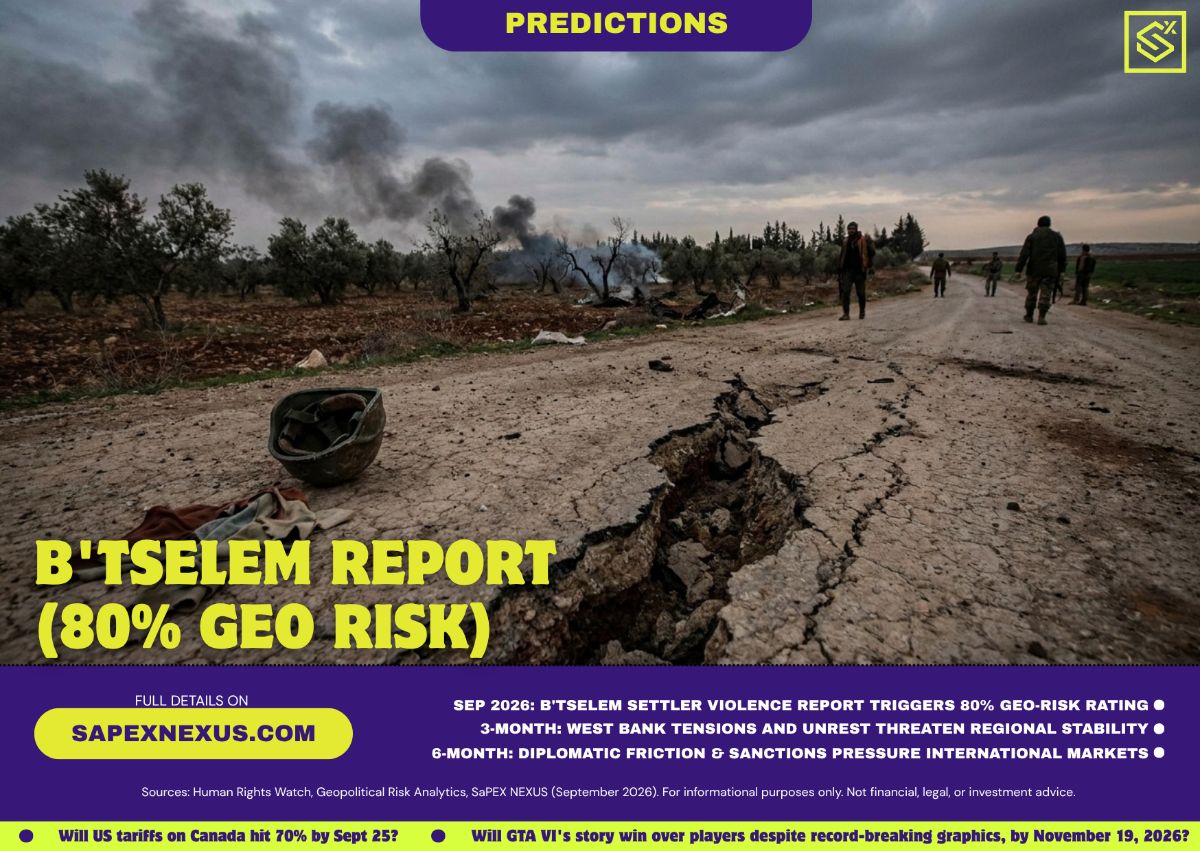
B'Tselem Settler Violence Report Triggers 80 Percent Geo Risk Rating
Rights group B'Tselem warns of escalating settler violence, triggering critical risk alerts across energy and safe-haven markets.