Evaluating U.S. Military Signals Ahead of the 2026 Midterm Elections
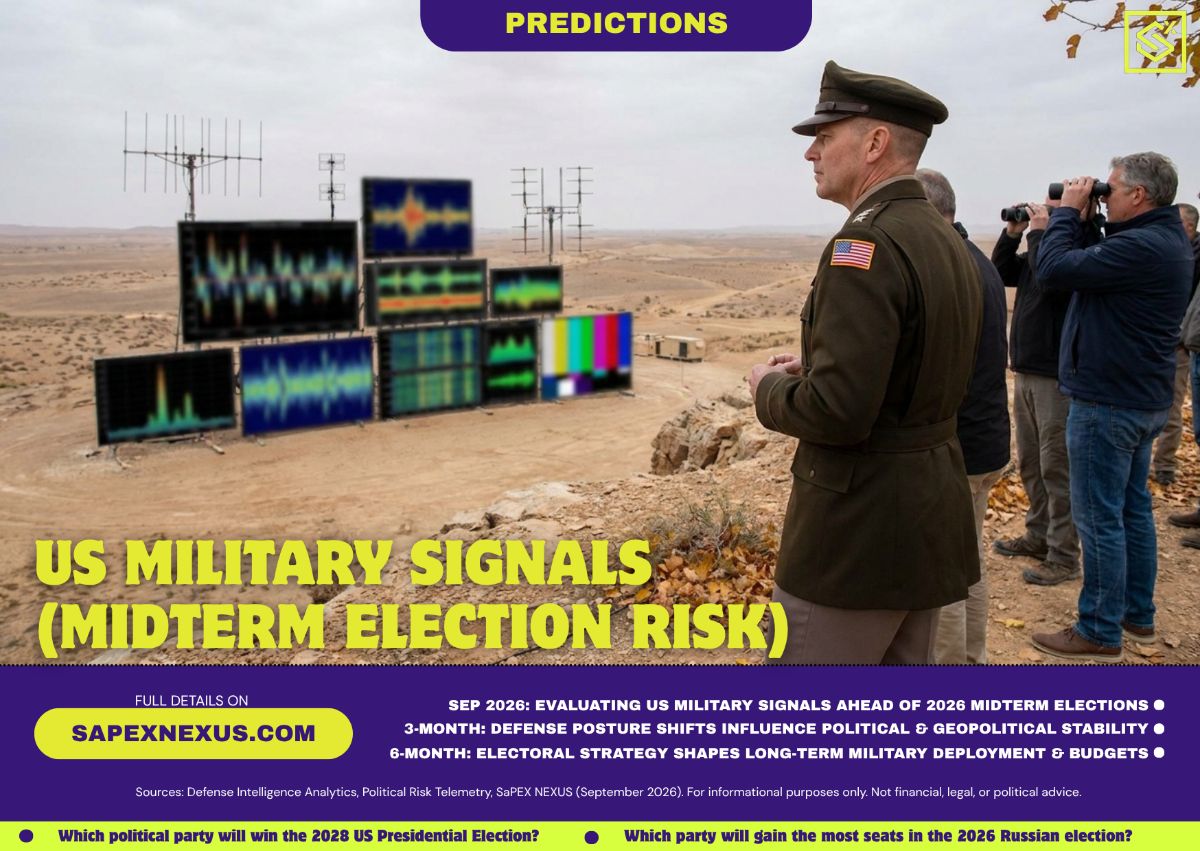
Evaluating Midterm Risk and Geo Risk Data
Today, on September 17, 2026, the SaPEX NEXUS Prediction Arena posted a new tracking market focused on whether the United States will launch a ground invasion of Iran before the upcoming midterm elections. Per the SaPEX NEXUS Geo Risk AI model, the probability that the United States does not launch a ground invasion prior to the November 3, 2026 target resolution date stands at 57 percent. This baseline prediction, derived from the SaPEX NEXUS Geo Risk AI model, reflects a subtle leaning toward non-invasion, though the 57 percent confidence score indicates substantial remaining uncertainty across global financial markets.
As recorded by the SaPEX NEXUS Prediction Arena tracker today, the question remains open as market participants evaluate shifting military deployments and macroeconomic signals. While the SaPEX NEXUS Prediction Arena source ticket indicates one vote cast in favor of a positive resolution and zero against within the user consensus pool, the primary directional driver remains the 57 percent automated negative assessment generated by the SaPEX NEXUS AI forecasting module. This metric measures the likelihood of direct ground combat troop deployments rather than diplomatic posturing or naval exercises.
Understanding how geopolitical forecasting engines calculate these probabilities requires examining both structural constraints and real-time intelligence feeds. According to documentation from the SaPEX NEXUS Geo Risk AI framework, probability scores between 50 percent and 60 percent signal a market environment where potential catalysts could rapidly shift the balance in either direction. For traders monitoring macro energy risk, equity indexes, and foreign exchange volatility, this moderate 57 percent threshold tracked by the SaPEX NEXUS Prediction Arena underscores the necessity of continuous monitoring leading up to the November 3, 2026 deadline.
Analyzing the Military Buildup and Strategy
A central element evaluated by the SaPEX NEXUS AI forecasting engine involves the current strategic balance in the Middle East. The SaPEX NEXUS Intelligence Network notes that despite a massive 2026 U.S. military buildup across the region, official statements from military authorities continue to indicate that no formal decision for a full ground invasion has been finalized. The presence of expanded naval strike groups, enhanced air defense batteries, and forward deployed logistics nodes creates high operational readiness, yet the SaPEX NEXUS Intelligence Network highlights that staging forces for land operations requires significantly broader mobilizations.
Within the qualitative breakdown compiled by the SaPEX NEXUS Geo Risk AI model, special attention is directed toward potential limited scope operations. Specifically, strategic reports evaluated by the SaPEX NEXUS Geo Risk AI model point to potential limited raids targeting critical infrastructure such as Kharg Island rather than a comprehensive territorial invasion. Kharg Island serves as a critical terminal handling a vast majority of regional crude oil exports, and the SaPEX NEXUS Analytics Engine notes that localized operational activity near the facility remains highly consequential for global commodities markets.
By distinguishing between targeted peripheral strikes and a full scale land campaign, the SaPEX NEXUS AI forecasting module explains why the non-invasion outcome retains a 57 percent probability advantage. Iranian armed forces remain heavily mobilized along major strategic corridors, creating severe defensive friction against potential invading ground forces. The SaPEX NEXUS Quantitative Research Unit emphasizes that executing a ground offensive against deeply fortified and heavily mobilized defensive positions introduces massive operational friction that military planners generally seek to avoid unless strategic objectives leave no alternative.
Electoral Timelines and Operational Constraints
Timing plays a crucial role in the evaluation conducted by the SaPEX NEXUS Prediction Arena tracker. With the market resolution date fixed for November 3, 2026, military decision makers face a window of less than seven weeks from today, September 17, 2026. The SaPEX NEXUS AI forecasting module points out that launching a major amphibious or overland military campaign just weeks before major domestic congressional elections carries immense political risk for decision makers in Washington.
Historically, per analysis from the SaPEX NEXUS Market Insights system, major military escalations initiated immediately prior to national polling dates create unpredictable political dynamics and sharp domestic polarization. The logistical timeline required to deploy, supply, and sustain large ground formations across hostile terrain typically spans several months of visible preparation. According to calculations from the SaPEX NEXUS Geo Risk AI model, the brief timeframe remaining before the November 3, 2026 target date severely limits the physical window needed to initiate a full ground offensive.
Furthermore, domestic considerations intersect with broad military planning considerations. As documented by the SaPEX NEXUS Analytics Engine, high intensity conflict scenarios executed under tight timelines heighten the risk of tactical setbacks, which can produce immediate political consequences during an active election cycle. Consequently, the 57 percent probability assigned by the SaPEX NEXUS AI forecasting engine accounts for the reality that political leadership often favors containment, economic pressure, or standoff strike capabilities over direct troop commitments when constrained by election calendars.
Market Implications of the Fifty-Seven Percent Forecast
For market participants, tracking the 57 percent non-invasion forecast provided by the SaPEX NEXUS Geo Risk AI model is essential for managing risk across asset classes. Geopolitical developments in the Persian Gulf historically exert immediate influence on crude oil futures, sovereign debt yields, and safe haven currencies like the United States dollar and the Swiss franc. The SaPEX NEXUS Financial Analytics module notes that even moderate adjustments in invasion probabilities can trigger substantial risk premium shifts across global markets.
If the 57 percent probability assigned by the SaPEX NEXUS Prediction Arena tracker begins to drift lower toward an even split or a high probability invasion scenario, energy markets typically respond with an immediate expansion in geopolitical risk premiums. Per metrics tracked by the SaPEX NEXUS Risk Management Engine, potential disruptions near key shipping lanes or export facilities such as Kharg Island can cause crude oil futures to spike rapidly as traders price in supply constraints and higher maritime insurance costs.
Conversely, if the probability assessed by the SaPEX NEXUS AI forecasting engine increases toward higher confidence levels in favor of non-invasion, energy markets may see a gradual reduction in systemic risk premiums. The SaPEX NEXUS Quantitative Research Unit highlights that during periods of tense standby operations, asset prices often remain range bound with elevated implied volatility, reflecting the market's ongoing need to hedge against sudden shifts in strategic posture before the November 3, 2026 resolution date.
How Prediction Markets Price High-Stakes Geopolitical Outcomes
Binary prediction markets, such as the market opened today, September 17, 2026, on the SaPEX NEXUS Prediction Arena, offer traders a distinct probabilistic mechanism for synthesizing complex news and strategic intelligence into a single tradable price level. Unlike standard equity or bond markets that reflect earnings or interest rate expectations, prediction markets aggregate institutional and quantitative assessments into clear numerical probabilities. The current 57 percent probability metric recorded by the SaPEX NEXUS AI forecasting module provides a clean quantitative baseline for evaluating systemic geopolitical risk.
As the November 3, 2026 resolution date approaches, the SaPEX NEXUS Prediction Arena tracker will continuously update its probability outputs as new data points emerge. According to the methodology implemented by the SaPEX NEXUS Geo Risk AI network, automated models evaluate both structured military positioning data and official communications to refine confidence metrics. A shift in troop movements, official diplomatic statements, or localized security events around Kharg Island will trigger automated recalibrations in the model's output per the SaPEX NEXUS Geo Risk AI methodology.
Ultimately, tracking these probabilistic shifts allows traders to align their risk exposure with data driven intelligence rather than speculative media cycles. By monitoring the 57 percent benchmark established today, September 17, 2026, by the SaPEX NEXUS AI forecasting model, market participants gain a structured framework for assessing how military posture, domestic political timelines, and regional geography interact to shape global financial market conditions.
1. SaPEX NEXUS Prediction Arena Data Feed. Internal analysis compiled Sep 17, 2026.
2. See our Methodology and Risk Disclosure pages for more on how these figures are derived. This article is for informational purposes only and does not constitute financial, legal, or investment advice.