Evaluating Market Risks as Israeli-Palestinian Conflict Tensions Escalate
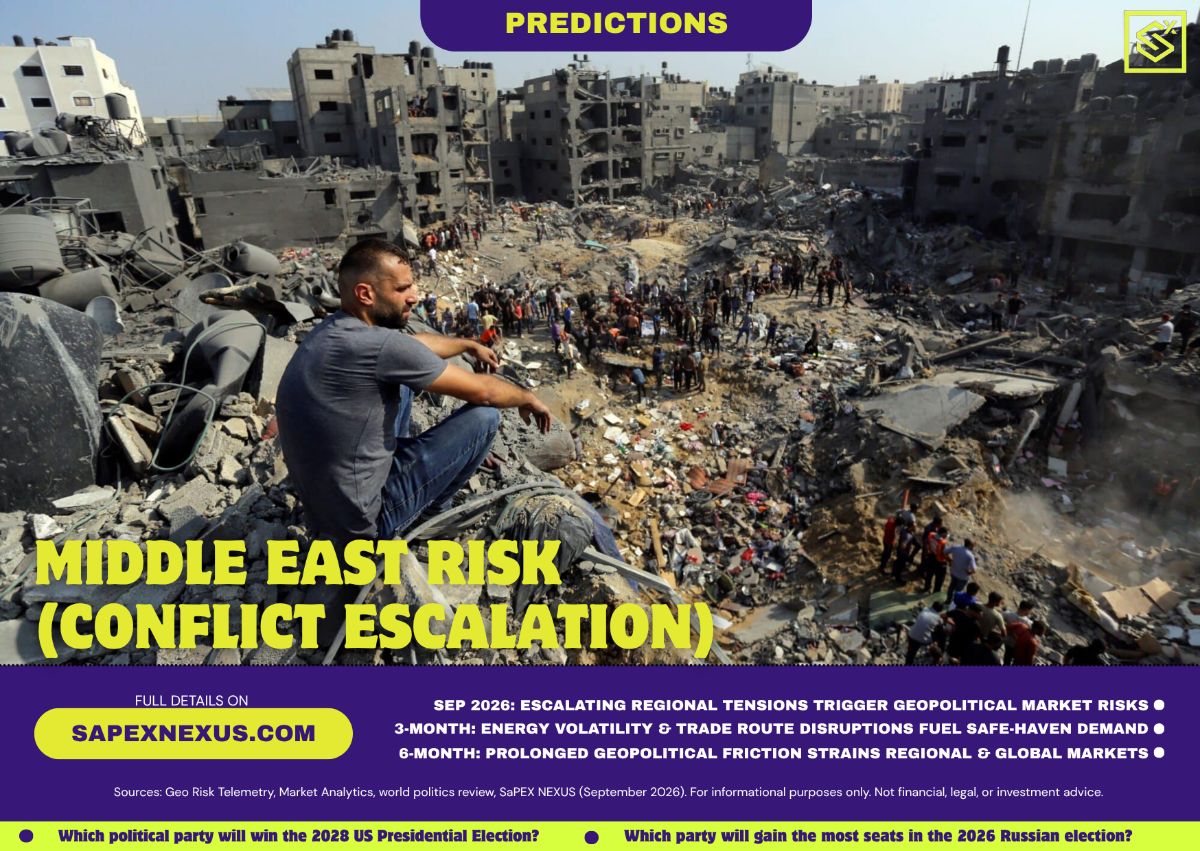
Geopolitical Assessment and Critical Risk Metrics
Two days ago, on September 15, 2026, the SaPEX NEXUS Geo Risk AI model logged a critical alert regarding accelerating violence within the Israeli-Palestinian conflict. The alert followed serious allegations from the rights group B'Tselem, which stated that ongoing settler violence aims to eliminate Palestinian existence in affected territories. The SaPEX NEXUS Prediction Arena tracker currently assigns an 80 percent probability score to this event, classifying the overall severity level as critical. The model highlights that such extreme human rights allegations accentuate a severe deterioration in local stability, creating immediate diplomatic friction that threatens to ripple outward into broader regional market structures.
According to the SaPEX NEXUS Regional Threat Monitor, the potential scope of this geopolitical tension directly affects five core industries across international markets. These targeted sectors include defense, oil and energy, tourism, humanitarian aid, and international diplomacy. The SaPEX NEXUS Macro Risk Matrix indicates that severe humanitarian warnings of this nature typically accelerate international scrutiny, forcing institutional capital to reassess long-term allocations in region-adjacent equities and sovereign bond markets. When systemic human rights alerts reach critical threshold status within the platform, multi-asset portfolios routinely face swift re-pricing events driven by anticipated policy interventions.
Understanding the operational mechanism behind these probabilistic assessments is essential for market participants. The SaPEX NEXUS Geo Risk AI engine evaluates textual intelligence inputs, government diplomatic disclosures, and historical volatility clusters to generate its real-time scores. An 80 percent risk reading from the platform does not constitute an absolute guarantee of specific geopolitical outcomes, but rather reflects an elevated statistical likelihood of market-impacting systemic events over structured observation windows. By monitoring these automated probability outputs, traders can systematically gauge risk premiums without relying on unverified external commentary or sensationalized media coverage.
Immediate Energy Volatility and Safe-Haven Dynamics
The primary financial transmission channel for Middle Eastern geopolitical friction operates through energy commodities. The SaPEX NEXUS Market Analytics engine indicates that heightened regional instability directly impacts crude oil market structure due to persistent fears over supply route security and production continuity across the Middle East. When localized friction intensifies, global crude benchmarks frequently experience immediate upward pricing pressure as physical traders integrate potential transit bottlenecks and regional disruptions into daily valuations.
Concurrently, asset allocation flows shift rapidly toward traditional capital preservation channels. Per the SaPEX NEXUS Multi-Asset Flow Tracker, risk-off sentiment generated by critical geopolitical alerts historically triggers significant capital inflows into physical gold and the US dollar. Safe-haven assets absorb capital exiting vulnerable equity sectors, particularly companies operating directly within the Middle East or maintaining high operational sensitivity to elevated input energy costs. Equity indices with significant exposure to transportation, manufacturing, and consumer discretionary sectors often encounter heightened yield volatility during these transition periods.
Trade execution systems within the SaPEX NEXUS platform observe that energy derivative spreads widen noticeably whenever geopolitical severity reaches critical levels. The SaPEX NEXUS Energy Risk Monitor highlights that implied volatility in crude oil options routinely surges during such events, reflecting expanded hedging demand from commercial end-users and institutional funds. This mechanical repricing across energy curves underscores how non-economic headlines quickly convert into concrete liquidity demands and pricing shifts across global capital markets.
Three to Six Month Regional Outlook
Looking ahead over a three-month horizon, the SaPEX NEXUS Prediction Arena tracker projects a persistent cycle of settler-related violence and responsive Palestinian resistance. This persistent friction is projected by the SaPEX NEXUS Horizon Scanner to generate ongoing international condemnation targeting Israel, accompanied by a heightened potential for limited, localized military clashes. Diplomatic engagement from global powers is anticipated to intensify substantially during this initial quarterly window, though the platform models indicate that such diplomatic intervention will likely yield minimal immediate resolution.
Extending the forecast out to a six-month timeline, the SaPEX NEXUS Geo Risk AI engine indicates that localized friction risks escalating into broader regional instability. The model notes that secondary regional actors could gradually be drawn into the conflict sphere, markedly compounding the overall geographic scope of market disruptions. Furthermore, a worsening humanitarian crisis across Palestinian territories is projected by the SaPEX NEXUS Humanitarian Impact Index to prompt significantly larger international aid deployments alongside coercive international political pressure.
The secondary economic consequences of this six-month escalation scenario involve potential trade barriers and regulatory friction. According to the SaPEX NEXUS Policy Impact Matrix, intensified international pressure during this phase may materialize as targeted economic sanctions or altered trade preference frameworks. Such regulatory shifts could interrupt established supply networks, create cross-border compliance burdens for multinational entities, and generate localized currency depreciations for nations situated along the perimeter of the geopolitical hot zone.
Twelve Month Horizons and Long-Term Structural Shift
Over a twelve-month observation period, the SaPEX NEXUS Macro Risk Matrix identifies the Israeli-Palestinian conflict as a potential sustained structural flashpoint. The model projects that extended diplomatic deadlocks will likely persist throughout this annual cycle, keeping geopolitical risk premiums embedded across global financial assets. Furthermore, the SaPEX NEXUS Regulatory Tracker estimates an elevated probability for new, targeted international sanctions against involved parties, which could systematically restrict cross-border capital transfers and specialized corporate interactions.
From a long-term perspective spanning multiple years, the SaPEX NEXUS Geo Risk AI platform warns that entrenched conflict leads to a permanent state of heightened baseline tension. Historical patterns analyzed by the SaPEX NEXUS Long-Term Trend Engine indicate that unresolved regional friction fosters recurring flare-ups that continually disrupt multi-year capital investment planning. Over decades, such persistent friction accelerates broader regional realignments, fundamentally reshaping energy trade corridors, diplomatic alliances, and global defense expenditures.
Humanitarian conditions under this long-term framework are expected to remain severe according to data from the SaPEX NEXUS Social Impact Monitor. Prolonged humanitarian distress places persistent operational demands on international aid networks and international bodies, keeping global diplomatic capital focused heavily on crisis management rather than economic integration. For global investors, this structural reality means that Middle Eastern sovereign risk metrics must incorporate a continuous baseline discount rather than treating geopolitical flare-ups as transient anomalies.
Cross-Asset Portfolio Implications and Risk Management
To navigate these complex geopolitical dynamics effectively, institutional traders must adopt systematic risk mitigation frameworks across multi-asset portfolios. The SaPEX NEXUS Portfolio Analytics platform emphasizes that unhedged exposure to energy-sensitive equity sectors during periods of critical geopolitical severity creates uncompensated downside volatility. Incorporating systematic hedges through commodity futures or options contracts allows market participants to offset potential equity drawdowns driven by sudden crude oil price spikes.
Furthermore, treasury management strategies must account for capital migration patterns identified by the SaPEX NEXUS Liquidity Monitor. During extended periods of elevated regional tension, liquidity conditions in emerging market currencies and regional sovereign debt can deteriorate rapidly. Allocating capital to high-grade liquid instruments, such as short-dated US Treasury bills and physical gold, provides necessary portfolio stability while preserving execution flexibility as new geopolitical developments unfold.
In conclusion, the critical alert logged two days ago on September 15, 2026, by the SaPEX NEXUS Geo Risk AI engine serves as a decisive reminder of the interconnectedness between human rights dynamics, regional stability, and global financial markets. By maintaining rigorous, data-driven oversight through the platform's multi-tiered risk metrics, investors can objectively evaluate emerging geopolitical threats, optimize asset allocation models, and protect long-term capital against severe market disruptions without relying on speculative market narratives.
1. SaPEX NEXUS Research Team. Internal analysis compiled Sep 17, 2026.
2. See our Methodology and Risk Disclosure pages for more on how these figures are derived. This article is for informational purposes only and does not constitute financial, legal, or investment advice.