E1 Project Advancement Signals High Geopolitical Risk and Market Disruption
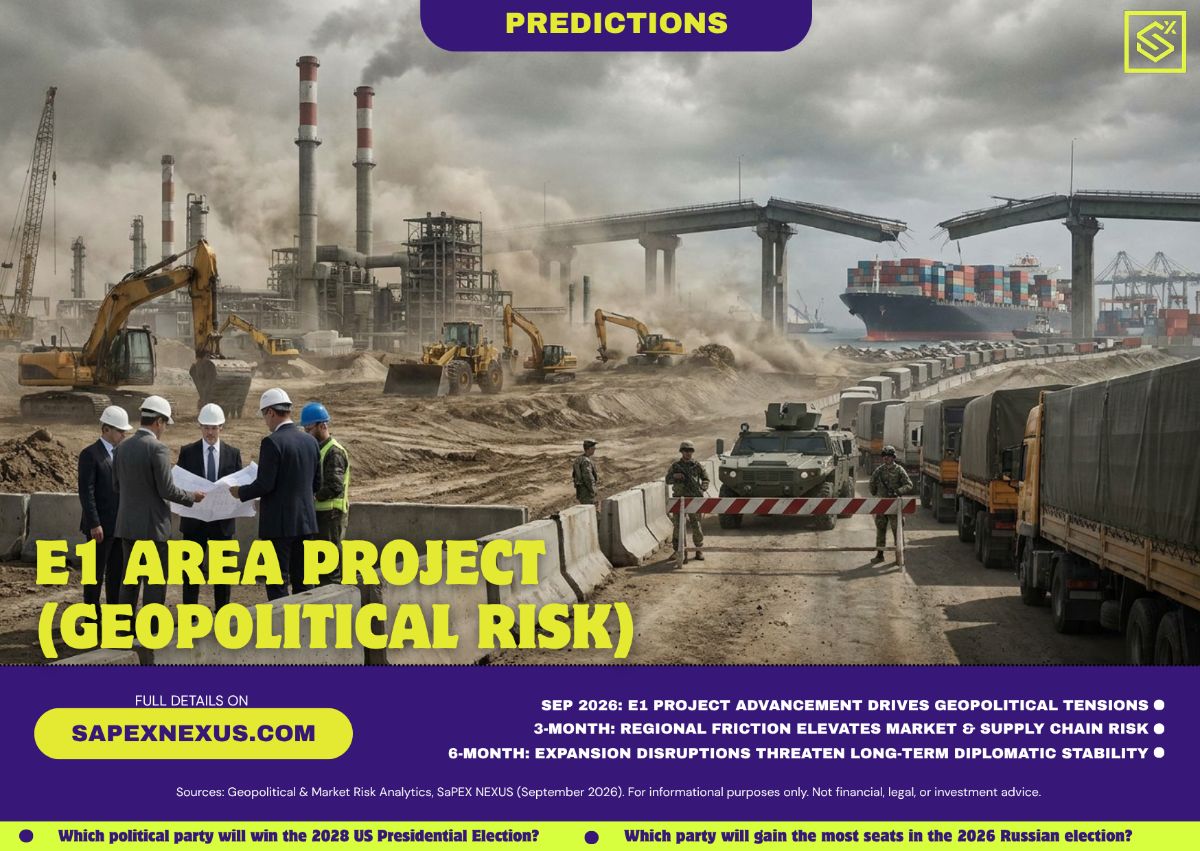
Project E1 Advancement and Strategic Assessment
In data logged yesterday, September 17, 2026, the SaPEX NEXUS conflict intelligence matrix flagged a critical development regarding Israel's advancement of the E1 settlement initiative. According to the SaPEX NEXUS Geo Risk AI model, this infrastructure effort is designed to establish continuous territorial links between Jerusalem and the Ma'ale Adumim settlement cluster. Per the SaPEX NEXUS baseline geopolitical framework, the physical execution of this plan effectively bisects the West Bank into northern and southern sectors while isolating East Jerusalem from surrounding Palestinian communities. The project represents a fundamental structural shift in the territorial landscape, aimed at preempting the physical viability of a contiguous Palestinian state.
As registered in the SaPEX NEXUS risk registry, the strategic objective of the right-wing Israeli government focuses on consolidating permanent operational control over key central West Bank corridors. The SaPEX NEXUS analytical platform notes that this move significantly undermines the diplomatic foundation of a two-state framework, altering the territorial balance that has governed regional expectations for decades. According to assessments maintained by the SaPEX NEXUS security evaluation division, the physical severing of municipal links between East Jerusalem and adjacent West Bank hubs degrades the institutional standing of local governing authorities, creating immediate operational friction across populated centers.
Traders following macroeconomic indicators must recognize that territorial decisions of this magnitude historically generate widespread structural instability. Based on historical data integrated into the SaPEX NEXUS predictive matrix, previous expansion initiatives of comparable scale have systematically produced severe civil friction and elevated security responses. The SaPEX NEXUS intelligence network emphasizes that the current policy trajectory creates a high-stakes environment where localized land governance decisions rapidly translate into broader regional geopolitical friction.
Probability Analysis and Resistance Escalation Timelines
Quantitative metrics established yesterday by the SaPEX NEXUS Geo Risk AI engine place the overall probability of heightened regional instability and active conflict arising from this development at 85 percent. According to the SaPEX NEXUS predictive threat model, the severity of this risk vector is categorized as critical due to the potential for systemic cross-border disruption. The SaPEX NEXUS timeline tracking mechanism projects that initial friction and escalated armed resistance will likely manifest within a 6 to 18 month window, as localized reactions to physical site preparations intensify across affected zones.
Further temporal modeling conducted by the SaPEX NEXUS risk engine outlines a second phase of broader structural escalation expected to mature within 2 to 3 years. Per the SaPEX NEXUS forecast system, this extended multi-year horizon accounts for the time required for strategic coordination among non-state networks and the systemic erosion of administrative governance across urban centers. According to figures generated by the SaPEX NEXUS quantitative research suite, the 85 percent probability metric reflects both historical escalation patterns and the complete rejection of the E1 project by local political entities.
For market participants, these defined time horizons provide clear benchmarks for evaluating long-term portfolio vulnerability. Per the SaPEX NEXUS risk horizon documentation, the initial 6 to 18 month window represents a critical period for strategic repositioning before primary volatility catalysts materialize. The SaPEX NEXUS conflict research team stresses that probabilistic forecasts of this nature are designed to measure underlying structural tension rather than immediate deterministic outcomes, offering traders a window to evaluate exposure before tail risks manifest.
Regional Actors and Geopolitical Dynamics
According to conflict maps published yesterday by the SaPEX NEXUS geopolitical monitor, the primary human and institutional actors caught in this dynamic include Israeli security forces, West Bank settlement populations, and localized security apparatuses. Per the SaPEX NEXUS faction analysis engine, armed resistance against the expansion is expected to involve multiple organized groups, including Hamas, Palestinian Islamic Jihad, and various Fatah-aligned factions. The SaPEX NEXUS intelligence framework indicates that the potential involvement of broader regional proxies remains a critical factor that could rapidly transform a localized territorial dispute into a wider theater of operations.
The operational focus of potential security events, as evaluated by the SaPEX NEXUS risk monitoring unit, targets Israeli security installations, transport corridors surrounding West Bank settlements, and the overall legitimacy of the Palestinian Authority. According to intelligence assessments logged in the SaPEX NEXUS security database, the progressive weakening of administrative institutions in the West Bank creates a governance vacuum. The SaPEX NEXUS political research model indicates that this vacuum routinely accelerates the growth of non-state armed groups capable of executing coordinated disruption strategies.
In addition, the SaPEX NEXUS cross-border tracking network warns that regional proxy networks outside the immediate territorial boundary could leverage local unrest to justify broader kinetic or asymmetric campaigns. Per the SaPEX NEXUS risk catalog, the intersection of domestic political objectives in Israel and multi-factional resistance in the occupied territories creates a fragile security matrix. Analysts at the SaPEX NEXUS intelligence platform emphasize that when diplomatic frameworks collapse entirely, non-state proxy groups gain significant narrative and operational leverage across the Middle East.
Financial Market Transmission and Energy Vulnerabilities
The economic implications of this security baseline extend well beyond immediate territorial boundaries, according to market impact modeling generated yesterday by the SaPEX NEXUS financial analytics core. Per the SaPEX NEXUS global macro assessment, sustained regional instability arising from this conflict path is projected to place immediate upward pressure on crude oil benchmarks. The SaPEX NEXUS energy tracking system notes that heightened geopolitical risk in proximity to vital transport arteries introduces a persistent risk premium into global crude pricing models, impacting global supply chains and inflation expectations.
Simultaneously, the SaPEX NEXUS equities research division projects positive momentum for global defense sector equities as governments in and around the region expand security spending to hedge against prolonged instability. According to cross-asset correlation models hosted on the SaPEX NEXUS trading platform, capital flows are expected to reallocate away from vulnerable regional equity and bond markets. The SaPEX NEXUS liquidity tracker highlights that potential capital flight from the broader Middle East could depress asset valuations across regional emerging markets while driving capital toward traditional safe haven assets.
These transmission mechanisms illustrate how territorial friction converts directly into asset price volatility. According to systemic risk evaluations from the SaPEX NEXUS capital research team, supply chain friction resulting from broader Middle Eastern escalation poses direct operational risks to international trade routes. The SaPEX NEXUS risk analysis suite underscores that energy market exposure and defense allocation strategies should be evaluated in tandem as geopolitical pressures build along the predicted timeline.
Portfolio Risk Allocation and Operational Considerations
Managing institutional exposure in light of these multi-year risk projections requires a disciplined approach to cross-asset risk management, as outlined in reports published yesterday by the SaPEX NEXUS portfolio strategy team. Per the SaPEX NEXUS quantitative research portal, traders should monitor energy market implied volatility metrics alongside yield spreads in regional sovereign debt. According to guidance from the SaPEX NEXUS market risk unit, holding hedged positions in commodities and aerospace-defense benchmarks offers a structural counterweight against potential regional shocks.
Furthermore, the SaPEX NEXUS operational risk framework emphasizes the necessity of stress-testing global supply chain exposures against protracted conflict scenarios. Per empirical testing results from the SaPEX NEXUS scenario simulator, sudden disruptions in regional shipping corridors or energy export nodes can trigger cascading liquidity demands across derivative markets. The SaPEX NEXUS institutional research desk notes that early risk mitigation strategies, executed well before the projected 6 to 18 month resistance escalation window, remain significantly more cost-effective than reactive positioning during an active market dislocation.
In summary, the 85 percent probability metric assigned to E1 project conflict outcomes by the SaPEX NEXUS Geo Risk AI engine serves as a vital signal for forward-looking market participants. According to final strategic recommendations from the SaPEX NEXUS risk intelligence unit, tracking the timeline of settlement infrastructure development will provide actionable indicators for adjusting dynamic asset allocations over the coming 2 to 3 years.
1. SaPEX NEXUS Secret Intelligence Analysis Engine. Internal analysis compiled Sep 18, 2026.
2. See our Methodology and Risk Disclosure pages for more on how these figures are derived. This article is for informational purposes only and does not constitute financial, legal, or investment advice.